

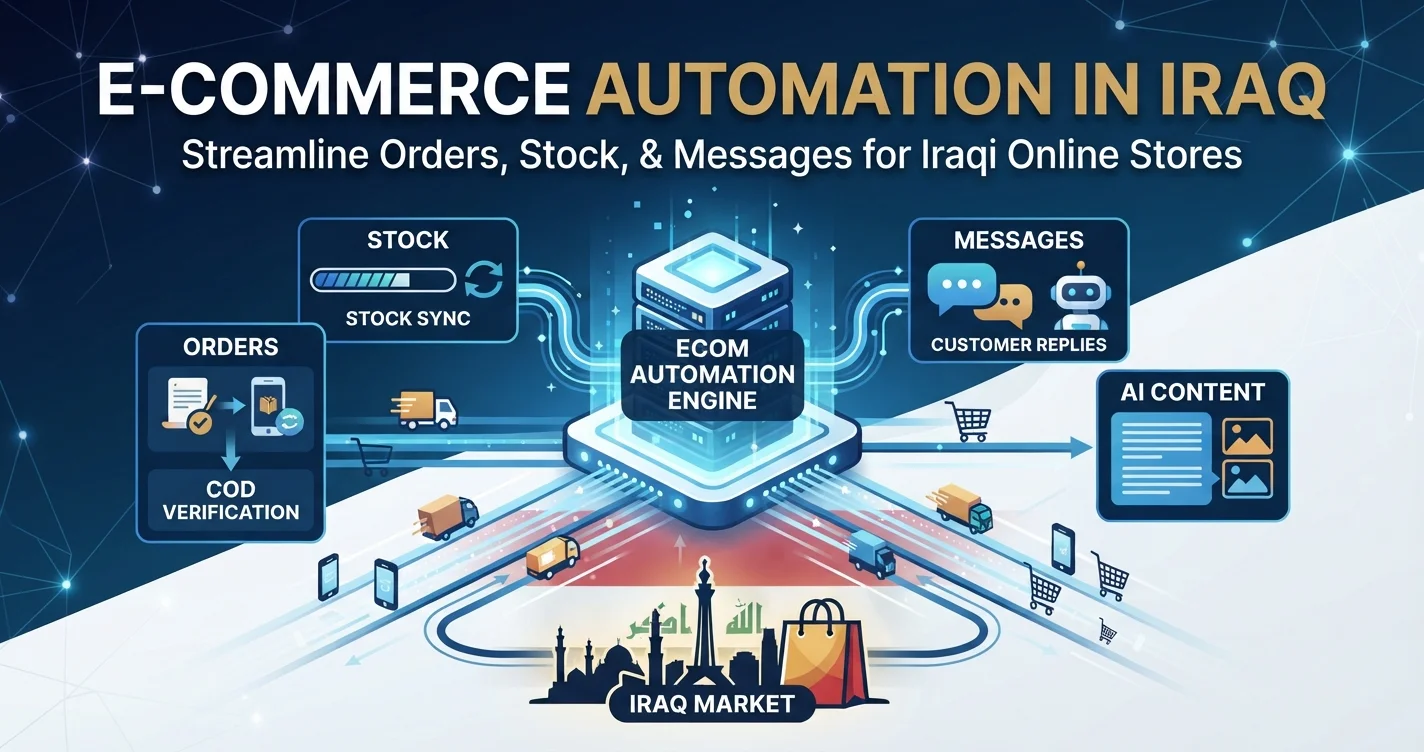
Running an online store in Iraq often means running three stores at once, which is why ecommerce automation has become a practical need rather than a luxury. Orders arrive through the website, through Instagram comments and direct messages, and through WhatsApp. Each one needs to be confirmed, often by phone, because the customer will pay cash at the door. Someone has to check stock, book the courier, answer “where is my order?” several times a day, and then reconcile the cash the courier brings back. When the store is small, the owner does all of this. As it grows, the same manual steps become the reason orders get lost, stock runs out unexpectedly, and customers refuse deliveries. Ecommerce automation is how growing stores take that repetitive load off their team.
This guide is written for ecommerce managers and store owners in Iraq. It explains where ecommerce automation delivers the most value, from capturing orders and verifying cash on delivery to syncing stock, updating customers about deliveries, handling returns, and using AI for product content and customer replies. It also covers the local realities that templates built for other markets usually ignore. Email flows such as abandoned-cart and welcome emails are covered separately in our guide to email marketing automation, so this article focuses on operations and messaging.
Why Ecommerce Automation Matters More in Iraq
Every online store benefits from automation, but several features of the Iraqi market make ecommerce automation especially valuable here.
Orders Arrive Through Many Channels
Many Iraqi stores sell through Instagram, WhatsApp, and a website at the same time, and some also have a physical shop. Without ecommerce automation and a single place where every order lands, the same item can be sold twice, and some orders are simply forgotten in a chat thread. Our guide to Instagram selling vs an online store explains why many stores end up using both.
Cash on Delivery Adds a Verification Step
Cash on delivery remains widespread in Iraq, and with it comes the risk of refused deliveries, fake orders, and wasted courier fees. Verifying orders before shipping protects margins, and that verification is a natural fit for ecommerce automation. Our guide to cash on delivery ecommerce in Iraq covers the commercial side in depth.
Small Teams Handle Large Volumes
A store with two or three staff, and no ecommerce automation, can receive hundreds of messages after a successful campaign or a seasonal sale before Ramadan or Eid. Well-planned ecommerce automation lets that small team respond quickly without burning out.
Automating Order Capture From Every Channel
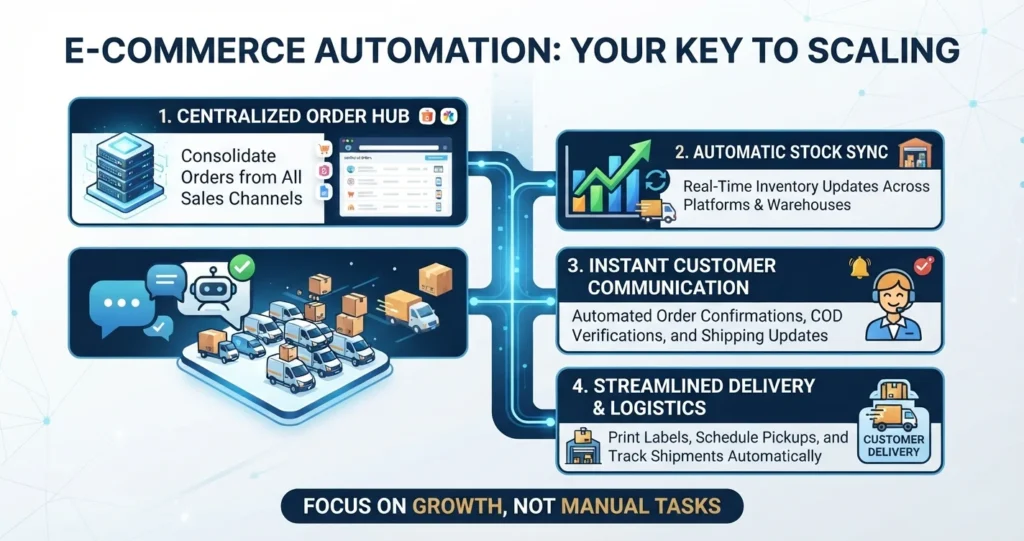
The first goal of ecommerce automation is simple: every order, wherever it starts, should end up in one system with the same information.
One Order System, Many Entry Points
Website orders usually land in your ecommerce platform automatically. Orders taken through WhatsApp or Instagram should be entered into the same system, ideally through a short order form that staff or the customer completes, rather than written in a notebook. If your platform does not support this well, it may be time to review your setup, as discussed in our guide to choosing an ecommerce platform in Iraq.
Collect Addresses the Iraqi Way
Many Iraqi addresses are described by district and nearby landmark rather than by street number. Instead of a single free-text address box, an order form designed for ecommerce automation should ask for the province, city, district, nearest landmark, and a phone number, and optionally a location pin shared on WhatsApp. Structured addresses mean fewer calls from couriers and fewer failed deliveries, and they make every later step of ecommerce automation more reliable.
Standardize Phone Numbers
Phone numbers are the key that connects an order to the customer, the courier, and their order history. Store them in one consistent format, including the country code, so the system can recognize repeat customers and match messages to orders.
Automating Order Confirmation and COD Verification
This is where ecommerce automation usually pays for itself first in Iraq.
Instant Order Confirmation
As soon as an order is placed, the customer should receive a confirmation, usually on WhatsApp, listing the items, total price including delivery, and expected delivery time. Asking the customer to reply to confirm turns that message into a verification step, replacing many manual confirmation calls.
Rules That Flag Risky Orders
Simple rules can flag orders that need a human check before shipping. Examples include a phone number linked to previous refused deliveries, unusually large orders from new customers, incomplete addresses, or several orders from the same number in a short time. Flagged orders go to a staff member; the rest move forward automatically. This kind of ecommerce automation reduces wasted courier trips without slowing down genuine customers.
Follow Up on Unconfirmed Orders
If a customer does not reply to the confirmation, the system can send one reminder and then create a task for a staff member to call. Orders that remain unconfirmed after a set time can be held rather than shipped. This small piece of ecommerce automation stops many wasted trips before they happen.
Keep Refusal History
When a delivery is refused, record it against the customer’s phone number. Over time, this history makes your ecommerce automation rules smarter and protects your store from repeat losses.
Automating Stock and Inventory
Selling something you no longer have is one of the fastest ways to lose a customer’s trust. Inventory is a core part of ecommerce automation.
Sync Stock Across Channels
When an item sells in your physical shop or through a WhatsApp order, the stock count on your website should update too. Stores that sell across channels need one inventory source that every channel reads from, rather than separate counts in different places. Stock sync is the backbone of ecommerce automation for multi-channel stores.
Low-Stock and Out-of-Stock Alerts
Set minimum stock levels for each product and send alerts to the person responsible for purchasing when an item falls below them. When an item does sell out, the website should mark it clearly or hide it, and your team should know not to promote it on Instagram.
Back-in-Stock Notifications
Customers who ask about an out-of-stock item can be added to a list and notified automatically when it returns, with their permission. This turns a lost sale into a future one with almost no effort, which is exactly what good ecommerce automation should do.
Spot Fast and Slow Movers
Weekly reports generated by your ecommerce automation setup, showing best sellers, slow movers, and items close to running out help you reorder at the right time and plan promotions for stock that is not moving.
Automating Delivery Updates and Courier Work
Once an order ships, most customer messages are about one thing: where it is.
Courier Booking and Ecommerce Automation
Some delivery companies offer systems that connect to ecommerce platforms, while others work through spreadsheets, WhatsApp groups, or their own portals. Where integration exists, orders can be sent to the courier automatically. Where it does not, ecommerce automation can still prepare a daily shipping file in the courier’s format, saving staff from typing each order by hand.
Proactive Status Messages
Sending customers short updates when their order ships, when it is out for delivery, and when it is delivered helps cut down “where is my order?” messages. It also reminds COD customers to prepare the cash, which helps reduce refused deliveries. Few forms of ecommerce automation are as visible to customers as this one.
Cash Reconciliation
When couriers return collected cash, matching it to delivered orders is tedious and error-prone. An ecommerce automation workflow can mark orders as delivered and paid based on courier reports and highlight any mismatches for review.
Returns and Exchanges
A simple returns flow lets customers request a return or size exchange through a form or message, records the reason, schedules collection, and updates stock when the item comes back. Recording return reasons through ecommerce automation also shows you which products or size charts cause problems.
Using AI for Product Content and Customer Messages
AI adds a layer on top of rule-based ecommerce automation, but it needs careful supervision.
Product Descriptions in Arabic and English
AI tools can draft product descriptions, titles, and attribute lists in both Arabic and English, which helps stores with large catalogs. Every draft must be checked against the actual product for sizes, materials, and specifications, and Arabic text should be reviewed by a native speaker. Unique, accurate descriptions also support your search visibility, as covered in our guide to ecommerce SEO in Iraq.
Answering Routine Questions With Ecommerce Automation
Many customer messages ask the same things: delivery fees to a province, delivery time, sizes, colors, and order status. A chatbot connected to your store data can answer these instantly in Arabic or English and pass anything else to a person. Our guide to AI chatbots for Iraqi businesses explains how to design one that helps rather than frustrates.
Sorting and Prioritizing Messages
AI can read incoming messages and label them as new order, order status, complaint, return request, or general question, so the right person sees urgent messages first. This is one of the more practical uses of AI in ecommerce automation for busy stores.
Keep People in Charge
Complaints, payment problems, damaged items, and anything sensitive should always reach a person quickly. Customers in Iraq often prefer to talk to someone real when something goes wrong, and an easy route to a human protects your reputation. Our guide to online reputation management covers how to handle negative experiences publicly and privately.
An Order Workflow Map for Iraqi Stores
The table below shows a simple ecommerce automation map you can adapt. Each stage lists what happens automatically and when a person steps in.
| Order stage | Automatic action | When a person steps in |
|---|---|---|
| New order | Record order, send WhatsApp confirmation | Order taken by phone or in a chat without the form |
| Verification | Apply risk rules, send reminder if unconfirmed | Flagged order or no reply after the reminder |
| Ready to ship | Reserve stock, add to courier file or system | Item missing or damaged |
| Shipped | Send tracking or status update | Courier reports a delivery problem |
| Delivered | Mark complete, reconcile cash, request review | Cash mismatch or customer complaint |
| Returned | Log reason, update stock | Damaged return or dispute |
Start by automating the first two rows. They usually deliver the biggest gain for COD stores.
Choosing Ecommerce Automation Tools
The right tools depend on your platform, your order volume, and how much of your selling happens outside the website.
Start With Your Ecommerce Platform
Most ecommerce platforms include order notifications, stock tracking, and low-stock alerts, and many offer extensions for WhatsApp messaging, courier connections, and chatbots. Check what you already have before adding any new ecommerce automation tools.
No-Code Connectors
No-code automation tools can link your store, spreadsheets, WhatsApp provider, and internal alerts using simple rules. They suit stores that want to start ecommerce automation quickly, though costs can rise with order volume, so check current pricing with each provider.
WhatsApp Business Platform
For automated order confirmations and delivery updates at scale, stores typically need the WhatsApp Business Platform through an approved provider, with Meta’s message template rules and pricing applying. Our guide to WhatsApp Business for Iraqi companies explains the difference between the app and the platform.
Custom Development
When your ecommerce automation needs involve several warehouses, branches, couriers, or a unique verification process, a custom system or custom extensions may be the better choice. Our ecommerce development services in Iraq cover both new stores and improvements to existing ones.
A Practical Rollout Plan
Use this sequence to introduce ecommerce automation without disrupting daily sales:
- Map how orders arrive today and where they get delayed or lost.
- Set up one order system and a structured order form for every channel.
- Automate WhatsApp order confirmation and basic COD verification rules.
- Add stock alerts, delivery status messages, and a courier file or integration.
- Introduce AI for product content and routine questions, with human review.
Review the results after a month. Useful measures include the share of orders confirmed without a call, refused delivery rate, “where is my order?” message volume, and out-of-stock incidents.
Frequently Asked Questions About Ecommerce Automation
Send an automatic WhatsApp message after each order with the items, total, and delivery details, and ask the customer to reply to confirm. Send one reminder if there is no reply, then route unconfirmed orders to a staff member before shipping.
It can help. Verification messages, risk rules based on order history, structured addresses, and delivery-day reminders all address common causes of refusal. Results depend on your products and customers, so track your refusal rate before and after.
Even small stores benefit from basic ecommerce automation such as instant order confirmations and stock alerts. Start with these, and add more as order volume grows and manual work starts to slow you down.
No. AI works well for routine questions such as delivery fees and order status, but complaints, payment issues, and sensitive cases should go to a person quickly.
Let Your Store Grow Without Growing the Chaos
Ecommerce automation helps Iraqi online stores capture every order, verify cash on delivery before shipping, keep stock accurate across channels, update customers without endless messages, and use AI where it saves time without risking accuracy. Start with order confirmation and verification, design around local realities such as landmark-based addresses and courier workflows, and expand one step at a time.
If you want help automating your store’s orders, stock, and customer messages, Creative 4 All can review your current setup and recommend practical next steps. Explore our AI agents and automation services in Iraq, see our ecommerce development services, or message us on WhatsApp to request a consultation.