
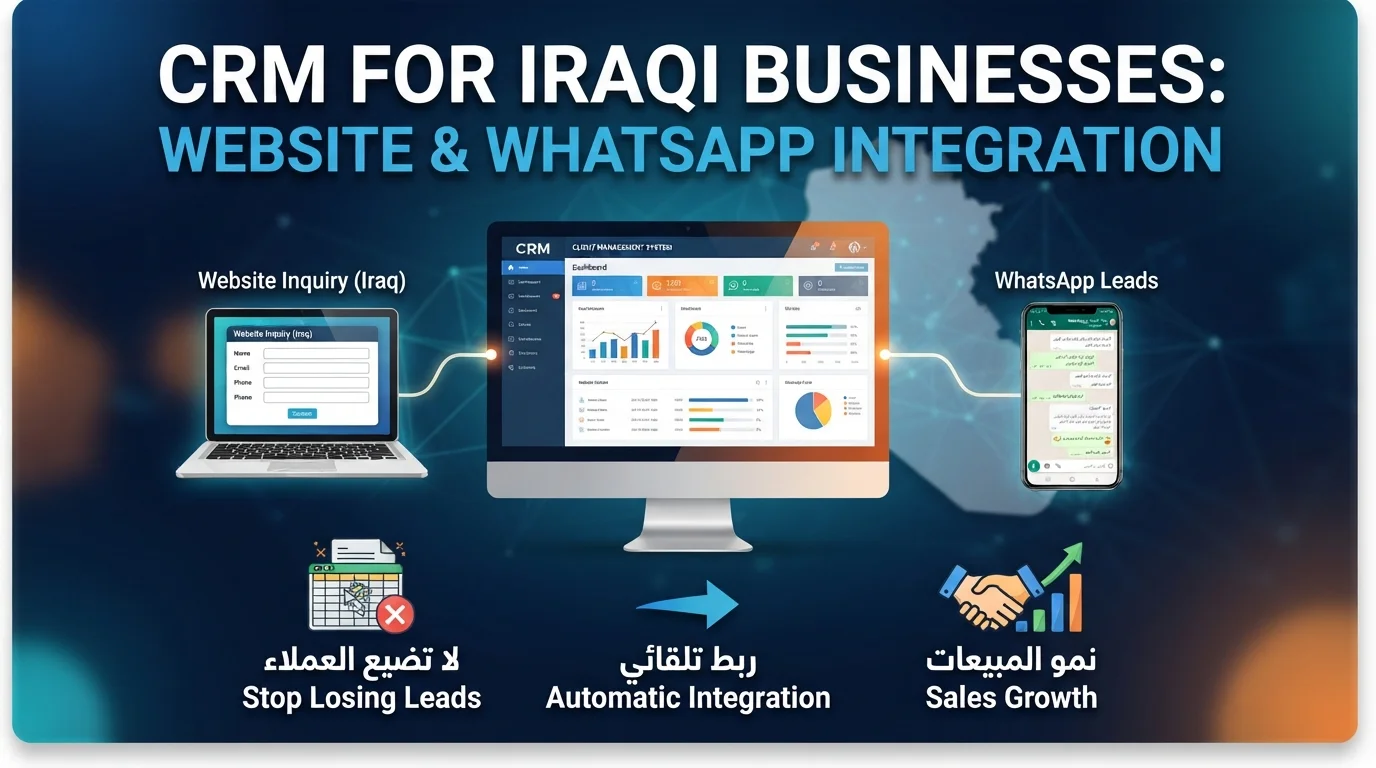
Ask the sales manager of a growing Iraqi company where last month’s leads are stored, and the honest answer is often “everywhere.” Some are in a spreadsheet. Some are in WhatsApp chats on three different phones. Some are written in a notebook at reception. A few are in someone’s email inbox. When a salesperson leaves, their customers’ history leaves with them. When a manager asks how many quotes were sent last month, nobody can answer without an afternoon of searching. A CRM fixes this by giving every lead, conversation, and deal one home.
This guide explains how Iraqi businesses can choose a CRM, connect it to website forms and WhatsApp, decide between off-the-shelf and custom systems, and get the team to actually use it. It is written for owners and managers of small and mid-sized companies who know they have outgrown spreadsheets but are not sure where to start.
Signs You Have Outgrown Spreadsheets
A CRM, or customer relationship management system, is software that stores contacts, tracks every interaction, and shows where each potential sale stands. Many businesses manage without one for years. These signs suggest it is time to change.
Leads Get Lost Between People and Channels
If enquiries arrive through the website, WhatsApp, phone calls, Instagram, and walk-ins, and each one is recorded differently or not at all, some will be forgotten. This is the most common and most expensive problem we see.
Nobody Knows the Pipeline
If you cannot quickly answer how many enquiries came in this month, how many received quotes, and how many became sales, you are making decisions without data. A CRM makes these numbers visible every day.
Customer History Leaves With Staff
When conversations live on personal phones, the company does not truly own its customer relationships. A staff change can mean losing years of context about important clients.
Follow-Ups Depend on Memory
If following up with a quote depends on someone remembering, it will sometimes be forgotten. A CRM can create reminders automatically, which is often where its value appears first.
What a CRM Should Do for an Iraqi Business?
Not every feature matters equally. For most Iraqi companies, these capabilities matter most.
One Record per Customer
Every contact should have one record showing their details, the products or services they asked about, every message and call, quotes sent, and purchases. Anyone in the team should be able to open the record and understand the relationship in a minute.
A Clear Sales Pipeline
A pipeline shows each opportunity moving through stages, such as new enquiry, contacted, quote sent, negotiation, won, or lost. This helps managers see where deals get stuck and helps salespeople focus on the right opportunities.
Tasks and Reminders
The CRM should create tasks for follow-ups, assign them to the right person, and remind them when they are due. This turns good intentions into consistent action.
Reports That Answer Business Questions
Look for simple reports on lead sources, conversion rates by stage, sales by salesperson, and response times. These are the numbers that guide marketing spend and sales coaching.
Arabic and Mobile Support
Your team will likely use the CRM on phones as much as computers, and some customer records will be in Arabic. Check that the system displays Arabic names and notes correctly, supports right-to-left text, and works well on mobile.
Off-the-Shelf vs Custom CRM
This is one of the biggest decisions, and the right answer depends on your size and processes.
Off-the-Shelf CRM Platforms
Ready-made CRM platforms are available by subscription and can be set up relatively quickly. They come with standard features such as contacts, pipelines, tasks, email integration, and reports, and many offer integrations with websites, email marketing tools, and messaging platforms. They suit most small and medium businesses whose sales process is fairly standard.
Custom CRM Systems
A custom CRM is built around your exact processes. It can make sense when your workflow is unusual, for example complex approval chains, industry-specific data, integration with in-house systems, or strict data hosting requirements. Custom systems cost more to build and maintain, and they take longer to launch. Our web applications development services in Iraq cover this kind of project.
A Middle Path
Many companies start with an off-the-shelf CRM, customize fields, stages, and automations, and only consider a custom build once they understand their needs clearly. This reduces risk and cost. Our guide to web applications in Iraq explains when custom development is worth it.
Questions to Ask Vendors
Ask about Arabic support, mobile apps, integrations with your website and WhatsApp, data export options, where data is stored, how pricing scales with users, and what support is available during your working hours. Check current pricing directly with each vendor, because plans change often.
Connecting Website Forms to Your CRM
Your website is one of the most important sources of leads, so connecting it to the CRM is usually the first integration.
Send Every Form Submission Automatically
Contact forms, quote request forms, booking forms, and newsletter sign-ups should create or update records in the CRM automatically, without anyone copying details by hand. Most platforms provide form tools, plugins, or connectors for this.
Capture the Source
Pass information such as the page the form was submitted from, the service selected, and campaign parameters into the CRM. This lets you see which pages and campaigns produce real customers, not just form fills.
Match Website Tracking With CRM Data
Website analytics show visits and form submissions; the CRM shows which of those became sales. Using both together gives the full picture. Our guide to GA4 lead tracking for Iraqi businesses explains how to track enquiries on the website side.
Capturing WhatsApp Conversations in a CRM
For many Iraqi businesses, WhatsApp is where most conversations happen, so leaving it out of the CRM leaves out most of the story.
The Basic Approach
With the WhatsApp Business app alone, integration is limited. Staff can manually add new leads to the CRM and use labels in WhatsApp to track status. This is better than nothing, but it depends on discipline.
The Integrated Approach
The WhatsApp Business Platform, accessed through approved providers, can connect directly to many CRMs. Conversations can then appear inside customer records, new chats can create leads automatically, and several team members can reply from a shared inbox. Meta’s rules and pricing apply, so check the details with your provider. Our guide to WhatsApp Business for Iraqi companies explains the difference between the app and the platform.
Do Not Forget Calls and Walk-Ins
Phone calls, showroom visits, and exhibition contacts should also be logged. A simple rule helps: if a customer interaction matters to a future sale, it goes in the CRM.
Getting Your Team to Use the CRM
The most common reason CRM projects fail is not technology. It is that people keep working the old way.
Keep It Simple at First
Start with only the fields and stages your team really needs. Too many required fields make data entry feel like a punishment, and people stop doing it.
Show the Benefit to Salespeople
Salespeople adopt a CRM faster when it helps them: reminders that prevent forgotten follow-ups, quick access to customer history, and fewer questions from managers because the pipeline is visible.
Make It the Single Source of Truth
Managers should run sales meetings from the CRM, not from separate spreadsheets. When reports and decisions come from the system, entering data becomes part of the job rather than an extra task.
Train and Review
Provide short training, check data quality after the first few weeks, and adjust stages and fields based on feedback. A CRM is never finished; it evolves with your business.
How Needs Differ by Sector?
The same principles apply everywhere, but what you track changes with your industry.
Clinics and Healthcare
Clinics usually care most about appointment requests, reminders, and repeat visits. Keep medical details out of general sales records unless the system is designed and secured for patient data, and limit who can see sensitive information.
Real Estate and Construction
Property agencies and contractors deal with long decision cycles, site visits, and several decision-makers per deal. Tracking every viewing, offer, and meeting date matters more than speed of first reply.
Retail and Online Stores
Stores need order history, delivery status, returns, and repeat purchase data, often linked to the ecommerce platform. For cash on delivery businesses, recording refused orders by phone number helps reduce future losses, as explained in our guide to cash on delivery ecommerce in Iraq.
B2B Suppliers and Service Firms
Business-to-business companies need company records with several contacts, tender deadlines, contract renewals, and account managers. A clear record of who said what, and when, protects relationships that may last for years.
Automation Inside the CRM
Once data flows reliably into the CRM, automation can save time and improve consistency.
Useful First Automations
Common starting points include assigning new leads to the right salesperson, sending an instant acknowledgment, creating follow-up tasks when quotes are sent, and alerting managers when high-value leads go untouched. Our guide to email marketing automation covers how these flows connect with email campaigns.
Do Not Over-Automate
Automation should support conversations, not replace them. Keep a human in the loop for complaints, negotiations, and anything sensitive.
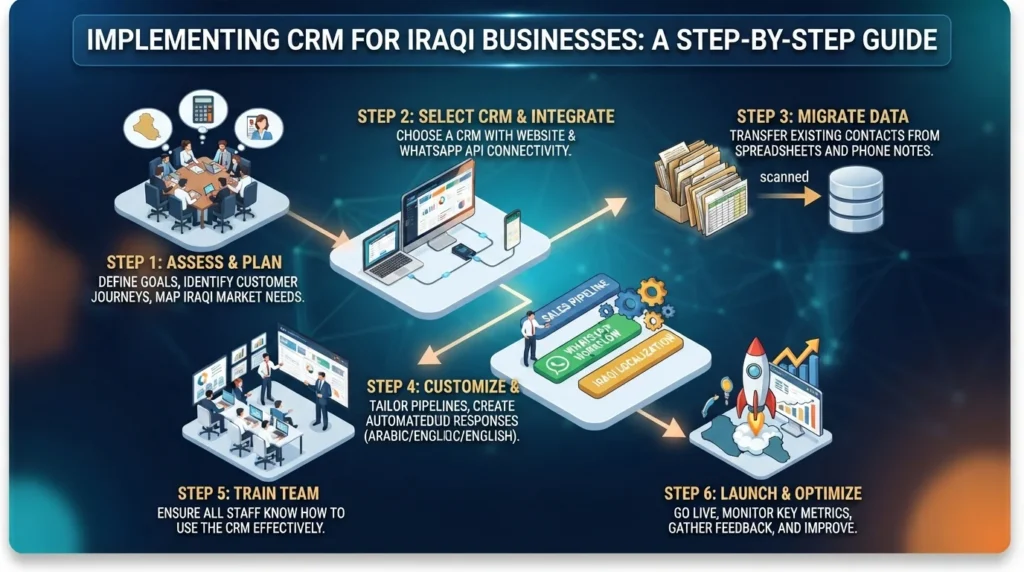
A Simple CRM Rollout Plan
Use this sequence for a smooth start:
- Map how leads arrive today and list your sales stages.
- Choose a CRM that fits your size, language needs, and integrations.
- Import clean contact data and connect website forms first.
- Add WhatsApp and phone logging, then simple automations.
- Review data quality and reports after one month, then refine.
Frequently Asked Questions About CRM
If you receive regular enquiries through several channels and have more than one person handling sales, a CRM usually pays for itself by preventing lost leads and forgotten follow-ups.
Many platforms support Arabic text in records and notes, but quality varies. Test Arabic names, notes, and right-to-left display before committing.
Yes. Basic tracking is possible manually with the WhatsApp Business app, while full integration usually requires the WhatsApp Business Platform through an approved provider.
Only if your processes are genuinely unusual or require deep integration with in-house systems. Most businesses do better starting with an off-the-shelf platform and customizing it.
Give Every Customer One Home
A well-chosen CRM stops leads from disappearing between phones, spreadsheets, and inboxes. Choose a system that fits your size and language needs, connect your website and WhatsApp, keep the setup simple, and make it the place where your team works every day. The result is faster follow-up, clearer reporting, and customer relationships that belong to your company.
If you want help choosing, integrating, or building a CRM for your business, Creative 4 All can review your current sales process and recommend the right approach. Explore our web applications development services in Iraq, see our digital marketing services, or request a consultation today.