
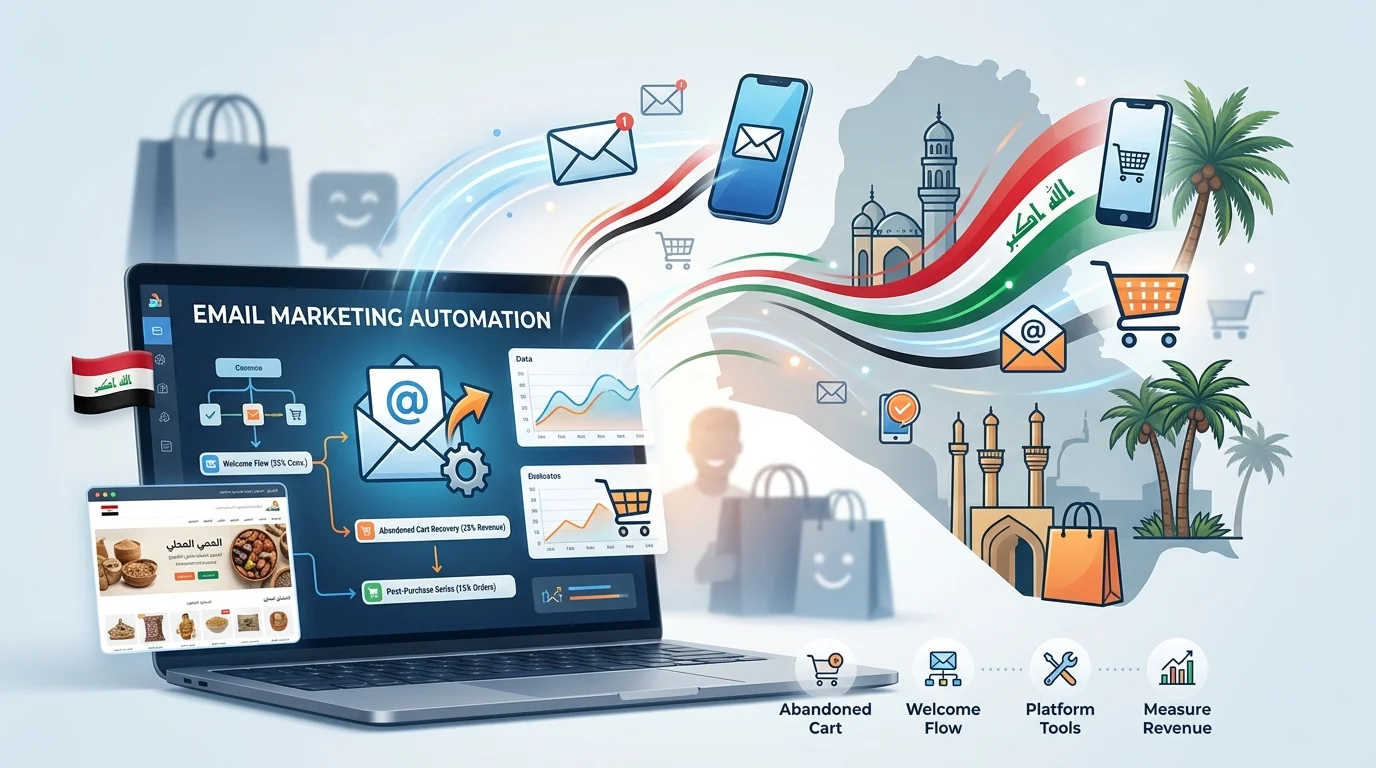
A one-off promotional email blast and a properly built automated email flow aren’t the same tool, even though both run through the same email platform. Email automation ecommerce Iraq stores set up correctly works continuously in the background — triggered by specific customer actions, running without manual effort once built — making it one of the more directly revenue-generating tactics available to an online store, not just another marketing task competing for attention.
This guide covers why automated flows genuinely outperform one-off email blasts for ecommerce specifically, how to build an effective abandoned cart recovery sequence, welcome and post-purchase flows that nurture the full customer relationship, which tools actually work well for Iraqi stores given local payment and logistics realities, and how to measure the actual revenue these automated flows generate. If your store sends occasional blasts but has never set up a proper automated flow, this guide is built to show you exactly where to start.
Why Automated Flows Outperform One-Off Emails?
Timing Based on Actual Customer Behavior
Automated flows trigger based on a specific customer action — adding an item to cart, completing a first purchase, browsing a product without buying — reaching customers at a moment directly relevant to their actual behavior, rather than an arbitrary time a business happens to send a blast.
Set Up Once, Work Continuously
Once properly built and tested, an automated flow continues working for every customer who takes the triggering action, without requiring a marketer to manually send anything — a genuine efficiency advantage over recreating and sending one-off campaigns repeatedly.
Why This Matters Specifically for Ecommerce?
Ecommerce email flows connect directly to trackable revenue in a way that’s harder to achieve with general content marketing — a recovered abandoned cart or a triggered post-purchase upsell email has a direct, measurable dollar value attached to it.
Abandoned Cart Recovery
Why Cart Abandonment Recovery Matters So Much?
A significant share of shoppers who add items to cart don’t complete the purchase in that session, representing lost revenue from customers who already demonstrated genuine purchase intent — recovering even a modest percentage of these abandoned carts through automated follow-up represents real, direct revenue.
A Practical Example of Recovery in Action
Consider an Iraqi electronics store that had no abandoned cart sequence at all, simply losing track of every cart that didn’t convert in the initial session. After setting up a simple two-message recovery sequence — a gentle reminder within a day of abandonment, followed by a message addressing common hesitations around delivery and payment options — the store began recovering a meaningful share of these otherwise lost sales each month, all from a flow built once and running automatically afterward. The revenue recovered wasn’t from new traffic or increased spend; it came entirely from customers who had already shown interest but simply needed a well-timed nudge.
Structuring an Effective Recovery Sequence
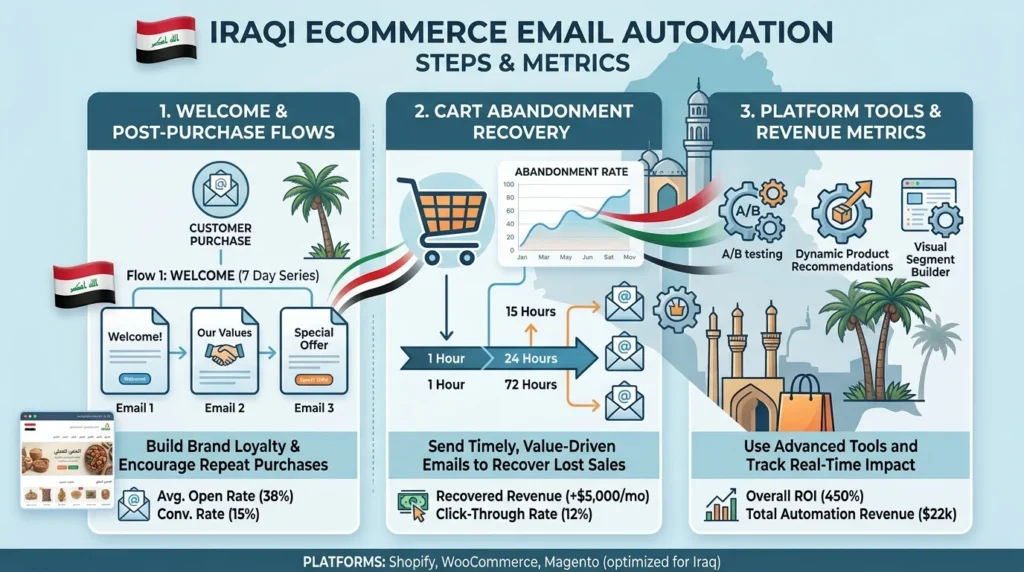
An effective abandoned cart sequence typically sends a gentle reminder relatively soon after abandonment, followed by a second message addressing potential hesitations (shipping cost, payment method concerns) if the cart remains abandoned, rather than a single generic reminder or an overly aggressive multi-message sequence that feels pushy.
Accounting for Cash-on-Delivery Behavior
Given how many Iraqi shoppers prefer cash on delivery, an abandoned cart sequence should account for the reality that some “abandonment” may simply reflect a shopper who intends to complete the order through a WhatsApp conversation rather than finishing checkout online — messaging that offers a direct WhatsApp option alongside the online checkout link can recover carts that a purely online-checkout-focused message would miss.
Welcome & Post-Purchase Sequences
Welcome Sequences That Set Expectations
A welcome sequence triggered immediately after a new subscriber joins — introducing the store, highlighting popular products or categories, and setting expectations for future communication — establishes a strong first impression during a new subscriber’s highest point of engagement.
Post-Purchase Flows That Build Repeat Business
A post-purchase sequence confirming the order, providing delivery updates, and following up after delivery to request feedback or suggest complementary products turns a single transaction into an ongoing relationship more likely to produce repeat purchases.
A Quick Flow-Building Checklist
- Does the abandoned cart sequence account for cash-on-delivery and WhatsApp-based completion behavior?
- Does the welcome sequence set clear expectations for what new subscribers will receive?
- Does the post-purchase flow include genuine delivery updates, not just a single confirmation email?
- Are all flows tested with real test orders before launching, not just configured and assumed to work?
Tools That Work for Iraqi Stores
What to Look for in an Automation Platform?
An email automation platform suited to Iraqi ecommerce needs straightforward integration with your specific ecommerce platform (whether WooCommerce or another system), genuine ease of building multi-step flows without requiring advanced technical skill, and clear reporting connecting automation performance to actual revenue.
A Quick Platform Evaluation Checklist
- Does the platform integrate cleanly with your specific ecommerce system without requiring custom development?
- Can your team build and edit multi-step flows without needing ongoing technical support?
- Does its reporting clearly connect automation activity to actual revenue, not just open and click rates?
- Does it support the order status flexibility needed to accommodate cash-on-delivery and WhatsApp-based order confirmation?
Integration With Local Payment and Logistics Realities
Since global payment processors don’t universally support Iraq and cash on delivery remains significant, automation flows and the platform running them should accommodate order statuses and triggers reflecting these local realities, rather than assuming a purely digital-payment, instant-confirmation purchase flow throughout.
Measuring Automation Revenue
Why Automation Revenue Is Genuinely Trackable?
Unlike broader brand-awareness marketing, automated ecommerce email flows connect directly to trackable actions — a recovered cart becomes an actual completed order, a post-purchase upsell becomes an actual additional sale — making automation one of the more directly measurable marketing investments available.
What to Track for Each Flow
For abandoned cart recovery specifically, track recovery rate (what percentage of abandoned carts the sequence actually recovers) and the revenue directly attributable to those recovered carts. For welcome and post-purchase flows, track engagement and any directly attributable repeat purchase activity.
Creative 4 All builds email automation services specifically for Iraqi ecommerce stores, coordinated with our ecommerce team to build flows that account for genuine local payment and logistics realities rather than generic global assumptions.
Request a Free Audit to get an honest assessment of what automated email flows would actually do for your specific store’s revenue.
FAQs
A one-off email is sent manually to a list at a chosen time. An automated flow is triggered by a specific customer action and runs continuously once built, reaching customers at a moment directly relevant to their behavior.
It varies by store and industry, but recovering even a modest percentage of abandoned carts represents direct, trackable revenue from customers who already demonstrated genuine purchase intent, making it one of the higher-return automation flows to build first.
Yes. Some “abandoned” carts may simply reflect customers intending to complete the order through WhatsApp rather than online checkout, so including a direct WhatsApp option in recovery messaging can capture sales a purely online-focused message would miss.
No. Most Iraqi ecommerce stores need a platform offering straightforward integration with their ecommerce system and genuine ease of building multi-step flows — sophisticated enterprise features are rarely necessary for effective abandoned cart and post-purchase automation.
Track metrics directly tied to revenue — cart recovery rate and attributable revenue for abandoned cart flows, engagement and repeat purchase activity for welcome and post-purchase flows — rather than relying on open rates alone.