
“We need an app” is one of the most common requests a digital agency hears, and one of the least examined — plenty of Iraqi businesses pursue a mobile app because competitors have one or because it feels like the obvious next step, without first confirming it’s actually the right tool for their specific goal. Mobile app development Iraq businesses should pursue only after answering that question honestly looks very different from the generic “every business needs an app” advice circulating online.
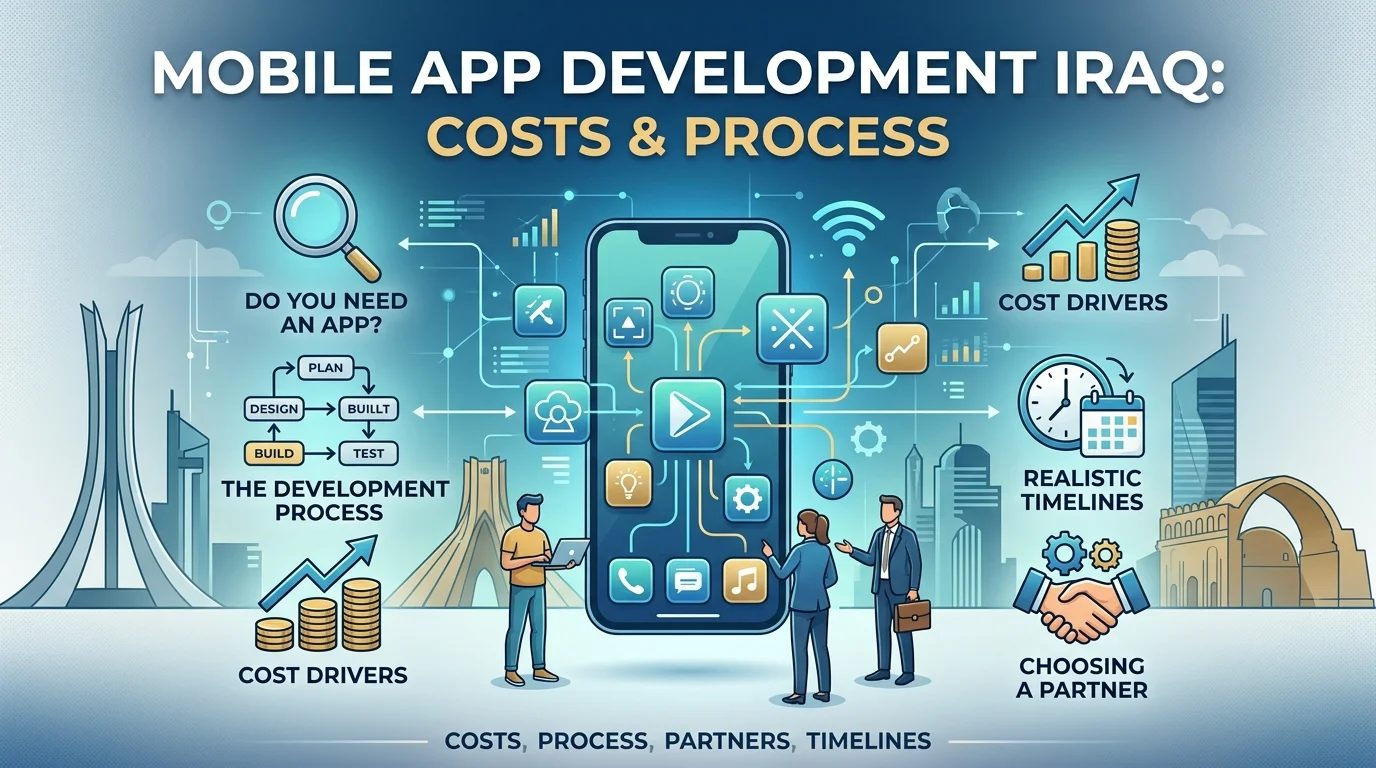
This guide covers how to determine whether your business genuinely needs an app rather than a well-built mobile website, what the actual development process looks like from start to finish, what drives cost across different levels of app complexity, realistic timeline expectations, and how to choose a development partner capable of delivering what you actually need. If you’ve been assuming an app is your obvious next step, this guide is built to test that assumption honestly before you commit a real budget to it.
Do You Actually Need an App?
What an App Does That a Website Can’t?
A native app offers advantages a website genuinely can’t replicate — offline functionality, push notifications, deeper integration with device features like camera or location, and a persistent icon on a user’s home screen — advantages that matter significantly for some business models and barely at all for others.
When a Mobile-Optimized Website Is the Better Choice?
A business whose customers primarily need to browse information, make occasional purchases, or submit an inquiry is often better served by a well-built, genuinely mobile-optimized website than an app, since a website requires no download, works across any device without installation friction, and costs meaningfully less to build and maintain.
Questions to Ask Before Committing to an App
Does your business genuinely need offline functionality or push notifications? Will customers realistically use your app frequently enough to justify the download friction? Is there a specific device feature (camera, GPS, biometrics) your actual use case requires? If the honest answers lean toward “not really,” a website likely serves your business better than an app.
A Practical Example of This Decision
Consider a Baghdad-based restaurant chain that initially requested a mobile app, assuming it was the expected modern approach, without clearly defining what the app would do beyond what their website already offered. After an honest discovery conversation, it became clear that customers primarily wanted to browse the menu, find locations, and place an order through WhatsApp — all of which a well-built mobile website already handled without requiring a download. The chain redirected that budget toward improving the website’s mobile experience and ordering flow instead, saving significant development cost while actually better serving how customers wanted to interact with the business. An app would have been a reasonable choice if loyalty-program push notifications or offline menu access had been genuine priorities — but they weren’t, and the honest conversation caught that before money was spent.
Development Process Overview
Discovery and Planning
Before any development begins, a genuine discovery phase defines exactly what the app needs to do, who it’s for, and what success looks like — skipping this step in favor of jumping straight to design or coding is one of the most common sources of costly mid-project changes later.
Design and Prototyping
User interface design and prototyping let stakeholders see and interact with how the app will actually work before committing to full development, catching usability issues and design disagreements while they’re still inexpensive to fix.
Development and Testing
Actual development builds the app’s functionality in stages, with ongoing testing throughout rather than only at the end, since catching issues early during development is significantly less costly than discovering them after the app is largely complete.
Launch and Post-Launch Support
Launching an app involves app store submission and approval processes (for iOS and Android specifically), followed by an ongoing period of monitoring, bug fixes, and updates that a realistic budget and timeline should account for, not treat as an afterthought.
Cost Ranges by App Complexity
Why This Guide Won’t Quote Specific Numbers?
App development costs vary enormously based on complexity, platform choice (native iOS and Android versus cross-platform), feature scope, and ongoing maintenance needs, making a single suggested figure potentially misleading rather than genuinely useful across the wide range of app concepts Iraqi businesses consider.
Simple Apps vs Complex Apps
A simple app with basic functionality — information display, a simple form, basic navigation — costs meaningfully less than a complex app involving real-time data, payment processing, complex user accounts, or significant backend infrastructure, since complexity directly drives development time and required expertise.
Native vs Hybrid Development Cost Implications
Native app development (building separately for iOS and Android) typically costs more than hybrid or cross-platform development (building once for both platforms), though native development often delivers better performance and platform-specific feature access — a genuine tradeoff worth discussing explicitly with a development partner rather than defaulting to either option.
Starting With an MVP
Building a minimum viable product (MVP) — a version with only the core functionality needed to validate the concept — rather than a fully-featured app from day one, reduces initial cost and lets a business validate real user demand before investing in additional features based on actual usage data rather than assumptions.
Timeline Expectations
Why App Development Takes Real Time?
Genuine app development — discovery, design, development, testing, and app store approval — takes meaningfully longer than a typical website project, reflecting the additional complexity of building software that must work reliably across different devices and operating system versions.
A Realistic Development Sequence
Most app projects move through discovery and planning, followed by design and prototyping, then development in stages with ongoing testing, and finally app store submission and launch — a sequence that, done properly, takes real time and shouldn’t be compressed to meet an arbitrary deadline at the expense of quality.
A Quick Readiness Checklist
- Have you clearly defined what success looks like for the app before development begins?
- Do you understand the tradeoff between native and hybrid development for your specific use case?
- Is your budget realistic for your app’s actual complexity, not based on an assumed low-cost figure?
- Have you planned for ongoing post-launch maintenance and updates, not just the initial build?
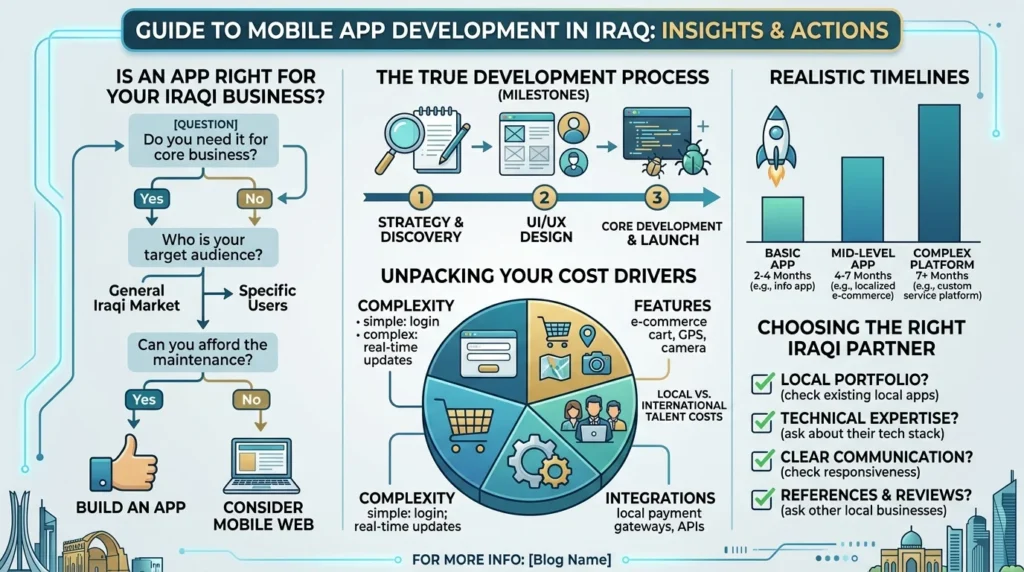
Choosing a Development Partner in Iraq
What to Look for in a Development Partner?
A genuine app development partner should ask detailed questions about your actual business goals before proposing a solution, provide a transparent breakdown of cost and timeline, show relevant past work, and be honest about whether an app is actually the right tool for your specific situation rather than agreeing to build whatever is requested.
Red Flags Worth Noticing
A provider promising an unrealistically fast timeline or unusually low cost relative to your described scope, one unwilling to explain their development process clearly, or one that doesn’t ask meaningful questions about your actual business goals before quoting a price are all signals worth taking seriously before committing.
Creative 4 All provides mobile app development services Iraq businesses can trust, coordinated with our app search optimization expertise so your app is built for genuine discoverability from the start, not just functionality.
Request a Free Audit to get an honest assessment of whether your business genuinely needs an app, and what a realistic development project would actually require.
FAQs
It depends on your specific use case. If you need offline functionality, push notifications, or deep device feature integration, an app makes sense. If customers primarily need to browse, purchase, or inquire, a well-built mobile website is often a better, less expensive choice.
It varies enormously based on complexity, platform choice, and feature scope. Rather than a single figure, request a detailed, itemized quote based on your specific requirements from a development partner you trust.
Native development builds separate versions for iOS and Android, typically offering better performance and platform-specific features at higher cost. Hybrid development builds once for both platforms, typically at lower cost but sometimes with performance tradeoffs.
Genuine app development — discovery, design, development, testing, and app store approval — takes meaningfully longer than a typical website project. Be skeptical of any timeline that seems too fast for your app’s actual complexity.
A minimum viable product includes only the core functionality needed to validate your concept. Starting with an MVP rather than a fully-featured app reduces initial cost and risk, letting you validate real demand before investing further based on actual usage data.