
Open the food and drink charts on Google Play in Iraq and the top spots are held by delivery platforms: at the time of writing, Toters and talabat rank first and second among free apps, with local players like Alsaree3 close behind, according to Appfigures’ tracking of the Iraqi store (rankings shift over time). For an independent restaurant owner in Baghdad or Erbil, that raises a fair question: if customers already order through these apps, does it make sense to build your own? A restaurant app Iraq owners commission can be a strong investment or an expensive duplicate of something customers already have, and the difference comes down to a handful of specific factors this guide walks through honestly.
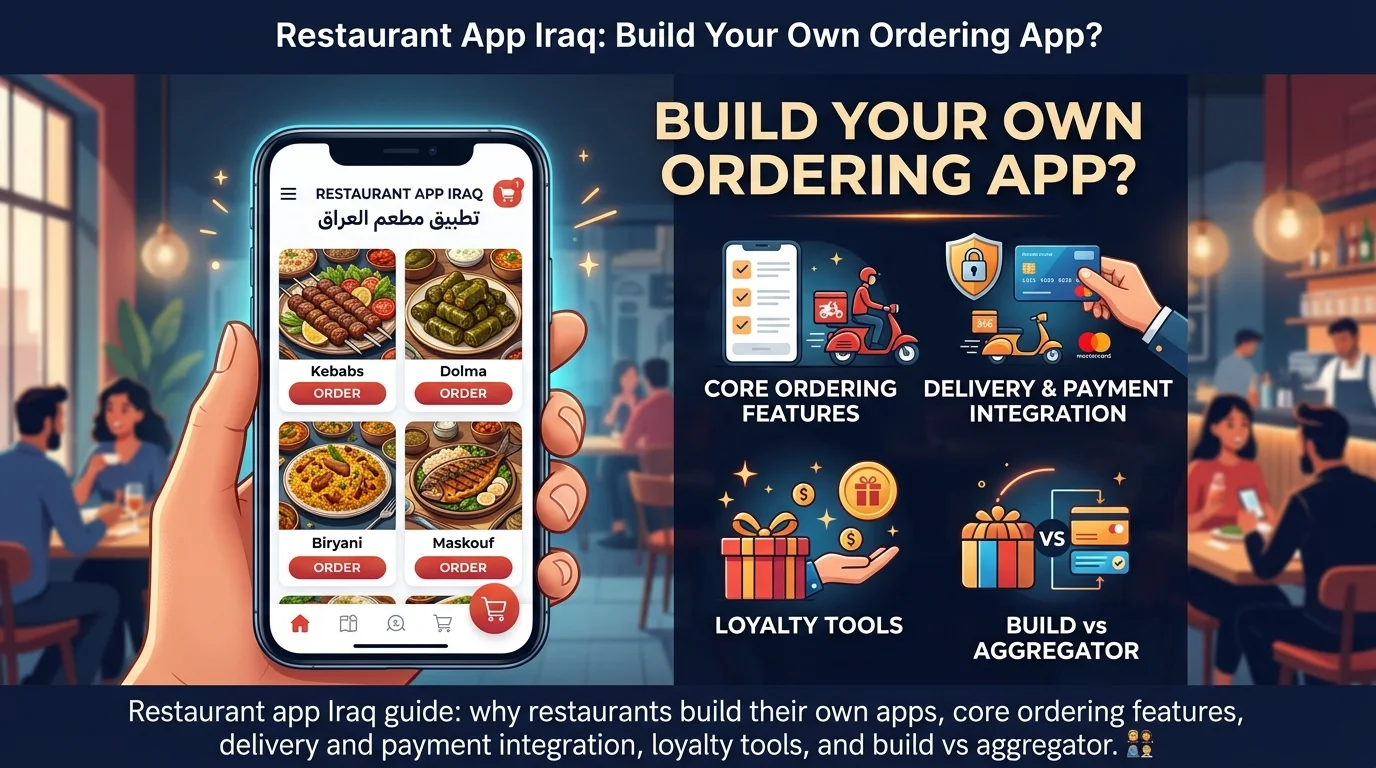
This guide covers why some restaurants build their own apps despite the dominance of delivery platforms, the core features an ordering app genuinely needs, how delivery and payments work in the Iraqi context, the loyalty features that justify an app over a third-party listing, and an honest build-versus-platform comparison that includes the cases where building your own app is the wrong call.
Why Restaurants Are Building Their Own Apps?
The Delivery Platform Landscape in Iraq
The Iraqi delivery market has several established players. Talabat, owned by Delivery Hero, launched in Iraq in spring 2021, starting in Erbil and extending to Sulaymaniyah, Duhok and Zakho, according to the Kurdistan Region Board of Investment. Lezzoo, founded in Erbil in 2018, began with food delivery and has since expanded into groceries and other on-demand services across the Kurdistan Region. Local and regional apps compete alongside them, and industry commentary describes a market where barriers to entry for new delivery startups remain relatively low.
What Restaurants Give Up on Third-Party Platforms?
A restaurant listed on a delivery platform gains discovery, but the platform owns the customer relationship: it controls how your brand appears, what promotions run alongside your menu, and who the customer’s loyalty ultimately attaches to. The restaurant typically pays the platform for each order, and the customer data that would let you build repeat business largely stays with the platform, not with you.
Why That Pushes Some Restaurants Toward Their Own App?
A restaurant with an established customer base, multiple branches, or a strong brand has a clear motivation to move repeat orders onto a channel it controls — where it keeps the customer relationship, sets its own promotions, and avoids paying a platform for customers it already won on its own. This is the genuine case for food delivery app development at the restaurant level, and it works best for businesses with enough repeat demand to justify the investment.
Core Features for Ordering Apps
The Essentials Every Ordering App Needs
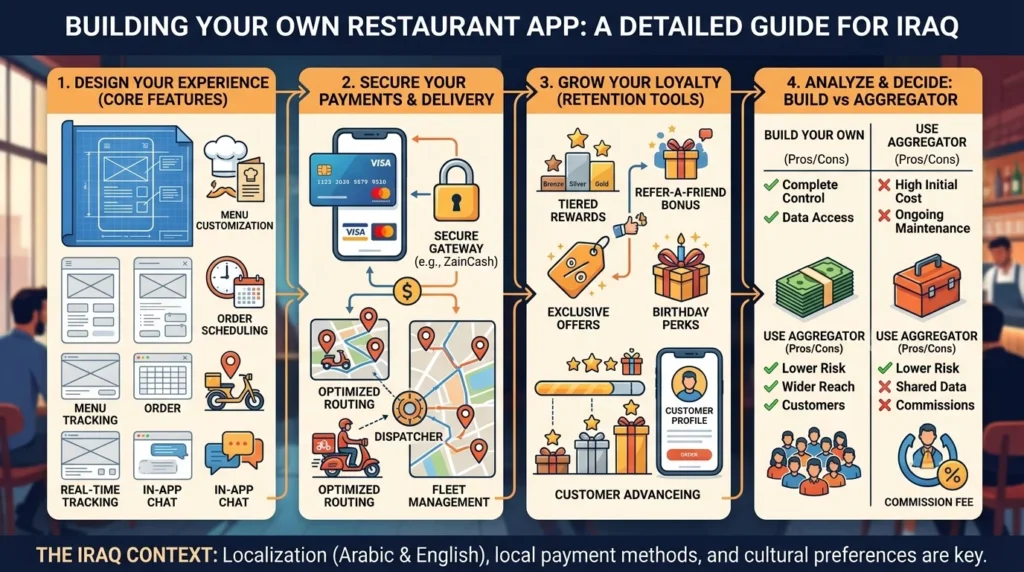
A functional ordering app needs a clear, fast-loading menu with photos and prices, simple customization options (size, extras, notes), a straightforward cart and checkout, order status updates, and reliable push notifications confirming each stage of an order. Anything beyond these basics should earn its place by solving a real customer problem rather than adding complexity.
Arabic-First, Bilingual Design
For an Iraqi audience, a properly implemented Arabic interface with right-to-left layout is a core requirement rather than a feature, and offering English alongside it serves mixed-language customers. Poorly implemented RTL — misaligned icons, awkward text flow — signals carelessness in an app whose entire value is a smooth ordering experience.
Restaurant-Side Tools Matter Too
The customer-facing app is only half the product. Restaurant staff need a clear way to receive, accept, and update orders, mark items unavailable, and manage peak-hour volume. An ordering app whose kitchen-side tools are clumsy creates operational problems that undermine the customer experience, however polished the customer app looks.
A Quick Feature Priority Checklist
- Fast, clear menu with real photos, accurate prices, and easy customization.
- Simple checkout supporting the payment methods your customers actually use, including cash on delivery.
- Order status notifications at each stage, from confirmation to delivery.
- A reliable kitchen-side system for receiving and managing orders without confusion.
Integrating Delivery & Payments
Payment Methods in the Iraqi Context
Cash on delivery remains important for many Iraqi customers, so an ordering app that supports only card payment will exclude a meaningful share of potential orders. Local digital payment options exist and are developing — including local gateways such as PayTabs Iraq and wallets such as ZainCash, as covered in our guide to payment gateways and logistics for Iraqi ecommerce — but availability and onboarding requirements should be verified directly before committing to a specific payment design.
Delivery: Your Own Riders or a Partner
A restaurant can run delivery with its own riders, which gives control over speed and quality but requires managing staff and coverage, or integrate with a third-party delivery service. Local last-mile providers have emerged in Iraq offering delivery and cash-on-delivery collection, and the right choice depends on your order volume, delivery radius, and whether delivery is core to your brand or simply an add-on.
Realistic Delivery Expectations
Delivery times vary with traffic and distance, particularly in dense areas of Baghdad and during peak hours. An ordering app should display honest estimated times rather than optimistic ones, since a customer who waits far longer than promised blames the restaurant, not the traffic.
Loyalty & Retention Features
Why Loyalty Features Are the Real Justification?
The strongest argument for a restaurant’s own app is retention, not acquisition. Third-party platforms are better at helping new customers discover you; your own app is better at turning one-time customers into regulars through features the platform has no incentive to provide for you.
Features That Build Repeat Orders
Simple loyalty mechanics — points or a free item after a set number of orders — one-tap reordering of a previous order, and push notifications for new menu items or time-limited offers give customers concrete reasons to return directly instead of defaulting to whichever platform they open first.
Using Customer Data Responsibly
An owned app gives a restaurant its own order history and customer preferences, which can inform menu decisions, targeted offers, and peak-time planning. Handling that data responsibly — collecting only what’s needed and being transparent about its use — protects customer trust as much as it protects the business.
Build vs Third-Party Platform
Where Third-Party Platforms Still Win?
Delivery platforms bring built-in discovery, an existing user base, and delivery infrastructure that a single restaurant would struggle to replicate. For a new restaurant with no existing customer base, a small independent with limited order volume, or a business unwilling to take on app maintenance, staying on platforms is often the more sensible choice.
A Practical Example of Doing Both
Consider a Baghdad restaurant group with several branches and a loyal base of repeat customers. It stays listed on major delivery platforms for discovery among new customers, while actively steering repeat customers toward its own ordering channel through a loyalty program and direct promotions. The platforms act as an acquisition channel; the owned app acts as a retention channel, and the restaurant avoids paying platform commissions on the customers it has already won.
Cheaper Alternatives Worth Considering First
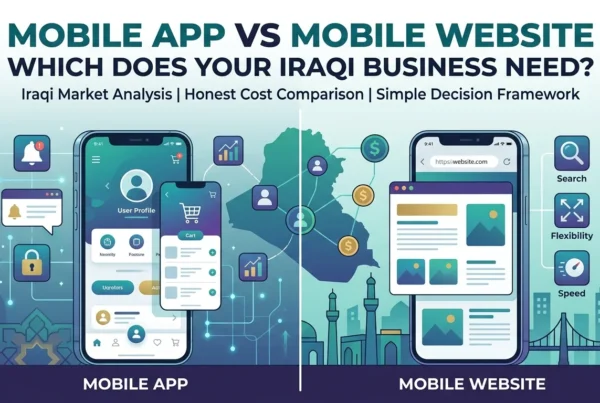
For a single restaurant not ready for a full app, a well-built mobile ordering page or a structured WhatsApp ordering flow can capture direct orders at a fraction of the cost of app development, and can validate whether customers will order directly before a larger investment — the same website-first logic covered in our guide to choosing between a mobile app and a mobile website.
Creative 4 All builds mobile app development for restaurants and delivery businesses, coordinated with our ecommerce team so ordering, payments, and delivery fit together, and we’ll tell you honestly if a simpler option serves your restaurant better right now.
Request a Free Audit to get a straight assessment of whether your own ordering app makes sense for your restaurant, and what it would realistically need.
FAQs
It depends on your repeat-customer base and order volume. A restaurant with loyal regulars or several branches often benefits from moving repeat orders to its own channel, while a new or small restaurant is usually better served staying on platforms for now.
No. Many restaurants use platforms for discovery among new customers and their own app for retention, which lets each channel do what it does best.
A well-built ordering app lets customers choose cash on delivery at checkout and records the order for the delivery rider to collect payment on arrival. Because cash on delivery matters to many Iraqi customers, supporting it is usually essential.
For a single restaurant testing direct ordering, a structured WhatsApp flow or mobile ordering page can be a sensible, lower-cost starting point. A dedicated app becomes more compelling once repeat demand and loyalty features justify the added investment.
Building a polished customer app while neglecting the kitchen-side tools and delivery operations behind it. A smooth ordering experience depends on the whole chain, from order receipt to delivery, working reliably.