
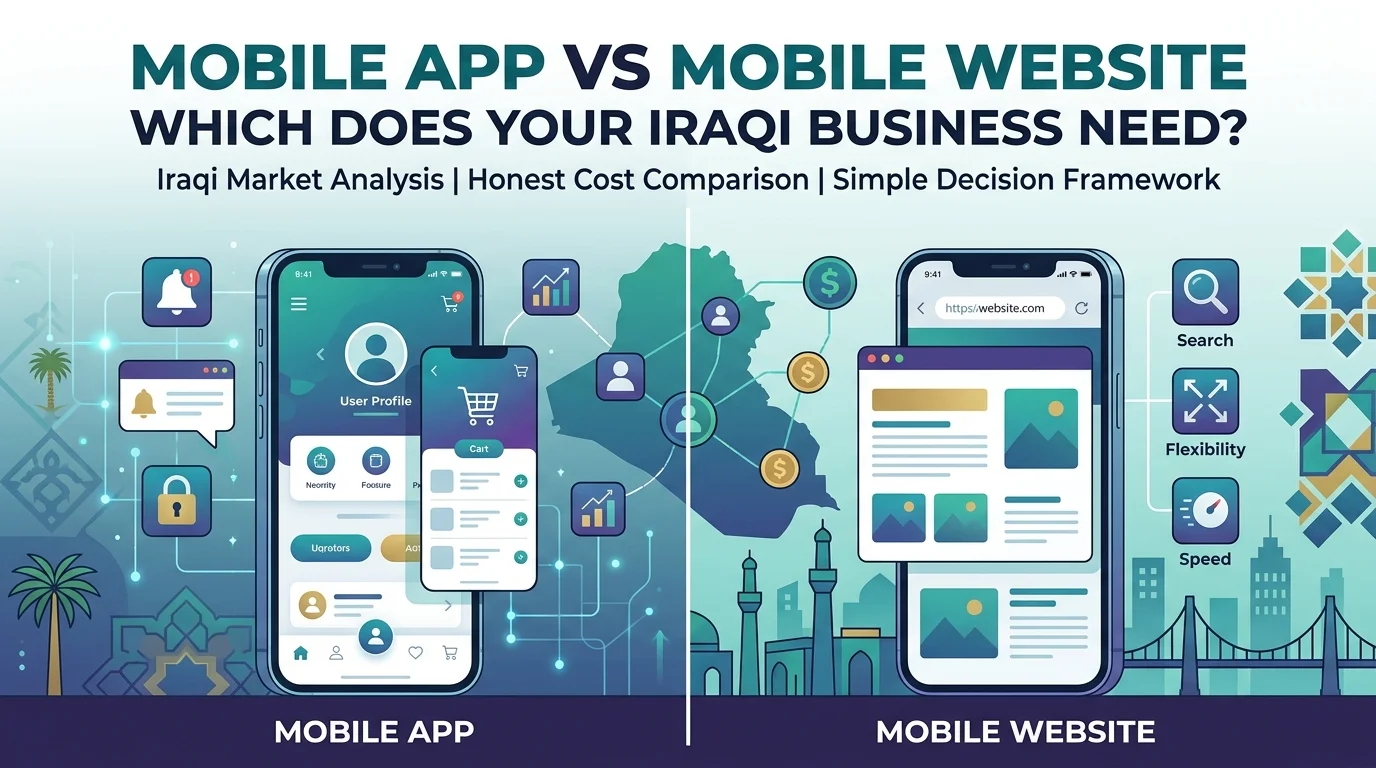
Few questions cost Iraqi businesses more money when answered wrongly than app vs mobile website — commit to an app you didn’t need and you’ve spent a large budget solving a problem a responsive website would have handled, while skipping an app you genuinely needed leaves real customer value unreachable. Because Creative 4 All builds both, we have no incentive to push you toward one over the other, which is exactly why this guide tries to answer the question honestly rather than defaulting to whichever service is more profitable to sell.
This guide covers what each option actually solves, an honest cost comparison, the situations where a responsive website is genuinely enough, the situations where an app adds real value a website can’t match, and a simple decision framework you can apply to your own business in a few minutes. If you’ve been going back and forth on this decision, the framework near the end is designed to give you a clear answer without needing technical knowledge.
What Each Option Actually Solves?
What a Mobile Website Solves?
A well-built, responsive website makes your business discoverable through search, accessible from any device without installation, and capable of presenting information, capturing inquiries, and even handling purchases — all through a link anyone can open instantly. Given that mobile connections in Iraq reached 50.8 million by late 2025 according to DataReportal’s Digital 2026 report, a genuinely mobile-friendly website already reaches the overwhelming majority of potential customers where they actually browse.
What a Mobile App Solves?
A mobile app solves a different set of problems: sustained, repeated engagement from an existing customer base, capabilities that depend on the device itself (push notifications, camera, offline access, location), and a persistent presence on a user’s home screen that a website simply can’t replicate.
Why These Aren’t Really Competing Solutions?
The two options address different needs rather than competing for the same one. A website is primarily about being found and reached by people who may not know your business yet; an app is primarily about deepening the relationship with people who already do. Understanding which of those two needs is actually yours resolves much of the decision.
The Discoverability Difference
A website can be found through Google, shared through a simple link, and opened by anyone with a browser. An app must first be discovered inside an app store — a smaller, more crowded environment — or promoted separately to get people to search for it at all. For a business whose main challenge is being found by new customers, this difference alone often settles the question in the website’s favor.
Cost Comparison
Why This Guide Won’t Quote Specific Numbers?
Both options’ costs vary enormously by scope and complexity, making a single comparative figure misleading rather than useful. What can be said honestly is the structural difference: a responsive website is generally the less expensive of the two to build and maintain, while an app typically involves higher development cost and ongoing maintenance across platforms and operating system updates.
Hidden Costs Specific to Apps
Beyond initial development, an app typically involves ongoing costs for updates as iOS and Android evolve, app store compliance, bug fixes, and the effort of persuading customers to download it in the first place — a user-acquisition cost a website, reachable through search and a simple link, largely avoids.
The Download Friction Cost
Every additional step between a potential customer and your service reduces how many complete it. A website opens with a tap; an app requires finding, downloading, installing, and opening before delivering any value, and a meaningful share of potential users won’t make that effort unless the payoff is clear.
When a Responsive Site Is Genuinely Enough?
Information, Inquiries, and Occasional Purchases
If your customers primarily need to learn about your services, check prices or locations, submit an inquiry, or make an occasional purchase, a responsive website serves them completely — and reaches them through search in a way an app, which must first be discovered in an app store, generally cannot.
A Practical Example of the Website Winning
Consider a Baghdad law firm considering an app so clients could “contact us easily.” After honest discovery, it became clear that clients primarily found the firm through Google, wanted to read about its practice areas, and preferred contacting it through WhatsApp or a phone call — needs a fast, well-built mobile website with prominent contact options already handled completely. An app would have required clients to download something just to reach a firm they found through search, adding friction without adding value.
A Quick “Website Is Enough” Checklist
- Do customers primarily find you through search or social media rather than through repeated direct use?
- Is your core need information, inquiries, or occasional transactions?
- Would customers realistically use an app often enough to justify downloading it?
- Can a prominent WhatsApp or call button satisfy your customers’ actual contact preference?
When an App Adds Real Value?
Frequent, Repeated Engagement
Businesses whose customers interact with them frequently — daily ordering, ongoing account management, loyalty programs, scheduling recurring services — benefit from an app’s persistent presence and push notifications, which can drive repeat engagement a website alone rarely matches.
Device-Dependent Features
When your core value depends on the device itself — scanning with the camera, location-aware services, offline access in areas with unreliable connectivity, or deep integration with phone features — an app can deliver something a website fundamentally can’t.
A Practical Example of the App Winning
Consider a delivery-focused business whose customers order repeatedly each week and want real-time courier tracking and instant status notifications. That combination of high-frequency use, location-aware tracking, and push notifications is a genuine app use case: the repeated engagement justifies the download, and the notifications deliver value a website can’t push to a customer unprompted.
A Simple Decision Framework
Three Questions That Resolve Most Cases
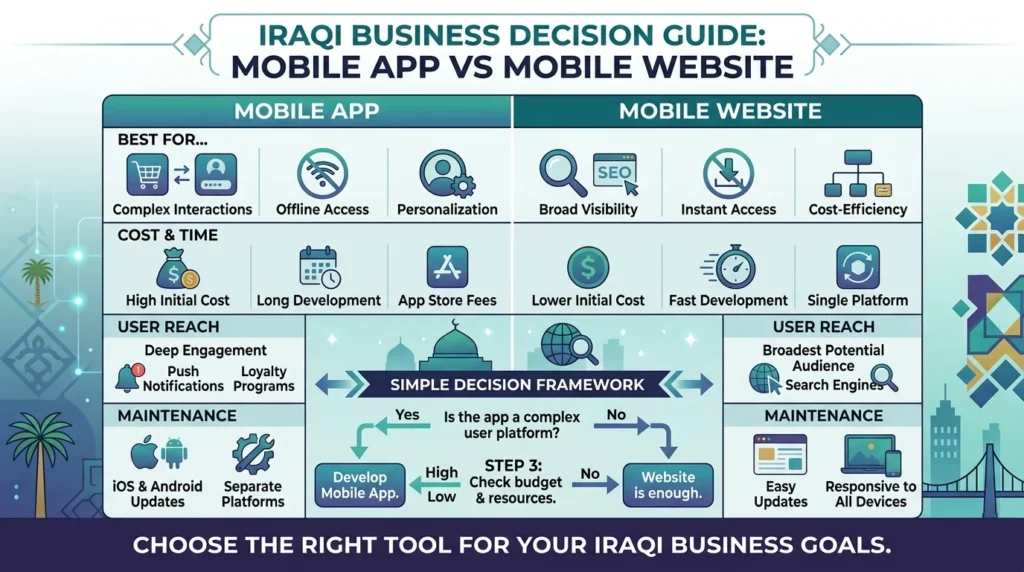
Ask honestly: Will customers use this frequently enough to justify downloading it? Does the core value depend on device features or push notifications? Are you trying to reach new customers, or deepen relationships with existing ones? Yes to the first two, and a focus on existing customers, points toward an app; otherwise a responsive website very likely serves you better.
Starting With the Website Is Often the Right Sequence
For many businesses unsure which they need, building a strong responsive website first — which also supports discoverability through search — and adding an app later once real customer behavior shows genuine demand for one is a lower-risk path than committing to an app speculatively.
Signals That It’s Time to Add an App
A website-first business typically discovers its moment for an app through observable behavior: customers returning to the site repeatedly for the same task, asking whether you have an app, or needing notifications and device features the website can’t provide. Treating an app as a response to genuine, observed demand rather than a default assumption keeps the investment tied to real customer behavior.
What If You Genuinely Need Both?
Some businesses do need both — a responsive website for discoverability and new customer acquisition, and an app for deepening engagement with a loyal existing base. When that’s genuinely the case, the two can share backend systems and be planned together from the start, which is typically more efficient than building them as entirely separate, disconnected projects.
Creative 4 All builds both responsive web design and mobile app development, which is exactly why we’re comfortable telling you honestly when you only need one of them — and when getting a quote for both genuinely makes sense.
Request a Free Audit and we’ll give you an honest recommendation on which option your specific business actually needs, even when the answer is the less expensive one.
FAQs
Only if your customers will use it frequently enough to justify downloading it, or if your core value depends on device features or push notifications. For many small businesses, a strong responsive website delivers more value at lower cost.
No. Websites can’t match an app’s push notifications, deep device integration, or persistent home screen presence. But for businesses whose customers mainly need information, inquiries, or occasional purchases, a website covers the real need.
Often, yes. A strong responsive website supports discoverability through search, and adding an app later, once real customer behavior shows genuine demand, is generally lower-risk than committing to an app speculatively.
Because the honest answer for many businesses is that a website serves them better. An agency that builds both has no reason to push you toward the more expensive option when it isn’t the right fit.
Ask whether customers will use it frequently, whether your value depends on device features or notifications, and whether you’re reaching new customers or deepening existing relationships. The answers usually make the right choice clear.