
Most agency pages list “native and hybrid app development” as a bullet point without ever explaining what actually separates them or which one a given business should choose — a directory-style gap that leaves founders no better equipped to make the decision than before they started researching. The native vs hybrid app decision has real, concrete tradeoffs worth understanding before committing budget, not a technical detail to defer entirely to whichever developer you happen to hire.
This guide explains what native and hybrid actually mean in practical terms, the genuine performance and cost tradeoffs between them, when hybrid development makes sense for most Iraqi SMEs, when native development is actually worth its additional investment, and how we approach recommending one over the other for a specific project. If every agency you’ve spoken to has used these terms without explaining them, this guide is built to actually close that gap.
What Native and Hybrid Actually Mean?
Native Development, Explained Simply
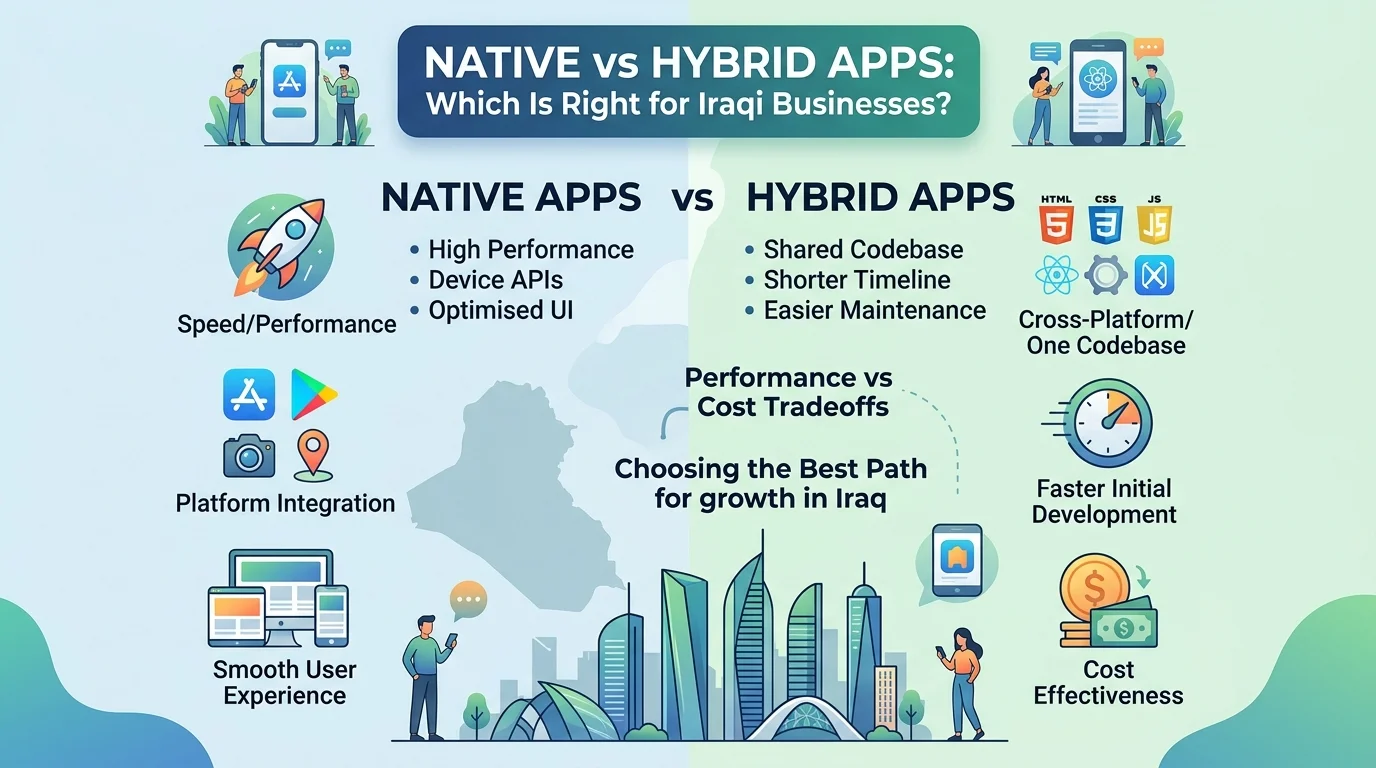
Native app development means building separate, dedicated versions of an app for iOS and Android, each written specifically for that platform’s own programming language and tools — Swift or Objective-C for iOS, Kotlin or Java for Android — giving each version direct, unmediated access to the platform’s full capabilities.
Hybrid Development, Explained Simply
Hybrid development means building a single codebase that runs on both iOS and Android through a shared framework — React Native and Flutter are the two most widely used examples — letting much of the development work serve both platforms simultaneously rather than duplicating it.
Why This Distinction Isn’t Just Technical Jargon?
This isn’t a distinction that only matters to developers — it directly affects your project’s cost, timeline, and the app’s eventual performance and capabilities, making it a genuine business decision a founder should understand rather than a technical detail to accept without question.
Performance & Cost Tradeoffs
Where Native Genuinely Wins?
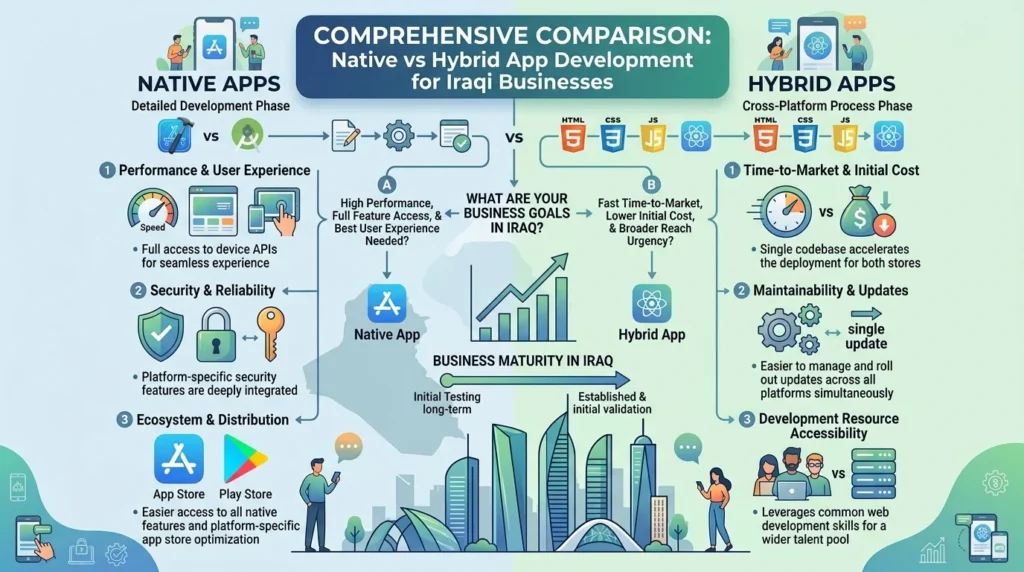
Native apps typically deliver better performance for graphics-intensive or highly interactive features, more reliable access to newly released platform capabilities without waiting for a framework to catch up, and generally smoother handling of complex animations or device-specific integrations.
Where Hybrid Genuinely Wins?
Hybrid development typically costs less and takes less time, since a single codebase serves both platforms rather than requiring two separate development efforts — a genuine advantage for a business needing to validate a concept or launch on a constrained budget and timeline.
Why Neither Option Is Universally Superior?
Framing this as native being simply “better” ignores the real cost and timeline tradeoff, while framing hybrid as always “good enough” ignores genuine cases where performance or platform-specific capability requirements make native the only viable choice — the right answer depends entirely on your specific app’s actual requirements.
When Hybrid Makes Sense for Iraqi SMEs?
Most SME Apps Don’t Need Native’s Full Capability
An app primarily displaying information, handling basic forms, or offering straightforward navigation and content — the majority of what most Iraqi SME apps actually need — rarely requires native development’s performance advantages, making hybrid’s cost and timeline savings a genuinely better fit.
A Practical Example of This Fit
Consider an Iraqi logistics company wanting an app for customers to track deliveries, view order history, and contact support — functionality that’s entirely about displaying data and handling straightforward interactions, with no graphics-intensive or platform-specific performance requirements involved. Building this natively for both iOS and Android would roughly double development effort for features that hybrid frameworks handle perfectly well, making hybrid development the clear, defensible choice here rather than a compromise.
Validating a Concept Before Heavier Investment
A business testing whether an app concept actually generates the user demand and engagement expected benefits from hybrid’s lower upfront cost, since validating the concept doesn’t require the performance ceiling native development offers — that investment makes more sense once real usage data justifies it.
A Quick Hybrid Suitability Checklist
- Does your app primarily display content, handle forms, or offer standard navigation?
- Is budget or timeline a genuine constraint for your project right now?
- Are you validating a new concept rather than scaling an already-proven one?
- Do you not have a specific need for cutting-edge platform features or graphics-intensive performance?
When Native Is Worth the Investment?
Performance-Critical Use Cases
Apps involving real-time gaming-style interactions, complex animations, intensive camera or AR features, or any use case where milliseconds of responsiveness genuinely matter to the user experience typically justify native development’s additional cost.
Deep Platform Integration Needs
An app requiring deep integration with specific device hardware, the latest platform-specific features immediately upon release, or capabilities that a hybrid framework hasn’t yet fully supported benefits from native development’s direct, unmediated platform access.
Scaling an Already-Validated Concept
A business that has already validated genuine demand through an initial hybrid version, and is now scaling toward a larger user base with higher performance expectations, may find the case for migrating to or starting fresh with native development becomes stronger at that stage.
Our Recommendation Process
Starting From Your Actual Requirements, Not a Default
Rather than defaulting to either option as a standard offering, a genuine recommendation process starts by understanding your specific app’s functional requirements, target timeline, and budget constraints, then matching the technical approach to what those requirements actually demand.
Being Honest When Hybrid Is the Better Choice
A development partner genuinely serving your interests should be willing to recommend hybrid development even when native might be the more impressive-sounding option, if your actual requirements don’t justify the additional cost and complexity native development involves.
Creative 4 All provides mobile app development services that start from your actual requirements rather than a default technology preference, coordinated with our web application expertise for projects where a web app might serve your needs even better than either native or hybrid mobile development.
Request a Free Audit to get an honest recommendation on whether native or hybrid development actually fits your specific app concept.
FAQs
It depends on your specific requirements. If your app primarily displays content or handles standard functionality, hybrid likely offers better value. If you need performance-critical features or deep platform integration, native is worth the additional investment.
Both are capable, widely used frameworks with their own strengths — the better choice often depends on your specific development team’s expertise and your app’s particular requirements rather than one being universally superior.
Yes, though it typically requires significant redevelopment rather than a simple conversion. Starting with hybrid to validate a concept, then considering native once genuine scale and performance needs justify it, is a reasonable approach for many businesses.
Not necessarily. Many successful, widely used apps are built with hybrid frameworks. The quality difference, where it exists, usually shows up in specific performance-intensive scenarios rather than across all app functionality.
Start by clearly defining your app’s core functional requirements, then evaluate whether any of them genuinely require native-level performance or platform integration. A development partner should walk through this assessment with you rather than defaulting to one option.