
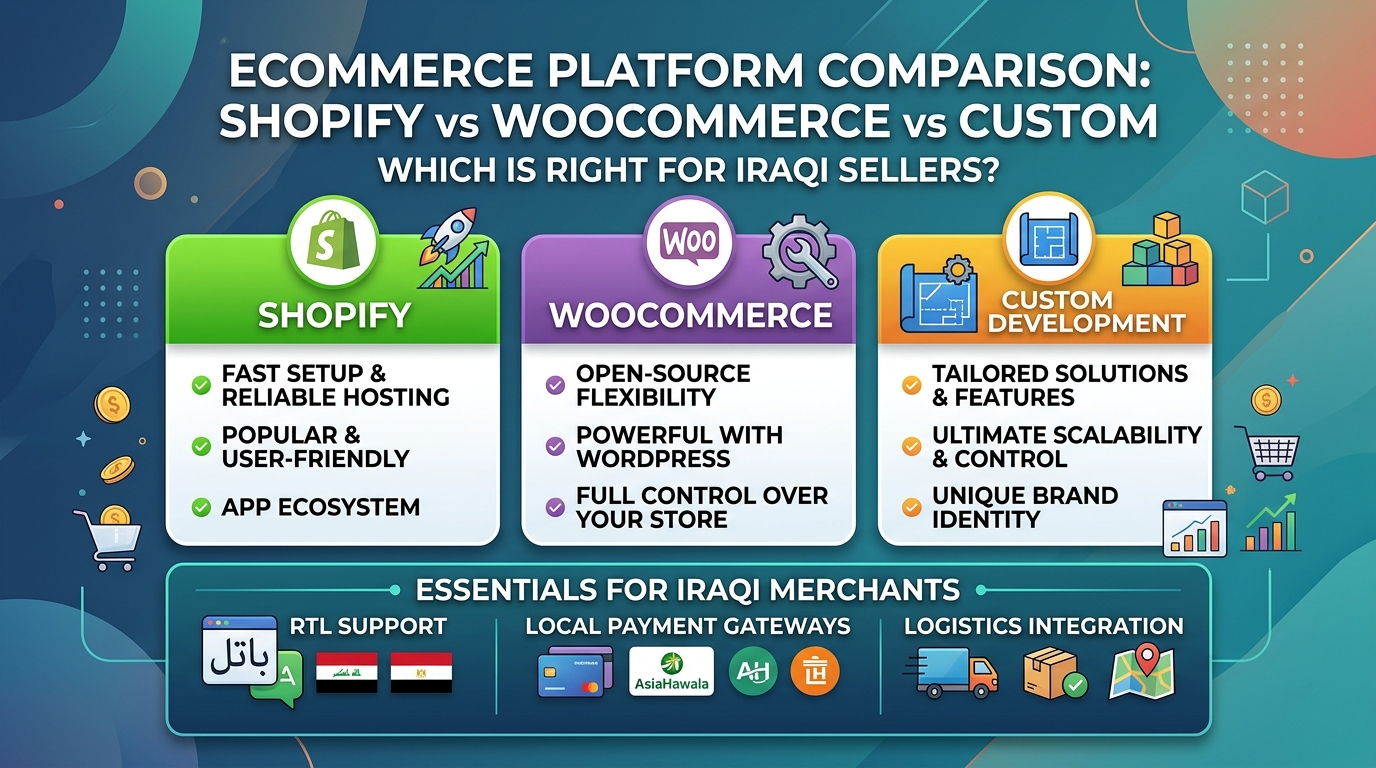
Nearly every global comparison of Shopify versus WooCommerce assumes a market with mature, widely integrated payment gateways, established local logistics APIs, and no particular language direction complexity — none of which describes the Iraqi market accurately. Choosing the right ecommerce platform Iraq sellers actually depend on requires asking Iraq-specific questions these generic comparisons never address: which platforms genuinely support the payment methods Iraqi customers actually use, how well each handles Arabic RTL content, and how logistics integration works when local delivery infrastructure doesn’t offer the same plug-and-play APIs common in more mature ecommerce markets.
This guide compares Shopify, WooCommerce, and custom development specifically through an Iraqi lens — payment gateway reality, RTL and bilingual support, logistics integration, and platform fee structures — rather than repeating generic pros and cons that don’t account for what actually matters when selling online in this specific market. If you’re comparing platforms right now and finding global reviews unhelpful for your actual situation, this guide is built to fill exactly that gap.
Key Selection Criteria for Iraqi Sellers
Payment Gateway Compatibility
The single most Iraq-specific consideration in platform selection is payment method support. Many Iraqi ecommerce customers rely heavily on cash on delivery, and digital payment method availability and integration options vary by platform and by which payment processors actually operate reliably in the Iraqi market. Verifying which payment methods a platform genuinely supports for Iraqi merchants — rather than assuming global payment gateway availability applies here — should be one of the first questions in any platform evaluation.
A Practical Example of Why This Matters
Consider a merchant who selects a platform based purely on its global reputation and feature list, only to discover during setup that most of its native payment integrations don’t function reliably for Iraqi transactions, leaving cash on delivery as the only practical option despite the platform’s marketing emphasizing seamless digital checkout. A different platform, perhaps less polished overall, might have offered more flexible payment configuration that better matched what Iraqi customers actually use. This is exactly the kind of mismatch a generic global comparison would never surface, and exactly why evaluating any ecommerce platform Iraq merchants consider requires local verification, not assumptions carried over from reviews written for other markets.
RTL and Bilingual Support Quality
Genuine right-to-left layout support, not just theoretical compatibility, varies meaningfully between platforms and even between themes within the same platform. A platform that claims RTL support but implements it inconsistently across checkout flows, email notifications, and admin interfaces creates ongoing friction for both merchants managing Arabic content and customers navigating the storefront.
Testing RTL Before Committing
Rather than trusting a platform’s or theme’s marketing claims about RTL support, testing an actual demo store with Arabic content loaded — checking the checkout flow, order confirmation emails, and the admin dashboard itself — reveals whether RTL support is genuinely comprehensive or limited to the storefront’s visible pages alone, which is a common and easily missed gap.
Logistics and Delivery Integration
Whether a platform integrates smoothly with the delivery providers actually operating in Iraq matters more than how many logistics integrations it offers globally, since a platform’s headline integration count is meaningless if it doesn’t connect with the specific providers a business actually uses. Manual order handoff to a delivery provider, while less elegant than automated integration, is a realistic and common approach given the current state of Iraqi logistics API availability.
Total Cost Structure, Not Just Sticker Price
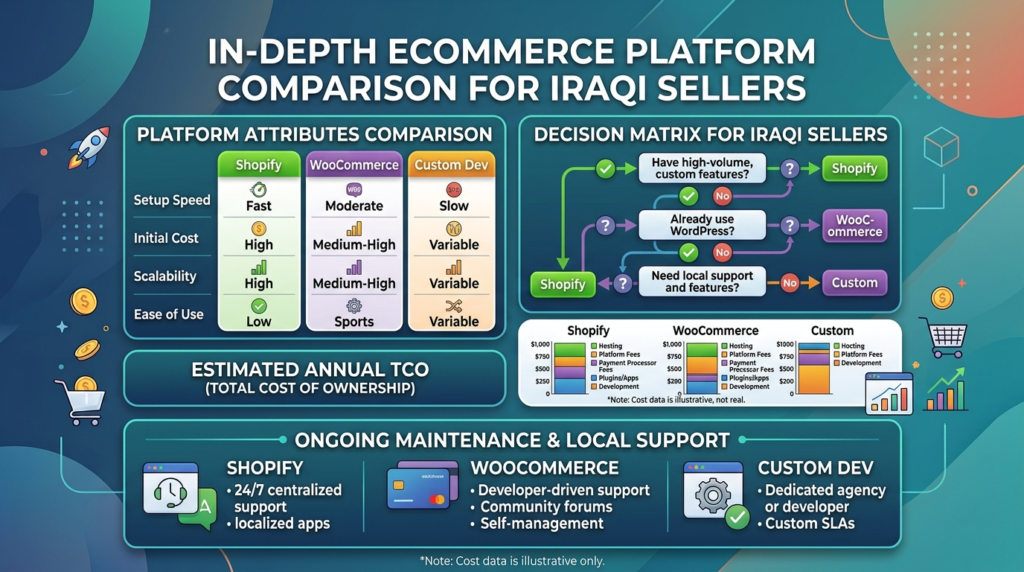
Platform costs include more than a monthly subscription fee: transaction fees, payment processing costs, theme and app costs, and hosting expenses for self-hosted options all factor into genuine total cost of ownership, which can differ substantially from how platforms initially present their pricing.
Shopify: Pros and Cons Locally
What Shopify Offers Well?
Shopify provides a polished, hosted platform with minimal technical maintenance required from the merchant, strong out-of-the-box design options, and a straightforward setup process that doesn’t require managing hosting or server-level technical details directly.
Where Shopify Falls Short for Iraqi Sellers?
Shopify’s payment processing ecosystem is built primarily around markets with mature, widely available payment gateway integrations, and Iraqi merchants frequently need to verify carefully which payment methods are actually usable rather than assuming global availability. RTL support on Shopify depends heavily on theme selection and configuration, and not every popular theme handles it equally well, requiring careful vetting before commitment.
Who Shopify Suits?
Shopify tends to suit merchants prioritizing ease of use and design polish over deep local customization, particularly those selling products where cash on delivery or manually coordinated payment can serve as the primary transaction method without heavy reliance on automated digital payment processing.
WooCommerce: Pros and Cons Locally
What WooCommerce Offers Well?
WooCommerce, built on WordPress, offers substantially more flexibility for customization, including deeper control over checkout flow, payment method configuration, and integration with third-party tools — an advantage when standard payment or logistics options don’t cleanly fit the Iraqi market’s realities. Its open-source nature also means a wider pool of developers, including local Iraqi developers, can typically support and customize it.
Where WooCommerce Requires More Effort?
WooCommerce requires more hands-on technical management than a fully hosted platform — hosting selection, security maintenance, and plugin management all become the merchant’s or their developer’s responsibility, rather than being handled entirely by the platform provider.
Who WooCommerce Suits?
WooCommerce tends to suit merchants needing genuine customization for local payment workarounds, specific logistics coordination, or bilingual content management, particularly when working with a developer familiar with configuring it specifically for Iraqi market realities rather than a generic global setup.
Custom Builds: When They’re Worth It
What Justifies Custom Development?
Custom ecommerce development makes sense when neither Shopify nor WooCommerce can accommodate genuinely unique requirements — unusual product configuration logic, tightly integrated custom logistics coordination, or specific business processes that don’t map onto either platform’s plugin or app ecosystem.
A Realistic Assessment of How Often This Applies
In practice, genuine custom-build necessity is rarer than the number of custom ecommerce projects in the Iraqi market might suggest. Many businesses that ultimately commission custom development could have achieved the same outcome through careful WooCommerce configuration and the right combination of plugins, at meaningfully lower cost and without the long-term dependency custom code creates.
The Real Tradeoff
Custom development offers maximum flexibility but requires significantly more upfront investment and creates greater dependency on the developer who builds it, since custom systems don’t benefit from the wide community support standard platforms offer. This tradeoff is worth accepting only when the functional need is genuine, not because custom development sounds more sophisticated.
Our Recommendation by Business Size
Small Sellers and Early-Stage Stores
For small sellers just starting out, a platform requiring minimal technical overhead — properly configured for actual payment method availability in Iraq — typically makes more sense than investing in complex customization before validating whether the product and market fit works.
Growing Businesses With Specific Needs
As a business grows and specific Iraq-market needs become clearer — particular payment workarounds, logistics coordination requirements, bilingual content demands — WooCommerce’s flexibility often becomes more valuable than a hosted platform’s simplicity, provided adequate developer support is available.
Which Ecommerce Platform Is Best for Iraq: The Honest Answer?
There’s no single answer to which ecommerce platform is best for Iraq — the right choice depends on specific payment needs, technical resources available, and how much customization the business genuinely requires, evaluated against Iraq-specific realities rather than generic global platform comparisons.
Creative 4 All helps Iraqi merchants choose and implement the right ecommerce platform services based on genuine local payment, logistics, and language requirements, coordinated with our CMS expertise to ensure the underlying platform choice supports real business needs, not just a generic recommendation.
Request a Free Audit to get an honest platform recommendation based on your specific product, payment needs, and growth plans.
FAQs
It depends on priorities. Shopify offers easier setup and less technical maintenance; WooCommerce offers more flexibility for local payment and logistics workarounds. Neither is universally better — the right choice depends on your specific needs and available technical support.
Support varies significantly by platform and, on WooCommerce, by theme selection. Genuine RTL quality should be verified directly rather than assumed from a platform’s general marketing claims, since implementation quality differs meaningfully across options.
Payment method availability and integration quality for Iraqi merchants varies by platform and should be verified directly for your specific situation, since global payment gateway availability doesn’t always translate to reliable local support.
Rarely for a small or early-stage business. Custom development typically makes sense only once specific, validated needs exceed what standard platforms can accommodate — a threshold most small businesses haven’t reached yet.
Yes, though migration involves real effort and some risk to existing SEO and customer data. Choosing thoughtfully upfront based on genuine needs reduces the likelihood of needing a costly platform switch later.