
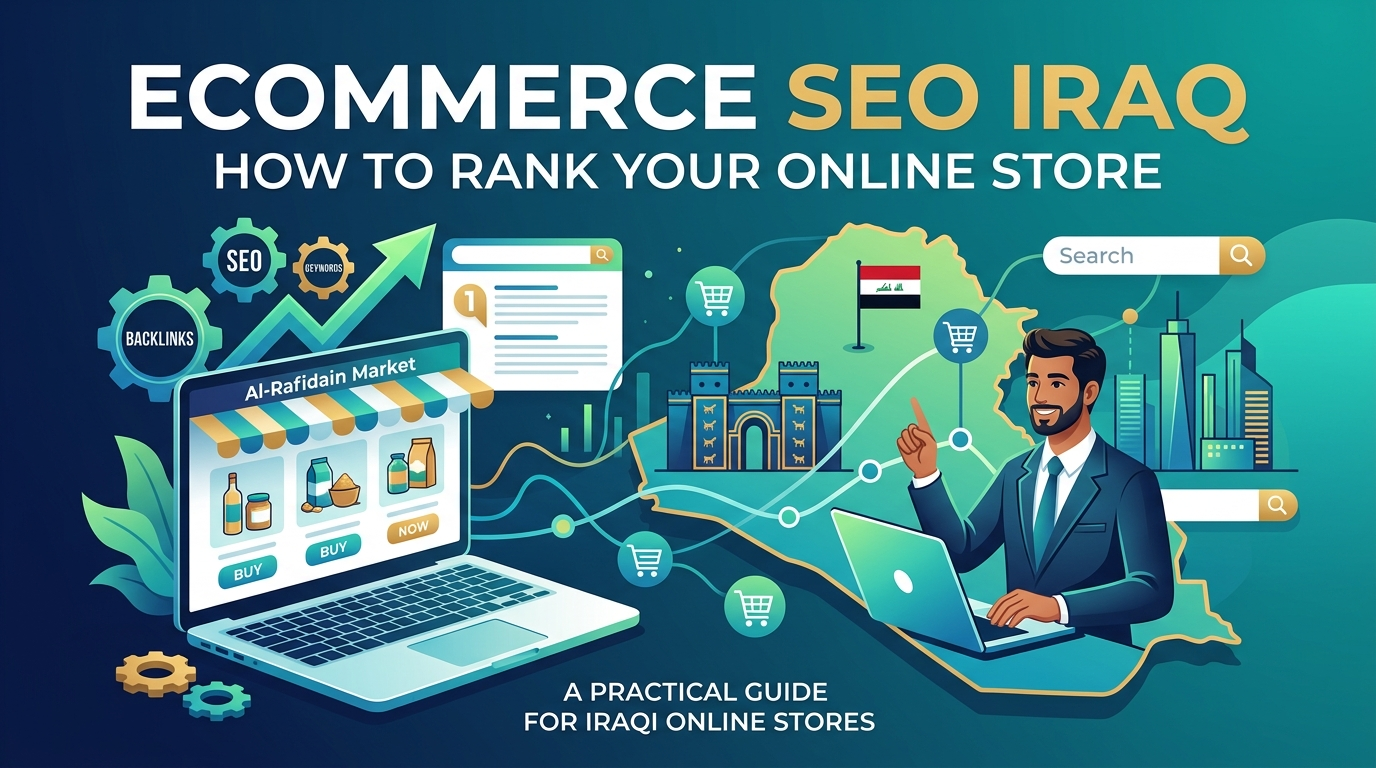
Iraq’s ecommerce market is growing, but most Iraqi online stores are competing almost entirely on paid ads and social media, leaving organic search largely uncontested. That gap is exactly why ecommerce SEO Iraq deserves far more attention than it currently gets: a well-optimized store can capture free, high-intent traffic from shoppers actively searching for specific products, while competitors spend their entire marketing budget renting visibility through ads that stop the moment spending stops.
This guide covers what ecommerce SEO Iraq stores specifically need — not the generic Shopify or WooCommerce advice written for saturated Western markets, but the site architecture, product page, and technical decisions that actually matter for an Iraqi online store competing in a thinner, less-optimized competitive field. Getting ecommerce SEO Iraq right early avoids the costly retrofit that comes from bolting SEO onto a store built without it in mind.
Why Ecommerce SEO Is Different?
More Pages, More Complexity
A typical service business website might have a dozen key pages. An ecommerce store can have hundreds or thousands — product pages, category pages, filtered views, and often duplicate content generated automatically by the platform itself. Ecommerce SEO Iraq stores need therefore has to solve problems that simply don’t exist for smaller sites: managing crawl budget efficiently, avoiding duplicate content across near-identical product variations, and maintaining a site architecture that stays logical as inventory grows. This scale is what separates ecommerce SEO Iraq work from the simpler on-page optimization a service business page typically requires.
The Commercial Intent Advantage
Ecommerce searches tend to carry stronger commercial intent than informational searches — someone searching a specific product name in Iraq is often close to a purchase decision, not just researching. This makes ecommerce SEO Iraq work particularly high-value per visitor, even when overall search volume for a given product term is comparatively low, because the traffic that does arrive converts at a meaningfully higher rate than generic informational traffic.
Why So Few Iraqi Stores Compete Here?
Most Iraqi ecommerce sites either launched without SEO consideration at all, or rely entirely on their platform’s default settings without any category structure planning, product page optimization, or technical cleanup. This leaves the organic search channel almost entirely open for any store willing to invest properly in ecommerce SEO Iraq fundamentals.
A Practical Example of the Opportunity
Consider two competing home goods stores selling similar products online in Iraq. One relies entirely on paid social ads and has never touched SEO — every visitor costs money to acquire, indefinitely. The other invested in proper site architecture, unique product descriptions, and product schema early on. Eighteen months later, the second store generates a meaningful share of its traffic organically, at effectively zero marginal cost per visitor, while the first store’s customer acquisition cost has only grown as ad competition increased. This is the compounding advantage genuine ecommerce SEO Iraq work builds: a channel that gets more efficient over time rather than more expensive.
Site Architecture for Iraqi Online Stores
Building a Logical Category Structure
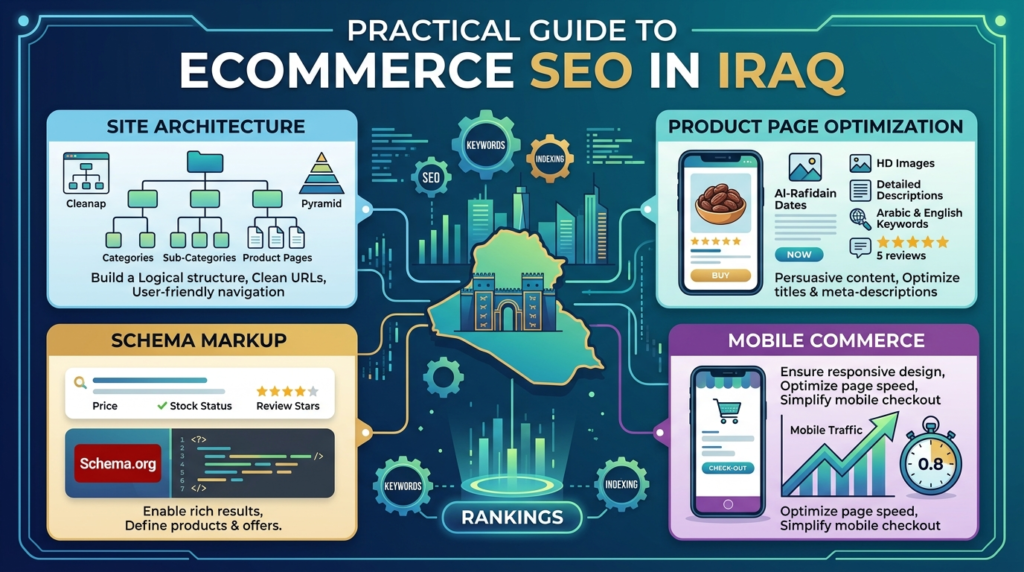
Search engines and shoppers both rely on clear category structure to understand what a store sells and how products relate to each other. A well-planned hierarchy — broad categories branching into specific subcategories, each with its own optimized page — helps Google understand the full scope of a catalog and helps shoppers navigate efficiently, both of which directly support ranking potential across any serious ecommerce SEO Iraq effort.
Avoiding Common Architecture Mistakes
The most common architecture mistake on Iraqi ecommerce sites is letting the platform generate an unlimited number of filtered and sorted URL variations (by price, by color, by size) without proper canonicalization, creating massive duplicate content issues that dilute ranking signals across near-identical pages. A second common mistake is burying products too deep in the site structure — if a product requires more than three clicks from the homepage to reach, both users and search engines struggle to find it efficiently.
Internal Linking Between Products and Categories
Strong internal linking between related products, categories, and informational content (like buying guides) distributes ranking authority across the site and helps Google understand product relationships. A well-built ecommerce SEO Iraq site links category pages to related categories, product pages to genuinely similar products, and any supporting blog content back to the relevant commercial pages it supports.
Faceted Navigation and Crawl Budget
Filters and sorting options — by size, color, price range — are useful for shoppers but can quietly generate thousands of near-duplicate URLs if left unmanaged, each one consuming crawl budget that could otherwise go toward important pages. Properly configuring which filtered views should be indexable, and which should carry a canonical tag pointing back to the main category page, is one of the more technical but highest-impact parts of ecommerce SEO Iraq site architecture work.
Product & Category Page Optimization
Writing Product Descriptions That Actually Rank
Copying manufacturer descriptions directly is one of the most damaging habits in ecommerce SEO Iraq stores fall into, since it creates content duplicated across potentially hundreds of other stores selling the same product — content Google has already indexed elsewhere and has no reason to rank a near-identical copy highly for. Original product page SEO requires unique descriptions that address what an Iraqi shopper specifically wants to know: sizing relative to local expectations, delivery timelines, warranty details, and practical use cases, not just a repackaged spec sheet.
Category Pages Need Content Too
Category pages are frequently left as bare product grids with no supporting content, which is a missed opportunity. A short, genuinely useful introduction to a category — explaining what to look for when choosing between product types, or answering a common pre-purchase question — gives Google meaningful content to rank the page on, beyond just a list of product thumbnails. This small addition is one of the easiest wins in any ecommerce SEO Iraq content plan.
A Quick Product Page Checklist
- Write unique, locally relevant product descriptions rather than reusing manufacturer copy.
- Include clear pricing, availability, and delivery information directly on the page.
- Optimize image file names and alt text with descriptive, relevant terms.
- Add genuine customer reviews where possible, which support both trust and content depth.
Schema for Products
Why Product Schema Matters?
Product schema markup tells Google exactly what a page represents — price, availability, ratings, and product details — which enables rich snippets in search results showing star ratings, price, and stock status directly in the listing. These enhanced results consistently earn higher click-through rates than standard listings, giving a schema-optimized product page a real competitive edge even before a shopper reaches the site. This is one of the more technical layers of ecommerce SEO Iraq work, but also one of the highest-leverage, since it improves conversion at the search results page itself, before any click happens.
Implementing Schema Correctly
Product schema needs to stay accurate and current — a price or availability field that doesn’t match what’s actually on the page can trigger warnings in Google Search Console and reduce trust in the markup over time. For Iraqi stores selling in multiple currencies or managing frequent stock changes, this makes automated schema generation tied directly to inventory data far more reliable than manually maintained markup, and it’s a detail worth getting right before scaling any broader ecommerce SEO Iraq effort.
Google Shopping Considerations
Structured, accurate product schema also supports eligibility for Google Shopping listings, which represent another largely untapped visibility channel for Iraqi ecommerce stores. Even businesses not currently running paid Shopping campaigns benefit from having correct product schema in place, since it’s foundational infrastructure either strategy depends on.
Mobile Commerce SEO
Why Mobile Performance Is Non-Negotiable for Iraqi Stores?
A large share of ecommerce browsing and purchasing in Iraq happens on mobile devices, often over inconsistent network conditions. A slow-loading product page doesn’t just hurt rankings through Core Web Vitals — it directly costs sales, since mobile shoppers abandon slow pages before ever seeing the product. Any ecommerce SEO Iraq strategy that treats mobile as secondary to desktop is optimizing for the wrong majority of its actual traffic, and it’s one of the fastest ways an otherwise well-optimized store loses conversions it should be winning.
Checkout and Navigation on Mobile
Beyond raw page speed, mobile usability extends to how easily a shopper can navigate categories, apply filters, and complete checkout on a small screen. A store with excellent SEO driving mobile traffic to a checkout flow that’s difficult to complete on a phone is solving only half the problem — ranking well is worthless if the resulting visit doesn’t convert.
How to Rank an Ecommerce Site in Iraq: Bringing It Together?
Businesses asking how to rank an ecommerce site in Iraq should treat mobile performance, clean site architecture, unique product content, and accurate schema as interdependent parts of a single strategy, not separate checkboxes. An ecommerce SEO checklist that covers all four areas consistently outperforms isolated fixes applied one at a time.
Creative 4 All builds ecommerce SEO Iraq strategies as part of comprehensive SEO services in Iraq engagements, working directly with the eCommerce team whenever site architecture or platform-level changes are needed alongside content and technical SEO work.
Request a Free Audit to see exactly where your online store’s SEO stands today, and what a realistic path to organic ranking looks like for your product catalog.
FAQs
Ecommerce sites deal with far more pages, greater duplicate content risk from product variations and filters, and a stronger emphasis on product-level schema and commercial intent, compared to the more limited page count and informational focus of a typical service business site — which is exactly why ecommerce SEO Iraq work requires its own dedicated approach.
Yes. Product schema supports rich snippets in organic search results even without any paid Shopping campaign, and it builds the structured data foundation needed if Shopping ads become part of the strategy later.
Yes, always. Reusing manufacturer copy creates duplicate content that Google has typically already indexed elsewhere, giving your page little reason to rank. Unique, locally relevant descriptions perform significantly better.
Allowing the platform to generate unlimited filtered and sorted URL variations without proper canonicalization, which creates widespread duplicate content and dilutes ranking signals across near-identical pages.
Similar to other SEO work, early indexation and impression signals typically appear within two to three months, with meaningful organic traffic and sales impact building from month four onward, depending on the competitiveness of the specific product categories targeted.