
A website can have excellent content, a clear service offering, and genuine expertise behind it — and still rank nowhere on Google, simply because of technical problems Google’s crawlers ran into before ever reading a single word. That’s why a technical SEO audit always comes before content work, not after it. If your site has been live for a while without meaningful organic traffic, the issue is very often technical, not content-related.
This checklist walks through exactly what a proper technical SEO audit covers, why each item matters specifically for Iraqi business websites, and what to actually check first if you’re doing this yourself before bringing in outside help.
What a Technical SEO Audit Covers?
The Four Core Areas
A complete technical SEO audit isn’t a single check — it’s an evaluation across four connected areas: crawlability and indexability (can Google find and store your pages), site performance (how fast and stable the experience is), mobile usability (how the site behaves on the devices most Iraqi visitors actually use), and structural health (broken links, duplicate content, and misconfigured technical settings). Weakness in any one area can undermine strong performance in the others, which is exactly why a genuine technical SEO audit treats these four areas as interconnected rather than reviewing them in isolation.
Why This Matters More for Newer Iraqi Websites?
Many Iraqi business websites were built quickly, often by generalist developers focused on visual design rather than search performance. That’s not a criticism — it’s simply a common starting point — but it means technical debt tends to accumulate unnoticed until a website SEO audit Iraq businesses eventually run reveals a long list of avoidable issues that have quietly been suppressing visibility for months or years.
A Real Example of What Gets Missed
Consider a Baghdad-based logistics company that had invested heavily in content — detailed service pages, a blog, case studies — yet organic traffic stayed flat for over a year. A technical SEO audit revealed the actual problem had nothing to do with the content itself: the site’s robots.txt file, left over from a staging environment during a redesign, was quietly blocking Google from crawling nearly a third of the site’s pages. Once corrected, indexation and organic visibility began improving within weeks — not because any content changed, but because Google could finally see what was already there. This is precisely why a technical SEO audit should be the first step, not an afterthought, whenever a site underperforms despite strong content.
Crawlability & Indexability
Confirming Google Can Actually Find Your Pages
The starting point of any technical SEO audit is verifying that Google Search Console shows your key pages as indexed. A page that isn’t indexed cannot rank, regardless of its content quality. Checking the “Pages” report in Search Console for excluded or error pages is the fastest way to catch this early, and it’s typically the very first step in any structured technical SEO audit process.
Robots.txt and XML Sitemap Checks
A misconfigured robots.txt file can accidentally block Google from crawling entire sections of a site — a surprisingly common issue on sites migrated between platforms or redesigned without a technical review. Alongside this, confirm the XML sitemap is present, accurate, and submitted in Search Console, since it’s the map Google uses to discover new and updated pages efficiently.
A Quick Crawlability Checklist
- Confirm robots.txt isn’t blocking important pages or sections.
- Verify the XML sitemap is submitted and free of errors in Search Console.
- Check for orphan pages — pages with no internal links pointing to them.
- Review canonical tags to ensure they point to the correct preferred URL.
Core Web Vitals for Iraqi Mobile Users
Why Core Web Vitals Matter More in This Market?
Core Web Vitals are Google’s set of performance metrics measuring loading speed, interactivity, and visual stability. They factor directly into rankings, and they matter disproportionately for Iraqi audiences because a large share of traffic arrives on mobile connections that are often slower or less consistent than fixed broadband. A site that performs adequately on a fast office connection can perform poorly for the exact audience it’s trying to reach.
The Metrics Worth Checking
Running a page through Google’s PageSpeed Insights tool reveals the specific Core Web Vitals scores for both mobile and desktop. The categories worth prioritizing in a technical SEO audit are loading performance (how quickly the main content becomes visible), interactivity (how quickly the page responds to a tap or click), and visual stability (whether elements shift unexpectedly while loading, which is a common and frustrating issue on image-heavy business sites). Any technical SEO audit that skips these three metrics in favor of generic speed scores alone is missing the details Google actually ranks on.
Practical Fixes That Move the Needle
Image compression is usually the single highest-impact fix available, since unoptimized images are the most common cause of slow loading on Iraqi business sites — particularly for eCommerce catalogs and portfolio-heavy service pages. Beyond that, reducing unnecessary third-party scripts, enabling browser caching, and choosing hosting with servers geographically closer to the target audience all contribute meaningfully to a faster experience.
Common Technical Issues on Iraqi Business Sites
Duplicate Content Across Language Versions
Sites planning or running both English and Arabic versions frequently run into duplicate content issues when hreflang tags are missing or misconfigured, causing Google to treat two language versions of the same page as competing duplicates rather than distinct language targets. This is a critical checkpoint in any technical SEO audit for a bilingual Iraqi site.
Missing or Duplicate Metadata
It’s common to find pages sharing identical title tags and meta descriptions, particularly on sites where pages were cloned from a template and never individually customized. This weakens each page’s ability to stand out both in search results and in Google’s own relevance evaluation — and it’s one of the fastest issues to spot in even a basic technical SEO audit, since it simply requires scanning the site’s title tags for repeats.
Slow Server Response and Hosting Issues
Hosting quality has an outsized impact on technical SEO that’s easy to overlook. A server with slow response times or frequent downtime directly affects Core Web Vitals scores and, in more serious cases, can affect crawl frequency if Google’s systems repeatedly encounter timeouts. Any thorough technical SEO audit should include a basic hosting and uptime review before assuming an issue is purely a matter of on-page configuration.
Structured Data and Schema Gaps
Many Iraqi business sites either skip structured data entirely or implement it incorrectly, missing an opportunity to help Google understand exactly what a page represents — a service, a local business, an article, a product. While schema isn’t a direct ranking factor on its own, it improves how a page can be understood and displayed, which matters increasingly as AI-driven search tools rely on clearly structured content. Reviewing existing schema markup for errors, and identifying where it’s missing entirely, belongs in any complete technical SEO audit.
A Quick Common Issues Checklist
- Check hreflang implementation on any bilingual or multilingual pages.
- Scan for duplicate title tags and meta descriptions across the site.
- Test server response time and confirm hosting uptime reliability.
- Look for broken internal or external links using a crawling tool.
- Confirm HTTPS is properly implemented sitewide, with no mixed-content warnings.
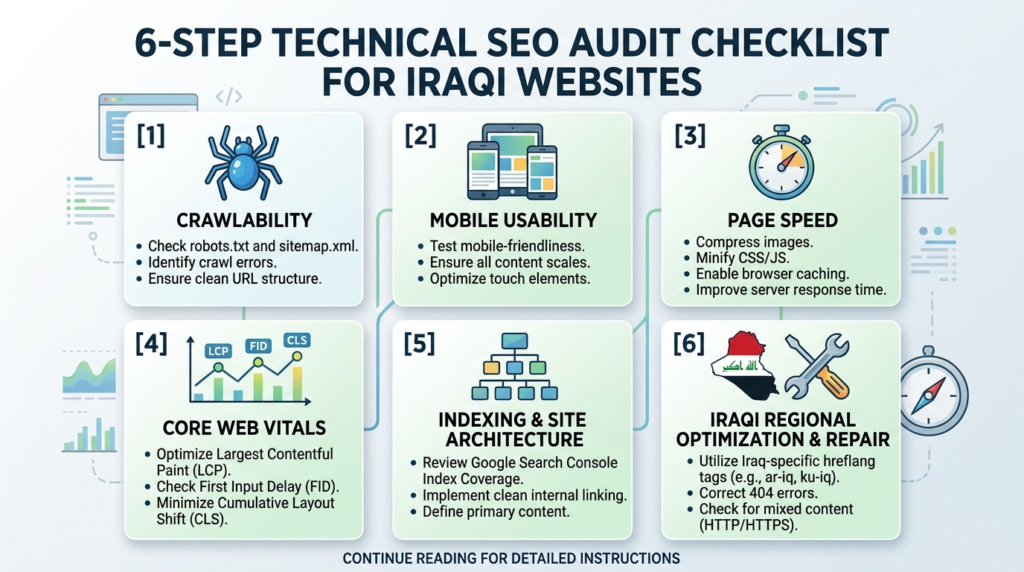
Downloadable Checklist
How to Do a Technical SEO Audit Yourself?
For a business owner or IT manager wondering how to do a technical SEO audit without outside help, the realistic starting sequence is: check indexation status in Search Console, run PageSpeed Insights on your three most important pages, scan for duplicate metadata, and confirm mobile usability manually by browsing the site on an actual phone over a mobile connection, not just a fast office Wi-Fi network. This won’t replace a full professional technical SEO audit, but it will surface the most common and most damaging issues quickly.
When a Free SEO Audit Checklist Isn’t Enough?
A free SEO audit checklist like this one is genuinely useful for catching obvious problems, but a full technical audit typically goes deeper — analyzing crawl budget efficiency, structured data implementation, JavaScript rendering issues, and competitive technical benchmarking against sites already ranking for your target terms. If your site has meaningful commercial value riding on its search visibility, that deeper layer is usually worth the investment.
Creative 4 All performs full technical SEO checklist-driven audits as the starting point for every SEO audit engagement, often working alongside the web design and development team when technical issues trace back to the platform or build itself rather than configuration alone.
Request a Free Audit to get a genuine technical breakdown of your site’s crawlability, speed, and mobile performance — not a generic automated report, but a review specific to what’s actually holding your Iraqi business website back.
FAQs
A complete technical SEO audit covers crawlability and indexability, Core Web Vitals and site speed, mobile usability, and structural issues like duplicate content, broken links, and metadata problems.
Common warning signs include pages missing from Google Search Console’s index, slow PageSpeed Insights scores, inconsistent rankings despite decent content, and a high bounce rate specifically on mobile traffic.
A checklist catches the most common and visible issues, which is a solid starting point. A professional audit goes further, identifying deeper technical patterns and benchmarking against actual competitors — worth it once meaningful traffic or revenue depends on search visibility.
Most established sites benefit from a full audit every six to twelve months, with lighter monitoring in between through Search Console. Sites undergoing redesigns, platform migrations, or the addition of new language versions should be audited immediately after those changes.
Yes, and often more than in markets with faster average connection speeds. Because a large share of Iraqi traffic is mobile and network conditions vary more, sites that perform poorly on Core Web Vitals lose both ranking potential and real visitors before content quality even comes into play.