
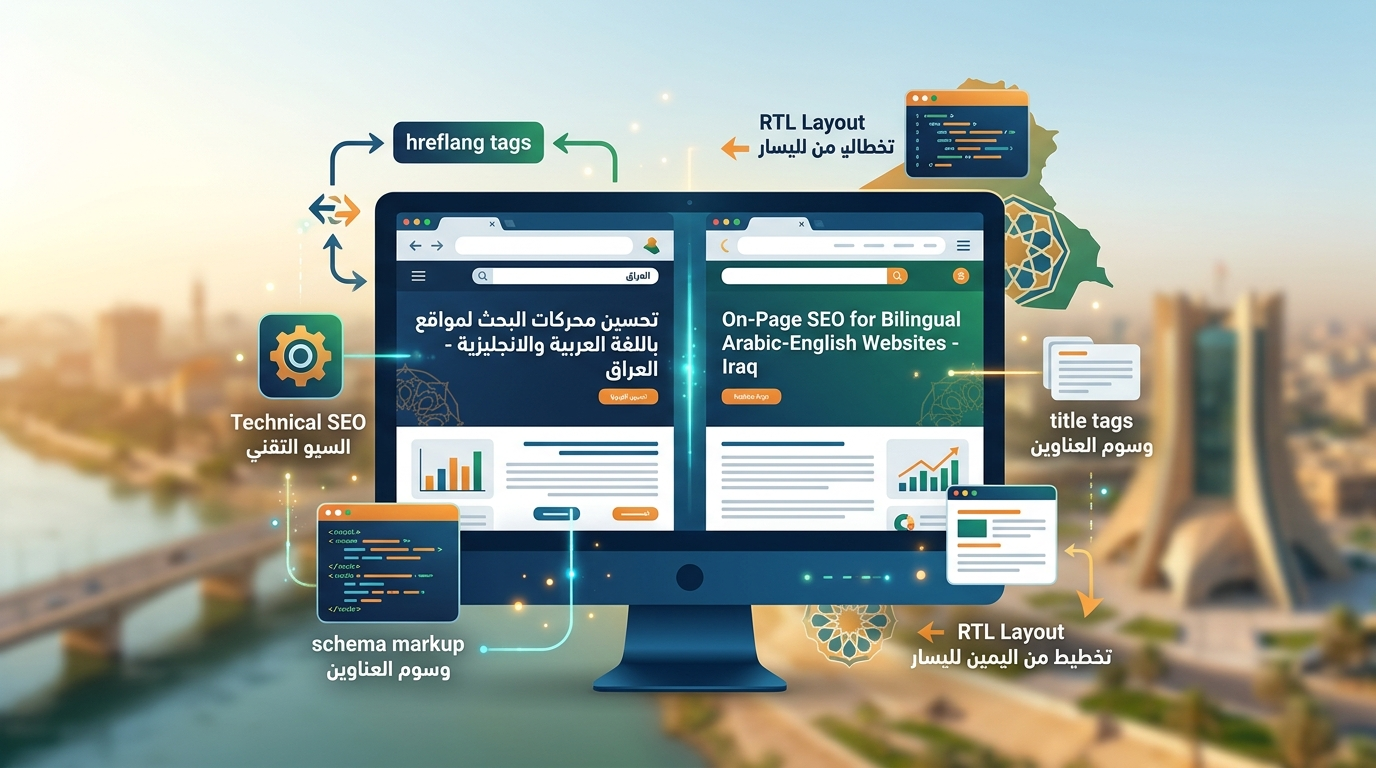
Most on-page SEO guides are written for single-language websites, which makes them only partly useful for Iraqi businesses running — or planning — both an Arabic and an English version of their site. Bilingual on-page SEO introduces a set of technical and content decisions that a standard English-only guide never addresses: which language a title tag should prioritize, how hreflang tags prevent Google from treating two language versions as duplicates, and how right-to-left layout affects on-page structure and readability.
This guide covers on-page SEO specifically for Arabic-English bilingual websites — the exact situation most Creative 4 All clients face today or will face as the Iraqi site’s Arabic expansion moves forward. If your site currently serves one language but Arabic is on the roadmap, the decisions covered here are easier to get right from the start than to retrofit later.
On-Page SEO Fundamentals
What On-Page SEO Actually Covers?
On-page SEO refers to everything on an individual page that can be optimized to help it rank and to help users understand it quickly: title tags, headings, meta descriptions, body content structure, internal links, and image alt text. It sits alongside technical SEO (site-wide infrastructure) and off-page SEO (backlinks and external signals) as one of the three core pillars of a complete SEO strategy — but on-page SEO is the pillar most directly controlled by whoever is managing the page itself.
Why Bilingual Sites Need a Different Approach?
A single-language on-page SEO checklist assumes one target audience, one search behavior pattern, and one content structure. A bilingual Arabic-English site has two of each, and treating the Arabic version as a simple translation of the English on-page elements — rather than an independently optimized version — is one of the most common and costly mistakes Iraqi businesses make when expanding into Arabic search.
A Practical Example of the Cost of Getting This Wrong
Consider a Baghdad-based real estate company that launched an Arabic version of its site by translating the English pages directly — same title tag structure, same meta descriptions, same H2 headings, just rendered in Arabic. Six months later, the English site was ranking respectably for its target terms, but the Arabic version was barely indexed and generated almost no organic traffic. A review found the Arabic title tags used stiff, overly literal phrasing that didn’t match how Iraqi Arabic speakers actually search for real estate, and the hreflang tags connecting the two versions were missing entirely, leaving Google uncertain which version to show to which searcher. Rebuilding the Arabic on-page SEO independently — researched keywords, natural phrasing, and correct hreflang — turned around visibility within a few months. The lesson holds broadly: bilingual on-page SEO fails most often not from lack of effort, but from treating the second language as an afterthought rather than its own optimization project.
Bilingual Title Tags & Meta Descriptions
Writing Title Tags That Work in Both Languages
Title tags should be written independently for each language version, not translated word-for-word, since strong on-page SEO treats each language as its own optimization target. English commercial searches in Iraq often favor direct, keyword-forward phrasing (“Web Design Company Iraq”), while Arabic searches frequently favor more natural, conversational phrasing that a literal translation can miss entirely. Each title tag still needs to stay under roughly 60 characters, include the primary keyword for that language version, and accurately represent the page content — the constraints are the same, but the actual wording has to be developed separately.
Meta Descriptions That Match Local Search Behavior
The same principle applies to meta descriptions. A meta description translated directly from English into Arabic frequently reads stiffly and misses the phrasing an actual Iraqi Arabic searcher would recognize. Writing the Arabic meta description as its own piece of persuasive, benefit-driven copy — rather than a translation exercise — consistently produces better click-through rates from Arabic search results.
A Quick Bilingual On-Page Checklist
- Write title tags and meta descriptions independently for each language, not translated.
- Confirm each language version targets keywords researched specifically for that language.
- Keep character limits consistent across both versions (roughly 60 characters for titles, 160 for descriptions).
- Verify H1 tags on each language version include that language’s primary keyword naturally.
Internal Linking as Part of On-Page SEO
Internal links are also part of on-page SEO, and bilingual sites need a clear rule for handling them: English pages should link to other English pages, and Arabic pages should link to other Arabic pages, rather than mixing languages within a single page’s contextual links. This keeps the user experience coherent in each language and helps Google understand the two site structures as parallel, complete language versions rather than a fragmented mix.
Image Alt Text in Two Languages
Alt text — the written description attached to an image for accessibility and SEO — is another on-page element that needs independent treatment per language. An English page’s alt text should describe the image in English, matching that page’s keyword context, while the Arabic version needs its own accurately written Arabic alt text rather than a duplicated or auto-translated string, which search engines and screen readers alike can render awkwardly.
hreflang for Arabic/English Sites
What hreflang Actually Does?
The hreflang tag tells Google which language and regional version of a page to show to a given searcher, and — critically — tells Google that two pages in different languages are alternate versions of the same content rather than duplicate or competing pages. Without correct hreflang implementation, Google may show the wrong language version to a searcher, or worse, treat the Arabic and English pages as separate pages competing against each other for the same ranking signals.
Common hreflang Mistakes on Iraqi Sites
The most frequent implementation error is a missing or incomplete reciprocal link — hreflang tags need to reference each other from both directions (the English page pointing to the Arabic version, and the Arabic page pointing back to the English version). A second common mistake is using incorrect language-region codes; for Arabic content targeting Iraq specifically, the correct code is typically
ar-IQ
rather than a generic
ar
tag, which helps signal the Iraqi market specifically rather than a general Arabic-speaking audience. Both mistakes are easy to introduce during a redesign and easy to miss without a dedicated on-page SEO review afterward.
hreflang for Arabic English Sites in Practice
Getting hreflang for Arabic English sites right generally requires either a technical SEO review during implementation or a platform that handles hreflang generation automatically and correctly. Testing hreflang implementation through Google Search Console’s International Targeting report is the most reliable way to catch errors before they suppress visibility in either language.
RTL Considerations
Why Right-to-Left Layout Affects On-Page SEO?
Arabic reads right-to-left (RTL), which affects far more than visual direction — it changes how headings, lists, and content hierarchy should be structured for both usability and, indirectly, SEO performance. A page that simply mirrors an English left-to-right layout without genuine RTL support often creates a confusing reading experience, which increases bounce rate and signals poor user experience to Google over time.
Practical RTL On-Page Elements
Beyond layout direction, RTL considerations extend to how breadcrumbs, navigation menus, and even number formatting should display for Arabic users. Headings and body text need proper RTL text alignment rather than simply flipping a left-to-right template, and any icons or directional visual elements (arrows, progress indicators) typically need mirroring to remain intuitive for RTL readers.
Testing RTL Pages Properly
The most reliable way to catch RTL on-page issues is to review the Arabic version of a page independently, on an actual device, rather than assuming a responsive template automatically handles RTL correctly. Many website builders and themes claim RTL support but implement it inconsistently across page templates, particularly for blog layouts and forms — making manual review a necessary part of any thorough on-page SEO process for bilingual sites.
Schema Markup Basics
Why Schema Matters for On-Page SEO?
Schema markup is structured data added to a page’s code that helps Google understand exactly what the content represents — a service, a local business, an article, a set of FAQs. It doesn’t directly boost rankings on its own, but it improves how a page can be displayed in search results (through rich snippets) and how clearly AI-driven search tools can extract accurate information from the page, which is an increasingly important dimension of modern on-page SEO.
Schema for Bilingual Pages
Schema markup should be implemented separately on each language version, describing that specific page’s content in that specific language, rather than duplicating identical schema across both. For a bilingual business page, this typically means separate
Service
or
LocalBusiness
schema blocks on the Arabic and English versions, each with locally accurate business details rather than a copy-pasted English block translated only in the visible text.
Getting Started Without Overwhelming the Team
Not every page needs every schema type. For most Iraqi business sites, prioritizing
Organization
schema sitewide,
Service
schema on core service pages, and
FAQPage
schema on articles with a genuine FAQ section covers the highest-impact use cases without requiring a full technical overhaul — a manageable starting point for on-page SEO teams without dedicated developer resources.
Bringing It Together
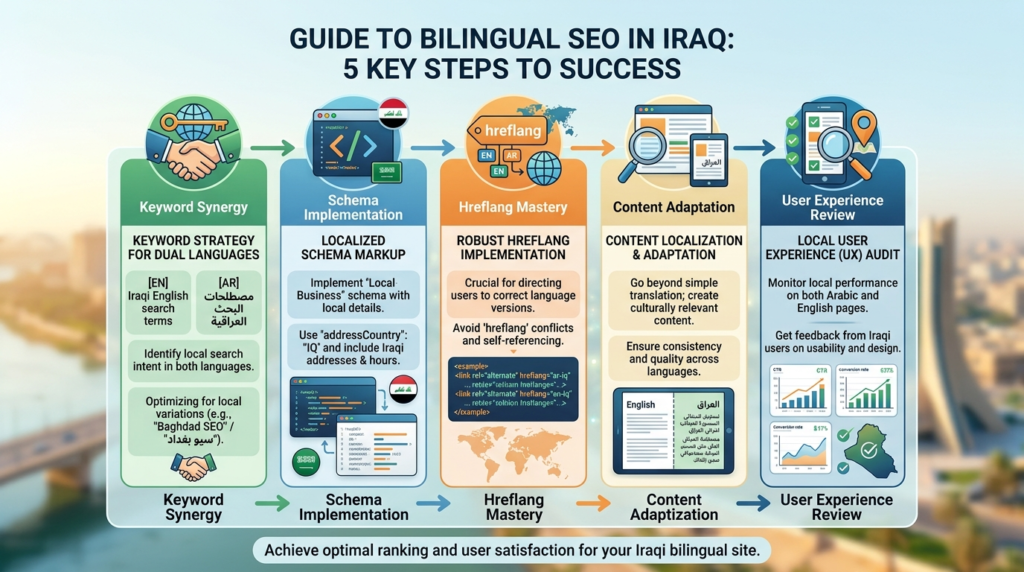
Strong on-page SEO on a bilingual Arabic-English site isn’t simply English best practices applied twice. It requires independently researched keywords, independently written title tags and meta descriptions, correctly implemented hreflang, genuine RTL support rather than a mirrored template, and language-specific schema markup. Getting these fundamentals right early avoids the more expensive rebuild that typically happens when a business launches an Arabic site as an afterthought rather than a parallel, equally considered version.
Creative 4 All builds on-page SEO Iraq strategies for both English and Arabic site versions as part of full SEO services in Iraq engagements, working closely with the web design and development team whenever RTL layout or hreflang implementation requires platform-level changes rather than content adjustments alone.
Request a Free Audit to see exactly how your current on-page SEO — and your hreflang setup, if you’re already running a bilingual site — is performing today.
FAQs
On-page SEO covers content-level elements like title tags, headings, and meta descriptions that a content manager can typically control directly. Technical SEO covers site-wide infrastructure — crawlability, site speed, and server configuration — that usually requires developer involvement.
No. Direct translation frequently misses how Arabic search behavior actually differs from English search behavior. Independent keyword research and independently written title tags, meta descriptions, and content produce meaningfully better results than translation alone.
Without correct hreflang, Google may show searchers the wrong language version, or treat the Arabic and English pages as competing duplicate content rather than complementary language versions — both of which suppress visibility in one or both languages.
Both. Poor RTL implementation creates a confusing user experience that increases bounce rate and reduces engagement — signals Google’s systems factor into how a page performs over time, even though RTL itself isn’t a direct ranking factor.
Yes, implemented separately for each language rather than duplicated. Each version should accurately describe that page’s content in its own language, not reuse identical schema translated only in the visible page text.