
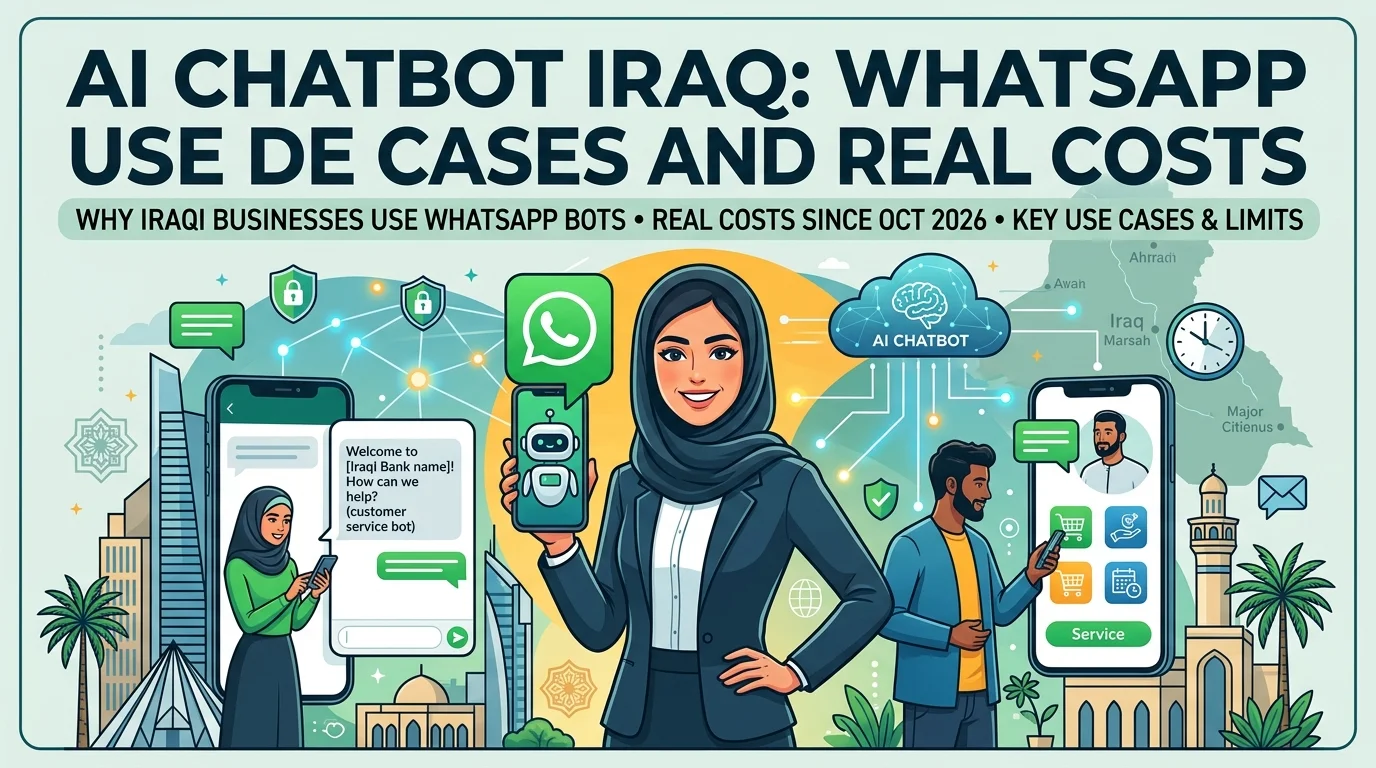
If your business gets a steady flow of WhatsApp messages — the same questions about prices, opening hours, delivery, and availability, many of them arriving late at night — you’ve probably wondered whether software could answer some of them. An AI chatbot Iraq businesses can actually deploy is a real option today, but the details matter: what it can handle, what it costs, which rules WhatsApp applies, and where it should hand over to a person. And one of those details changed very recently. On 1 October 2026, WhatsApp began charging for the replies that chatbots and agents send inside a customer conversation, which makes older cost advice out of date.
This guide covers why WhatsApp-based chatbots suit the Iraqi market, the use cases that work best, what the current costs actually consist of (including the October 2026 pricing change), a realistic implementation timeline, and the limitations worth understanding before you build anything.
Why WhatsApp-Based Chatbots Fit the Iraqi Market?
Enquiries Already Happen on WhatsApp
For many Iraqi businesses, WhatsApp is the dominant enquiry channel. Customers message to ask about price, check availability, confirm delivery, or book a visit, often before or instead of filling in a web form. A WhatsApp chatbot Iraq customers can message needs no new app to download and no new habit to learn, because it meets people in the channel they already use.
The Problem a Chatbot Actually Solves
The real pain isn’t a lack of messages; it’s response time and repetition. Staff spend hours answering identical questions, and enquiries that arrive after hours wait until morning, by which time some customers have moved on. A well-built bot answers routine questions instantly, collects the details a person needs, and passes real conversations to staff.
Where the Free Starting Point Is Enough?
Before building anything, check whether the free WhatsApp Business App covers your need. It offers basic automation such as greeting messages, away messages, and saved quick replies, which handle a surprising share of simple situations at no extra cost. A chatbot becomes worth considering when volume, speed, or complexity outgrows those basics.
Common Use Cases (Lead Qualification, FAQs, Booking)
Answering Frequently Asked Questions
The simplest and safest use: instant, consistent answers about hours, locations, prices, delivery areas, and policies. The bot draws on a fixed set of approved information, which keeps answers accurate and on-brand.
Lead Qualification
For businesses where an enquiry is the start of a sale — real estate, education, vehicles, B2B services — a bot can ask the questions a salesperson would ask first: what are you looking for, what’s your budget range, which area, when do you need it. It then hands a prepared lead to the right person, so staff spend their time on serious prospects.
Appointments and Bookings
Clinics, salons, and service businesses can let customers request a time slot, confirm it, and receive a reminder through the same chat, reducing missed appointments and phone tag.
Order Status and After-Hours Cover
An ecommerce store or restaurant can let customers check an order’s status, and any business can give customers an immediate, accurate reply outside working hours instead of silence until morning.
A Practical Example
Consider a Baghdad dental clinic that receives dozens of WhatsApp enquiries a day, most asking about treatment prices, opening hours, and available appointments. A bot answers the standard questions instantly, offers available time slots, collects the patient’s name and preferred time, and passes the request to reception for confirmation. Staff stop retyping the same answers, and enquiries that come in at night get an immediate reply. Complicated medical questions are routed straight to a human, not answered by the bot.
A Quick Use-Case Fit Checklist
- Do you receive many repetitive enquiries that have clear, stable answers?
- Do enquiries arrive outside working hours that currently wait for a reply?
- Is there a clear point where a human should take over?
- Can you list the approved information the bot is allowed to share?
Realistic Cost Ranges
Why This Guide Won’t Quote a Build Price?
AI chatbot Iraq projects range from a simple FAQ bot to a system connected to your booking calendar, CRM, and order database, and quoting one figure would mislead. What we can do is show you every line a real quote should contain, and give you the one cost component that is publicly documented: WhatsApp’s own messaging charges.
What WhatsApp Charges Since October 2026?
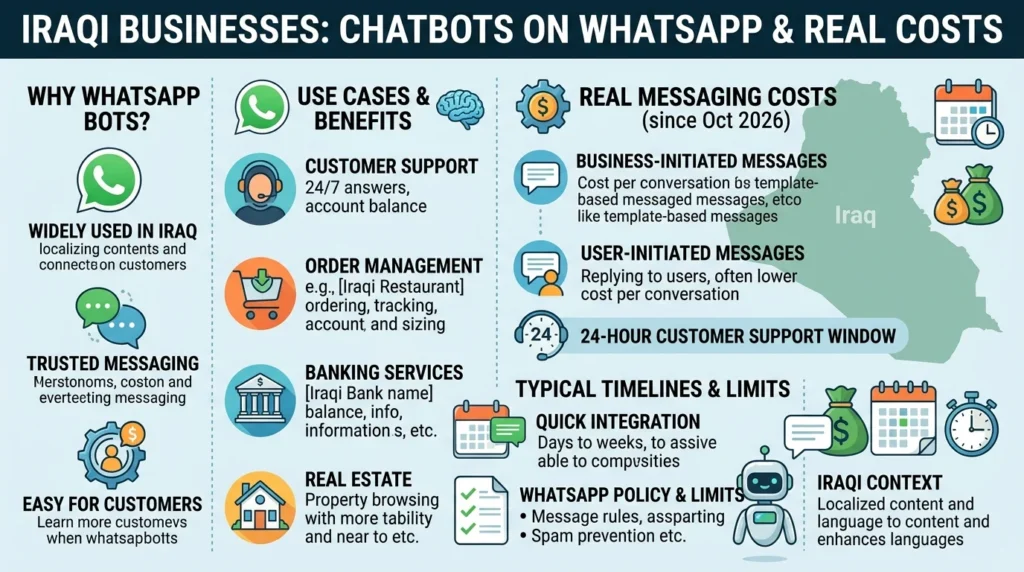
Meta’s pricing documentation states that, effective 1 October 2026, service messages — the free-form replies a business sends inside the 24-hour window after a customer messages first — are charged per message, whether a person or a bot sends them. Each business phone number gets a free tier of 1,000 service messages per month. Meta’s documentation also lists Iraq as its own pricing market, and messaging providers report the Iraq rate for service messages at roughly $0.0079 per message, which is under one US cent. Meta can update rates up to quarterly, so confirm the current rate card before budgeting.
What That Means in Practice?
Take an illustrative case: a business whose bot sends 3,000 replies in a month. The first 1,000 are free, and the remaining 2,000 at the reported rate come to roughly $16. That is arithmetic on a provider-reported rate, not a quote, but it shows the messaging charge is usually small compared with the other costs below. Messages customers send to you remain free, and conversations that begin from a click-to-WhatsApp ad on Meta’s platforms get a 72-hour free window, a useful point if you already run Meta ads.
The Other Cost Lines to Ask About
A complete quote should itemize: setup and conversation design (the work of deciding what the bot says and when it hands over); platform or provider fees, since most businesses reach WhatsApp’s business platform through an approved provider; AI model usage fees if the bot uses a language model, which are billed separately from WhatsApp’s charges; integration with your calendar, CRM, or store; and ongoing maintenance as your prices, products, and policies change.
A Quick Cost-Question Checklist
- Is WhatsApp’s messaging cost shown separately from the build and platform fees?
- Are AI model usage costs included, estimated, or left open-ended?
- Who maintains the bot’s information when your prices change, and at what cost?
- What happens to costs if message volume doubles?
Implementation Timeline
What a Realistic Project Looks Like?
A properly built AI chatbot Iraq businesses can rely on takes weeks rather than days, mostly because the technical setup is the smaller part. The work breaks into scoping what the bot should and shouldn’t do, writing and reviewing the approved information it draws on, designing the conversation flows including the handover to staff, setting up the WhatsApp business account with your provider (which typically involves business verification), testing with real example messages, and launching to a small audience first.
Start Small, Then Expand
Launch with the handful of questions that make up most of your volume, watch the real conversations for a few weeks, and fix gaps before expanding. A narrow bot that works beats an ambitious one that fails in front of customers.
Keep Improving After Launch
Real customers ask things you didn’t predict. Reviewing conversations regularly and updating the bot is part of the job, not an optional extra.
Limitations to Know Before Building
Meta’s Rules on AI Assistants
Since early 2026, Meta restricts general-purpose AI assistants on the WhatsApp Business Platform, according to several provider summaries, while business-specific bots that handle customer support, bookings, and similar tasks remain permitted. A bot designed to serve your customers on defined topics fits that. Rules change, so confirm current terms with your provider.
Accuracy and Arabic
Language models can state wrong things confidently, and performance in Arabic, particularly Iraqi dialect, can be less consistent than in English. Keep the bot to approved information, test it on real Arabic messages, and have a native speaker review its answers.
A Human Must Always Be Reachable
Customers who are upset, confused, or ready to buy want a person. Always provide a clear way to reach one, and route sensitive situations — complaints, medical questions, payments — to staff.
Data and Privacy
Customers share personal details in chats. Collect only what you need, be clear about how it’s used, and remember that Iraq’s national AI strategy is still being developed, so it’s wise to handle data conservatively.
When a Chatbot Is Not the Answer?
An AI chatbot Iraq customers actually appreciate is one that solves a real volume problem. If you receive few enquiries, or they’re mostly complex and individual, a bot may add cost without value, and a well-organized team with saved replies may serve you better.
Creative 4 All can help you scope where an AI chatbot would genuinely help your enquiry flow and what it would involve, as part of our digital marketing services, and we’ll tell you honestly if a simpler option is the better fit.
Request a Free Audit to get a chatbot consultation and an honest view of whether a WhatsApp chatbot fits your business.
FAQs
It depends on scope, so a single price would mislead. A quote should itemize setup, provider fees, AI usage, integrations, and maintenance. WhatsApp’s own per-message charges are documented separately: since 1 October 2026, replies are billed per message after 1,000 free per business number each month, at a rate providers report as under one US cent for Iraq.
Yes. Iraq has its own pricing market on the WhatsApp Business Platform, and businesses typically connect through an approved provider. Confirm availability and onboarding requirements with your chosen provider.
It shouldn’t. A good bot handles repetitive questions and after-hours replies and hands real conversations to people, freeing staff for work that needs judgment.
Meta restricts general-purpose AI assistants on the WhatsApp Business Platform, according to provider summaries, so a bot should be built for your business and defined tasks. Check current rules with your provider.
Only if you receive enough repetitive enquiries to justify it. Many small businesses are well served at first by the free WhatsApp Business App’s greeting, away messages, and quick replies.