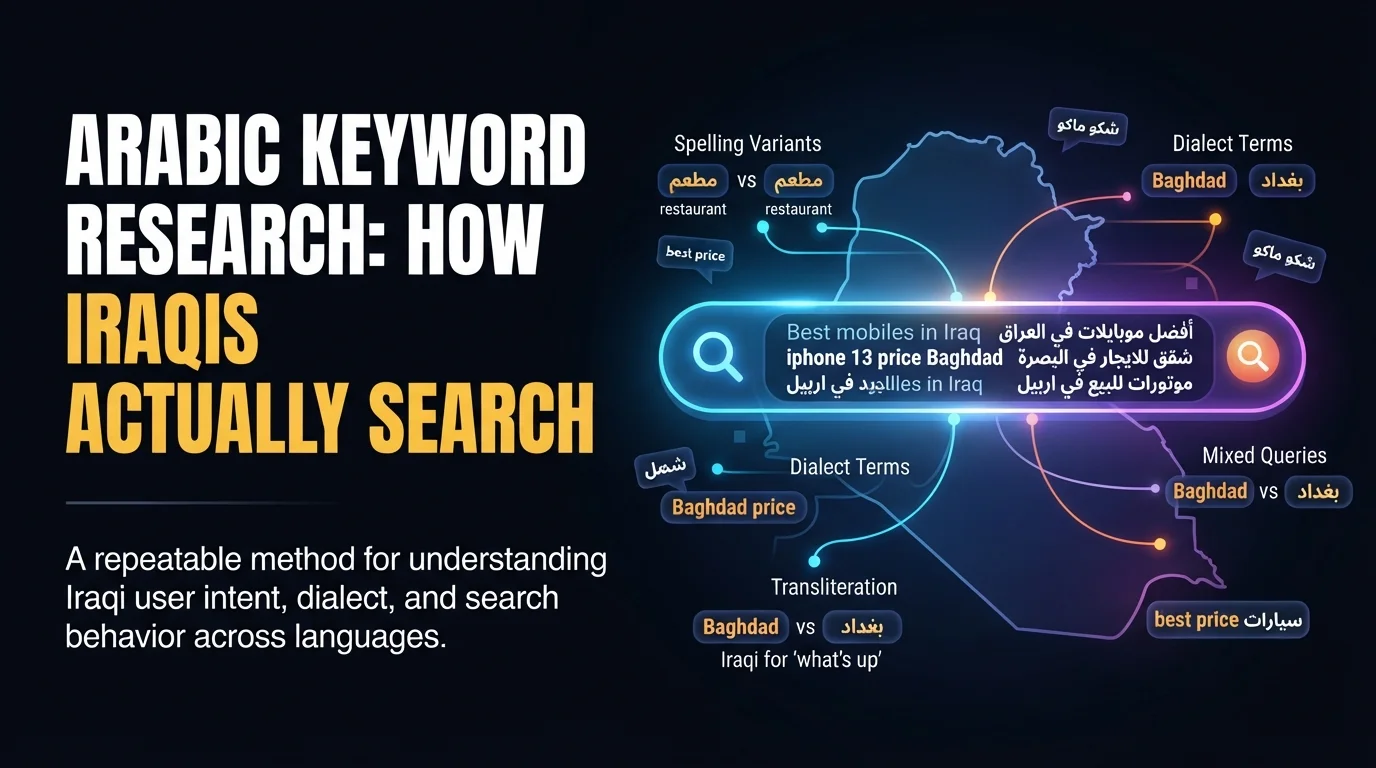
A Baghdad company once asked us why its new Arabic service page had no traffic after six months. The page was well written and technically sound. The problem became obvious within minutes: every keyword had been translated directly from the English site. The page targeted phrases that sounded correct in formal Arabic but that Iraqi customers rarely typed, while ignoring the shorter, mixed, and sometimes transliterated words they actually used. That is the core lesson of Arabic keyword research: you cannot translate your way to the right keywords. You have to find out how people in your market really search.
This guide explains keyword research for Arabic and bilingual websites targeting Iraq. You will learn why translated keywords fail, how Modern Standard Arabic and Iraqi terms appear in search, how to handle spelling variants and transliteration, which tools help and where they fall short for Iraq, and a repeatable process your team can use for every new page.
Why Translated Keywords Fail in Iraq?
Translation produces correct language. Keyword research is about finding real behavior. The two often point in different directions.
Formal Language vs Search Language
A translator rendering “web design company” will produce a grammatically perfect formal phrase. Searchers, however, often type the shortest phrase that gets results, sometimes dropping articles, mixing in English, or using a common colloquial word. A page optimized only for the formal version can miss most of the demand, which is why keyword research must start from real queries.
Different Intent Behind Similar Words
Two Arabic phrases that translate to the same English term may carry different intent. One might be used mainly by students looking for definitions, the other by business owners looking for a provider. Good keyword research checks what the search results actually show for each phrase, because the results reveal intent better than any dictionary.
One English Keyword, Several Arabic Searches
A single English service term often splits into several Arabic searches: formal and informal wording, singular and plural, with and without the definite article, and spelling variations. Treating them as one keyword hides opportunities; treating them as separate pages creates duplication. The skill lies in grouping them correctly.
MSA vs Iraqi Terminology in Search
For keyword research purposes, it helps to know that Iraqi users read and write Modern Standard Arabic comfortably, especially in professional contexts, but everyday searching does not always follow formal usage.
When MSA Dominates?
For professional services, many searches use standard terms, such as the formal words for web design, digital marketing, or search engine optimization. Website copy and service pages usually perform best in clear MSA, because it reads as professional and matches a wide range of queries.
When Local Terms Matter?
Certain commercial behaviors have everyday local vocabulary. For example, paid boosting of social media posts is commonly described in parts of the Arab market with a word meaning “funding” rather than the formal phrase for paid advertising. Terms like this may represent real local search demand, but they should be validated with data before you build pages around them. Strong keyword research treats local terms as hypotheses to test, not assumptions.
Do Not Write Service Pages in Dialect
Using local terms in headings, FAQs, and examples can match real queries, but writing entire service pages in colloquial Iraqi Arabic usually looks unprofessional. Combine MSA body copy with natural local phrasing where your keyword research data supports it.
Spelling Variants and Transliteration
Arabic spelling variation is one of the most overlooked parts of keyword research, and it directly affects how pages match queries.
Hamza and Common Variants
Many users type without the hamza or other diacritics. The word for “electronic,” for example, appears with and without its initial hamza, and both forms are widely searched. Similar patterns affect taa marbuta and alif maqsura endings. Search engines often understand these variants, but not always perfectly, so it helps to use the common forms naturally across your content.
Transliterated Commercial Terms
Iraqi users frequently type English business terms in Arabic letters. “SEO” is commonly written as an Arabic transliteration of the sound, and words like “website,” “design,” “store,” and “logo” all have transliterated forms in everyday use. These transliterated terms can carry real commercial intent and deserve a place in your keyword research.
Group Variants Into One Topic
Spelling variants and transliterations of the same idea should usually live on the same page. Use them naturally in headings, body text, and FAQs rather than creating near-identical pages for each version. Creating separate pages for trivial variations confuses search engines and splits your authority.
Mixed Arabic-English Queries
Mixed queries are common in Iraq, especially among younger users, professionals, and anyone searching for technical services.
Typical Mixed Patterns
Users often combine an English product or service term with an Arabic location or modifier, such as an English service name followed by the Arabic name of a city, or an Arabic question containing an English brand or technical term. These queries reflect how people actually think about the topic, and good keyword research captures them, especially in sectors where English vocabulary is standard.
Writing for Mixed Queries
You do not need separate pages for mixed queries. Instead, include the English technical term alongside the Arabic explanation on your Arabic pages, for example writing the Arabic term followed by the English acronym in parentheses. This matches both pure and mixed searches and helps readers who know only one form. Our guide to on-page SEO for Arabic and English websites covers how to structure bilingual pages without duplication.
Separate English Pages Still Matter
Some audiences search entirely in English: international organizations, foreign partners, oil and gas procurement teams, and many B2B buyers in the Kurdistan Region. Those searches deserve dedicated English pages with their own keyword research, not translations of the Arabic keywords.
Tools for Arabic Keyword Research and Their Limits
No single keyword research tool gives a complete picture of Iraqi search behavior. Use several and treat each one’s data critically.
Google Keyword Planner for Arabic Keyword Research
Keyword Planner lets you set Iraq as the location and Arabic as the language, which makes it a useful starting point. Its volumes are often shown in broad ranges, and low-volume Iraqi queries may appear as zero or be grouped with similar terms. Use it in your keyword research for direction and relative demand rather than exact numbers.
Google Autocomplete, People Also Ask, and Related Searches
Typing seed terms into Google with Iraqi settings reveals autocomplete suggestions, “People also ask” questions, and related searches. These show real phrasing, including variants and questions that tools miss. They are especially valuable for Arabic keyword research because they reflect live behavior.
Google Search Console
If your site already has Arabic pages, Search Console is the most reliable source of all. It shows the exact queries that trigger impressions for your site, including variants you never targeted. Review it monthly and filter by Iraq and by your Arabic URLs; it is the best feedback loop for keyword research.
Third-Party Keyword Research Platforms
Tools such as Ahrefs and Semrush are useful for competitor analysis and keyword ideas, but their Arabic and Iraq-specific data is often thinner than for larger English-language markets. Small volumes may be underreported or missing entirely. Treat their numbers as estimates and cross-check with Google’s own data.
A Repeatable Arabic Keyword Research Process
Use this keyword research process for every new service page or article.
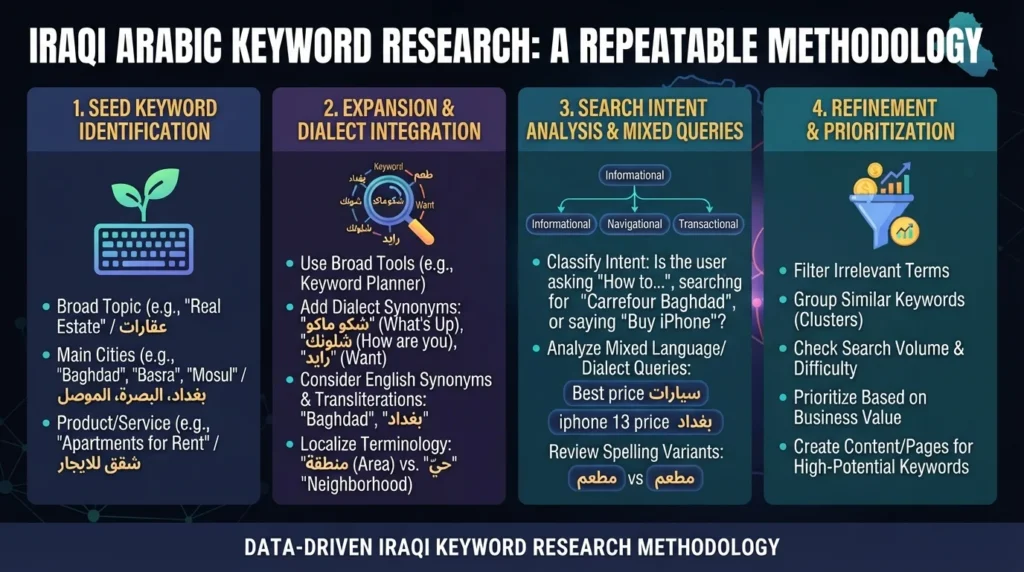
Step 1: Start From the Customer’s Problem
Write down what the customer wants to achieve in plain words, in both Arabic and English. Ask your sales or WhatsApp team how customers describe their needs. These phrases are often better seeds for keyword research than any keyword list.
Step 2: Expand With Variants and Tools
Collect formal and informal wording, spelling variants, transliterations, singular and plural forms, and mixed queries. Run them through Keyword Planner, autocomplete, and People Also Ask with Iraq as the location.
Step 3: Check the Search Results
Search each important phrase and note what ranks: service pages, articles, directories, social profiles, or marketplace listings. This tells you what type of page Google expects. If the results are mostly directories, a service page may struggle; if they are guides, an article may fit better. This step turns raw lists into strategic keyword research.
Step 4: Group and Assign
Group phrases with the same intent and assign each group to one page. Make sure no two pages on your site target the same intent, and decide which page owns each commercial term. Assigning keywords carefully prevents your own pages from competing with each other.
Step 5: Measure and Refine
After publishing, use Search Console to see which queries actually bring impressions and clicks. Add missing variants to the page, update headings where real queries differ from your assumptions, and record what you learn so your next round of keyword research starts smarter.
Common Arabic Keyword Research Mistakes
A few keyword research errors appear again and again:
- Translating English keywords and assuming the result reflects real Iraqi demand.
- Creating separate pages for spelling variants of the same term.
- Ignoring transliterated and mixed queries that carry commercial intent.
- Trusting tool volumes for Iraq as exact rather than directional.
Avoiding these mistakes alone puts most Iraqi websites ahead of their competitors. If you want expert help applying this process to your site, our SEO services in Iraq include native Arabic research.
Frequently Asked Questions About Arabic Keyword Research
It depends on the topic and audience. Consumer and local service searches lean heavily toward Arabic, while technical, B2B, and international business searches often use English or mixed queries. Your keyword research should cover both and decide case by case.
Use local terms where data shows real demand, mainly in headings, FAQs, and examples. Keep the main body of service pages in clear Modern Standard Arabic for professionalism.
Treat them as directional. Many Iraqi queries have modest volumes that tools round to ranges or underreport. Search Console data from your own site is the most reliable measure once you have pages live.
No. Spelling variants and transliterations of the same idea should usually be covered on one page, used naturally throughout the content.
Research the Market, Not the Dictionary
Effective Arabic keyword research starts from how Iraqi customers actually search: formal and local terms, spelling variants, transliterations, and mixed queries. Combine tools with live search results and Search Console data, group phrases by intent, and assign each group to one page. The result is content that matches real demand instead of sounding correct and attracting no one.
If your Arabic pages are not attracting the traffic they should, Creative 4 All can audit your keywords and rebuild your targeting around real Iraqi search behavior. Explore our SEO services in Iraq, read our complete guide to SEO services in Iraq, or request an SEO audit today.