
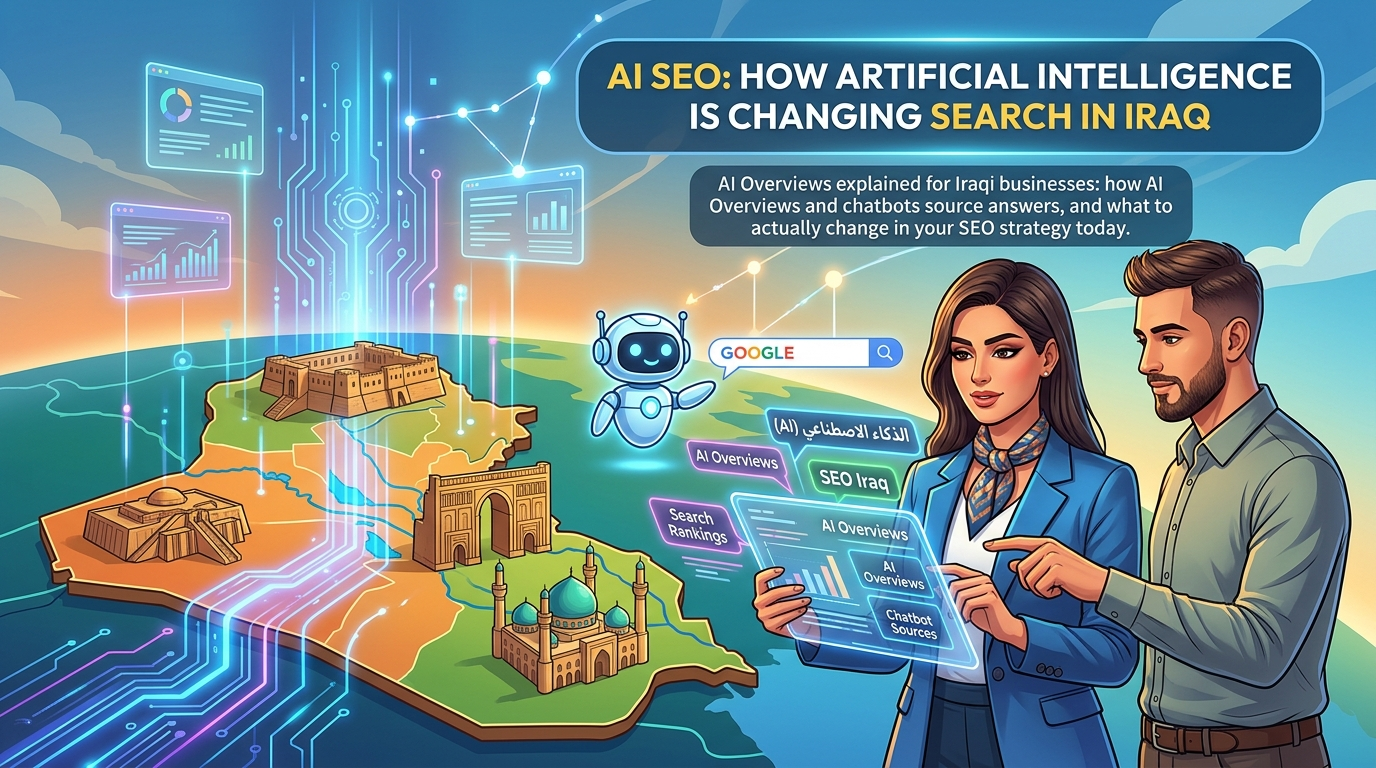
Search no longer means a list of ten blue links. Google’s AI Overviews now answer many queries directly at the top of the results page, and a growing number of people research businesses and services through ChatGPT and similar tools before ever opening a search engine. AI SEO is the practice of adapting to this shift — and for Iraqi businesses, it’s still early enough that genuinely useful, non-hype guidance is rare, which makes this exactly the right moment to build a real understanding rather than reacting later once the shift is fully underway.
This guide covers what AI SEO actually means in practice, how AI Overviews and chatbots source the answers they generate, what specifically needs to change in a content strategy to stay visible, and — just as important — what hasn’t changed despite all the noise around generative search.
What AI Search Means for Iraqi Businesses?
A New Layer, Not a Replacement
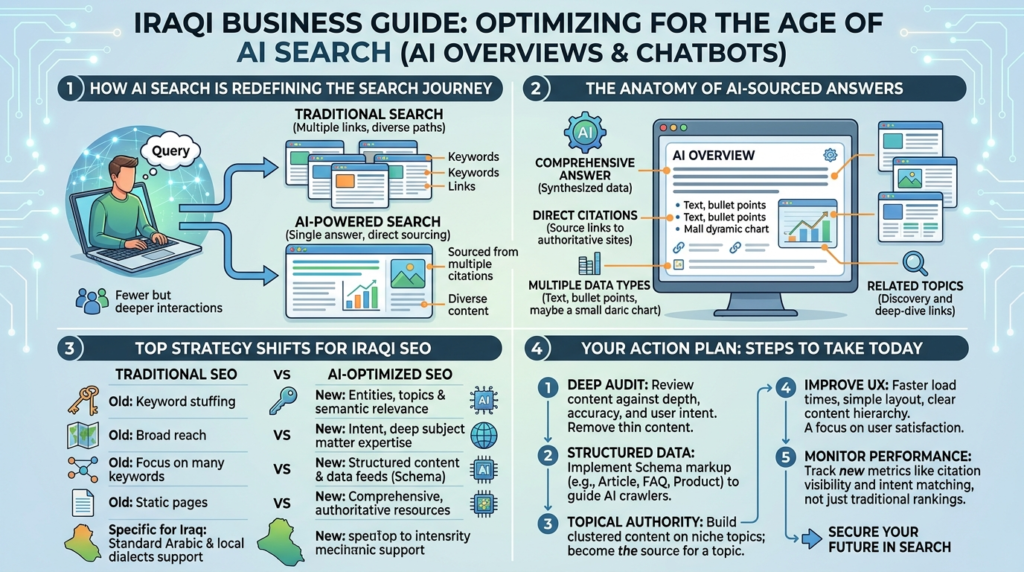
AI Overviews and chat-based search tools represent a new layer on top of traditional search, not a wholesale replacement of it. Traditional organic rankings still matter — in fact, they often feed directly into what AI Overviews draw from — but there’s now an additional visibility target: being the source an AI system cites or summarizes when answering a question relevant to your business. AI SEO is fundamentally about earning visibility in both places at once, not choosing one over the other.
A Practical Example of the Shift
Consider an Iraqi business owner searching “what does a website redesign typically involve” through a chat-based AI tool rather than a traditional Google search. If a web design agency’s blog has a genuinely clear, well-structured article answering exactly that question, there’s a real chance the AI tool surfaces and cites that content directly in its answer — potentially introducing the business to a prospective client who never even visited a traditional search results page. This is the practical opportunity AI SEO represents: a new discovery channel layered on top of, not instead of, traditional organic visibility.
Why This Matters Earlier for Iraq Than It Might Seem?
Because Iraqi search competition remains relatively thin compared to saturated global markets, businesses that build genuinely well-structured, entity-rich content now have a real opportunity to become the source AI systems reference for Iraq-specific business and service queries, before the competitive field catches up. AI search Iraq visibility is, at this stage, still largely unclaimed territory for most commercial categories, which makes early, genuine investment in this area unusually low-risk compared to competing for the same positioning in a more saturated market.
Will AI Replace Google Search?
The honest answer to whether AI will replace Google search is: not in the near term, and not entirely. AI Overviews and chat-based tools are increasingly used for research and quick answers, but transactional searches — finding a specific business, comparing prices, checking hours — still rely heavily on traditional search and maps. The realistic expectation is a blended search landscape, not a full replacement, which is why AI SEO should be treated as an addition to a solid SEO foundation, not a separate strategy built from scratch.
How AI Overviews and Chatbots Source Answers
The Role of Existing SEO Fundamentals
AI Overviews and chatbot search tools largely draw from the same indexed web content that traditional search relies on, meaning the technical SEO, content quality, and authority signals a business has already built remain foundational. A site that isn’t properly indexed or technically sound has little chance of being surfaced by an AI system either, since these tools generally can’t cite what they can’t access and evaluate reliably.
Why Structure and Clarity Matter More Than Ever?
AI systems tend to favor content that answers questions directly and clearly, with information organized in a way that’s easy to extract — clear headings, direct definitions, well-labeled lists, and unambiguous factual statements. Content that buries the actual answer under vague introductions or requires significant inference to understand is harder for an AI system to summarize accurately, even if a human reader would eventually find the answer. This is one of the clearest, most actionable takeaways of practical AI SEO work: clarity isn’t just a stylistic preference anymore, it’s a visibility requirement.
The Growing Importance of Entities
AI-driven search increasingly reasons in terms of entities — specific, identifiable things like a business name, a location, a service category — and the relationships between them, rather than just matching keyword strings. A business that consistently and clearly establishes its identity, services, and location across its website, Google Business Profile, and other credible sources builds the kind of entity clarity that supports both traditional rankings and AI-generated answers. This entity-based thinking is a genuine shift in how search systems interpret a business, and it rewards the same completeness and consistency that good local SEO practice has always recommended.
Structuring Content for AI Visibility
Answer the Question Directly, Early
Content built for SEO for AI answer engines should state the direct answer to the core question near the top of the relevant section, rather than building up to it gradually. This isn’t just good practice for AI extraction — it also improves the experience for human readers who are scanning for a specific answer rather than reading start to finish.
Use Clear, Extractable Formatting
Definitions, step-by-step processes, comparisons, and FAQs are particularly well-suited to how AI systems parse and cite content, since they present information in discrete, clearly bounded units. This doesn’t mean every page should be a bulleted list — narrative content still matters for depth and trust — but genuinely useful structural elements make content more accessible to both AI systems and time-pressed human readers.
Reinforce Facts With Consistency
AI systems build more confidence in factual claims that are consistently stated across multiple credible sources, which reinforces why consistency across a business’s website, Google Business Profile, directory listings, and any press or industry mentions matters more than ever. Contradictory information across sources — a different service list here, an outdated address there — makes it harder for both traditional search and AI systems to confidently represent a business accurately. This consistency requirement connects directly back to the local SEO and citation work covered elsewhere in this content series — it isn’t a new discipline, but the same discipline now serving an additional purpose.
What Doesn’t Change
E-E-A-T Still Matters, Arguably More
Expertise, authoritativeness, and trustworthiness remain foundational, and if anything, matter more in an AI-driven search environment, since these systems are specifically designed to avoid citing unreliable or unverifiable sources. The fundamentals covered elsewhere in this content series — genuine expertise, credible sourcing, avoiding overstated claims — aren’t being replaced by AI SEO considerations; they’re becoming more directly rewarded by them.
Technical SEO Remains the Foundation
Crawlability, site speed, mobile usability, and clean technical structure remain just as important as they’ve always been, since AI systems still depend on being able to access and process a site’s content reliably. No amount of AI-focused content structuring compensates for a site Google’s systems, AI-driven or otherwise, struggle to crawl and index properly.
Genuine Usefulness Still Wins
The businesses that will be favorably cited by AI systems are, unsurprisingly, the ones producing genuinely useful, accurate, well-organized content — the same standard that has always separated strong SEO from thin, low-value content. AI SEO doesn’t introduce a fundamentally new bar for quality; it raises the reward for already meeting it.
Practical First Steps
Where to Start Without Overhauling Everything?
A business doesn’t need to rebuild its entire content strategy to start improving AI SEO readiness. Reasonable first steps include reviewing top existing pages to ensure the core answer appears clearly and early, adding genuine FAQ sections to pages that naturally support them, and verifying that business information is consistent across the website, Google Business Profile, and other public listings. None of these steps require abandoning existing SEO work — AI SEO readiness is largely a refinement of good practices already in place, not a separate project competing for the same time and budget.
How AI Is Changing SEO Over Time?
Understanding how AI is changing SEO is less about a single dramatic shift and more about a gradual raising of the bar for clarity, structure, and verifiable accuracy — changes that benefit any business willing to invest in them now, well ahead of when AI-driven search becomes the default expectation rather than an emerging trend.
Creative 4 All builds AI SEO considerations into every SEO services in Iraq engagement, structuring content for both traditional rankings and emerging AI-driven visibility as part of comprehensive digital marketing in Iraq strategy, not as a separate add-on service.
Read More on the SEO Blog — or subscribe for future insights as AI-driven search continues to develop in the Iraqi market.
FAQs
AI SEO is the practice of structuring content and technical SEO to be favorably surfaced not just in traditional organic search results, but also in AI-generated answers like Google’s AI Overviews and chatbot-based search tools.
No. AI SEO builds on the same technical and content fundamentals as traditional SEO — crawlability, quality content, E-E-A-T — with additional emphasis on clear structure, direct answers, and consistent factual accuracy across sources.
It’s possible for some purely informational queries where the AI answer fully satisfies the search. However, transactional and local searches still typically drive users to a website or business listing, and being cited as a source in an AI answer can itself build brand visibility and trust.
The underlying AI systems work the same way globally, but because competition for AI-citable, well-structured Iraqi business content is currently thin, Iraqi businesses have a genuine early-mover opportunity that’s harder to find in more saturated markets.
The underlying shift — AI-assisted research and answers becoming a normal part of how people search — appears durable rather than a passing trend, making early investment in the fundamentals a reasonable, low-risk strategic choice rather than premature hype-chasing.