
Most articles about PPC settle for a list of generic benefits — “immediate visibility,” “targeted reach,” “measurable results” — without explaining what any of that actually looks like for a business operating specifically in Iraq. PPC Iraq business owners actually need isn’t another list of advantages; it’s a realistic understanding of how paid search actually works, what it genuinely costs, and what results to expect on a timeline grounded in reality rather than a sales pitch.
This guide covers how PPC actually functions mechanically, how Google Ads compares to other paid channels available to Iraqi businesses, what realistically drives campaign costs in this specific market, honest timelines for when results actually show up, and exactly how to get started without wasting budget on a poorly structured first campaign. If you’ve read a list of PPC benefits and still don’t feel ready to actually launch a campaign, this guide is built to close that gap.
How PPC Works?
The Auction Mechanism, Explained Simply
Pay-per-click advertising works through an auction: advertisers bid on specific keywords, and when someone searches one of those terms, an automated auction determines which ads appear and in what order, based on bid amount combined with ad quality and relevance. Understanding that quality matters alongside bid amount is important — a well-targeted, relevant ad can outrank a higher bid from a less relevant competitor.
What You Actually Pay For?
Despite the name, you don’t pay for an ad simply appearing in search results — you pay only when someone actually clicks it. This means impressions (people seeing your ad without clicking) cost nothing directly, though they still contribute to brand visibility, while every click represents real spend regardless of whether that click converts into an inquiry or sale.
Campaign Structure Basics
A PPC account is organized into campaigns, which contain ad groups, which contain the actual ads and the keywords that trigger them. Structuring this hierarchy thoughtfully — grouping closely related keywords together with matching ad copy — produces better relevance scores and lower costs than a loosely organized account throwing many keywords into a single broad campaign.
A Practical Example of Structure Mattering
Consider a Baghdad-based clinic running PPC for the first time, bidding on a mix of terms — “dental clinic Baghdad,” “pediatric doctor Baghdad,” and “physiotherapy Baghdad” — all within a single ad group using one generic ad. Because the ad copy can’t speak specifically to each distinct service, relevance scores suffer across the board, and cost-per-click rises accordingly. Restructuring into separate campaigns for dental, pediatric, and physiotherapy services, each with tailored ad copy matching its specific keywords, typically improves both relevance scores and cost efficiency — the same total budget producing meaningfully better results simply through better organization, before any change to the bidding strategy itself.
Google Ads vs Other Paid Channels
Why Google Ads Is Usually the Starting Point?
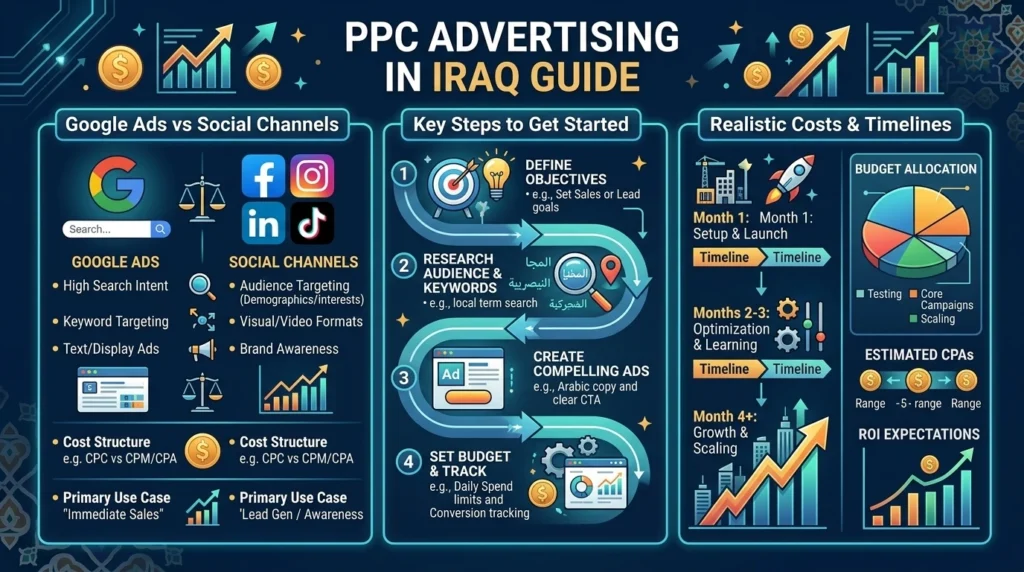
Google Ads captures high-intent search traffic — people actively searching for a specific product or service right now — making it particularly effective for businesses with clear, well-defined commercial search terms. For most Iraqi businesses evaluating paid advertising for the first time, Google Ads represents the most direct path to capturing existing demand rather than needing to generate awareness from scratch.
Social Media Advertising as a Complementary Channel
Social platforms like Facebook and Instagram excel at reaching people who aren’t actively searching but might be receptive to discovering a product or service through visual, interest-based targeting. This makes social advertising more suited to awareness-building and demand generation, complementing rather than replacing the high-intent capture Google Ads provides.
Choosing Based on Business Type
A business with clear, specific search demand — “web design company Baghdad,” for instance — typically sees stronger initial results from Google Ads, while a business with a visually engaging product benefiting from broader discovery might see social advertising deliver comparable or better value, particularly earlier in the customer journey.
What a Campaign Costs in Iraq?
Why This Guide Won’t Quote Specific Numbers?
Cost-per-click varies enormously by industry, keyword competitiveness, and campaign quality, and presenting a single figure would misrepresent the genuinely wide range seen across different Iraqi business categories. Rather than a number that would quickly go stale, this section explains what actually drives cost so any PPC Iraq quote can be evaluated against a realistic framework.
Factors That Drive Cost-Per-Click
Highly competitive commercial terms — where many businesses bid for the same valuable keywords — cost more per click than niche or less contested terms. Industry also matters significantly: categories with high customer lifetime value or high-margin transactions tend to see more competitive bidding, since businesses can justify paying more per click when the potential return is larger.
Budget Allocation and Campaign Scale
Total campaign cost scales with how many keywords are targeted, how much daily or monthly budget is allocated, and how competitive the specific market and terms are. A narrow, well-targeted campaign focused on high-intent local terms can perform efficiently on a modest budget, while broader, more competitive national campaigns typically require correspondingly larger budgets to generate meaningful volume.
Realistic Timelines & Results
How Quickly PPC Actually Generates Results?
Unlike SEO, PPC can generate clicks and traffic within hours of campaign launch, since visibility is purchased rather than earned. However, genuinely optimized performance — refined targeting, tested ad copy, adjusted bidding based on real data — typically takes several weeks of active management to reach its full potential, not a single day of setup.
What Realistic Success Actually Looks Like?
Meaningful PPC success isn’t measured by clicks or impressions alone, but by whether those clicks convert into actual leads or sales at a cost that makes business sense. A campaign generating substantial traffic at a cost per acquisition that exceeds the value of an actual customer isn’t succeeding, regardless of how impressive the traffic numbers look in isolation.
Ongoing Optimization, Not Set-and-Forget
PPC campaigns require ongoing management — reviewing which keywords and ads actually perform, adjusting bids, pausing underperforming elements, and testing new approaches. A campaign launched once and left unmanaged typically underperforms one receiving regular, data-driven optimization.
The Compounding Value of Campaign Data
Every week a campaign runs generates data about which keywords, ad copy, and audience segments actually convert for a specific business — information that becomes more valuable over time as patterns emerge. A PPC Iraq campaign abandoned after a few days of disappointing results never accumulates enough data to reveal what would have worked with reasonable adjustment, which is why premature abandonment is one of the most common ways businesses conclude PPC “doesn’t work” for them when the real issue was insufficient time to optimize.
Getting Started With PPC
Setting a Genuine Goal Before Launching
Before spending any budget, define specifically what success looks like — a target number of qualified leads, a maximum acceptable cost per acquisition, a specific product or service being promoted — since campaign structure and targeting should follow directly from this goal rather than being decided arbitrarily.
A Quick PPC Readiness Checklist
- A specific, measurable goal defined before any campaign launches.
- A landing page ready to receive traffic, not just a generic homepage.
- Conversion tracking set up to measure actual leads or sales, not just clicks.
- Realistic budget allocated based on actual competitive cost-per-click research.
What to Ask a PPC Agency Iraq Businesses Consider?
A genuine PPC agency Iraq businesses should trust will explain keyword research methodology specifically for the Iraqi market, provide transparent reporting tied to actual conversions rather than vanity metrics, and set realistic expectations about timeline and results rather than promising guaranteed outcomes no legitimate provider can control.
Creative 4 All builds PPC advertising services for Iraqi businesses around genuine strategy and realistic expectations, coordinated with our SEM expertise to build a paid search approach matched to your actual business goals.
Request a Free Audit to get an honest assessment of whether PPC makes sense for your business right now, and what a realistic campaign would actually require.
FAQs
It depends heavily on your industry and target keywords’ competitiveness. Rather than starting with an arbitrary number, research actual cost-per-click for your specific target terms and set a budget that allows meaningful data collection over at least a few weeks.
Clicks and traffic can appear within hours of launch, but genuinely optimized performance typically develops over several weeks of active management, testing, and adjustment based on real campaign data.
It depends on your business type. Google Ads captures existing high-intent search demand, while social advertising excels at reaching people who aren’t actively searching but might be receptive to discovery. Many businesses benefit from both, used for different purposes.
A dedicated landing page focused specifically on the ad’s offer typically converts significantly better than a generic homepage, since it eliminates distractions and speaks directly to what the visitor was searching for.
Ask for specific methodology explanations, transparent reporting tied to actual conversions rather than surface metrics, and realistic timeline expectations. Guaranteed results or vague explanations of strategy are warning signs.