
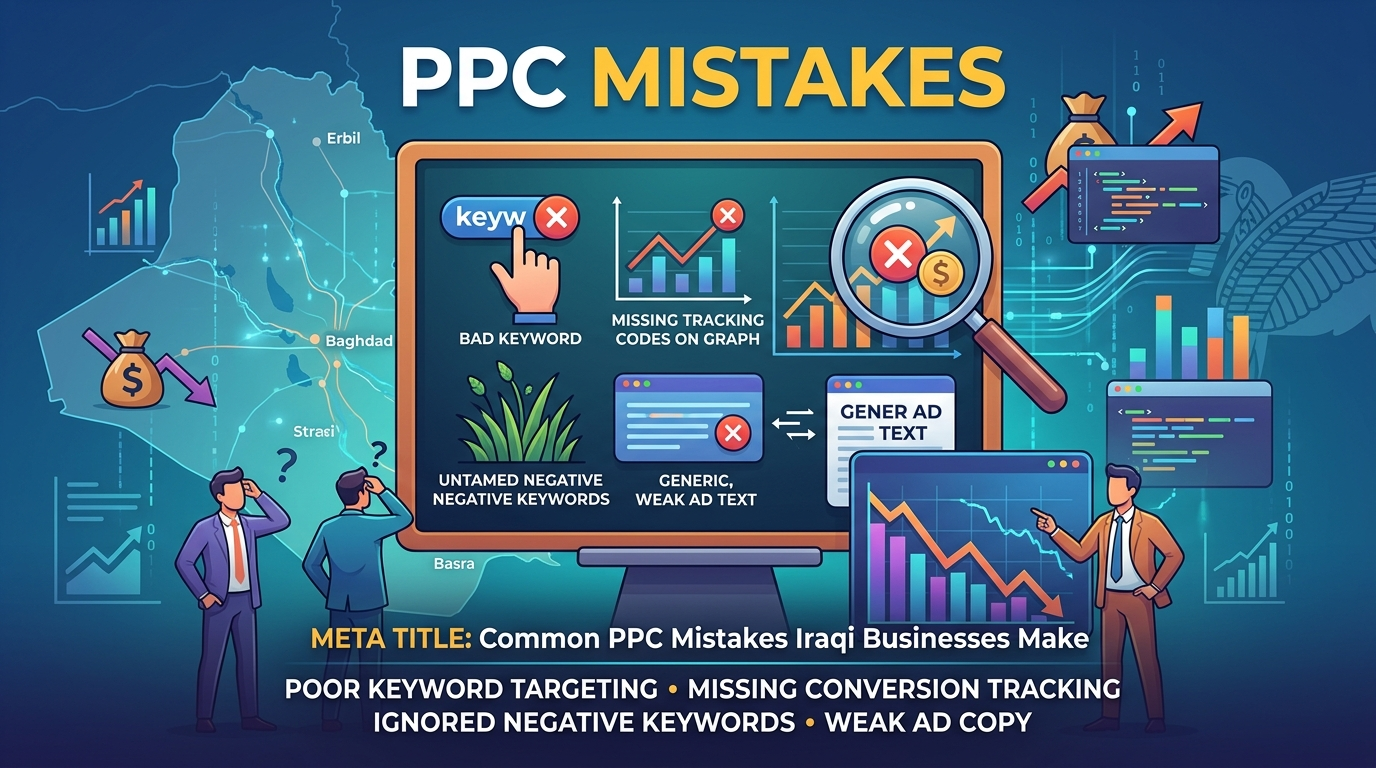
“Why is my Google Ads not working?” is one of the most common frustrated searches from Iraqi business owners who’ve already spent real budget on PPC with disappointing results. In most cases, the platform isn’t the problem — a specific, identifiable, and fixable mistake in how the campaign was set up or managed is. These PPC mistakes show up repeatedly across underperforming Iraqi campaigns, and recognizing them is usually the fastest path to turning a wasteful campaign into a genuinely productive one.
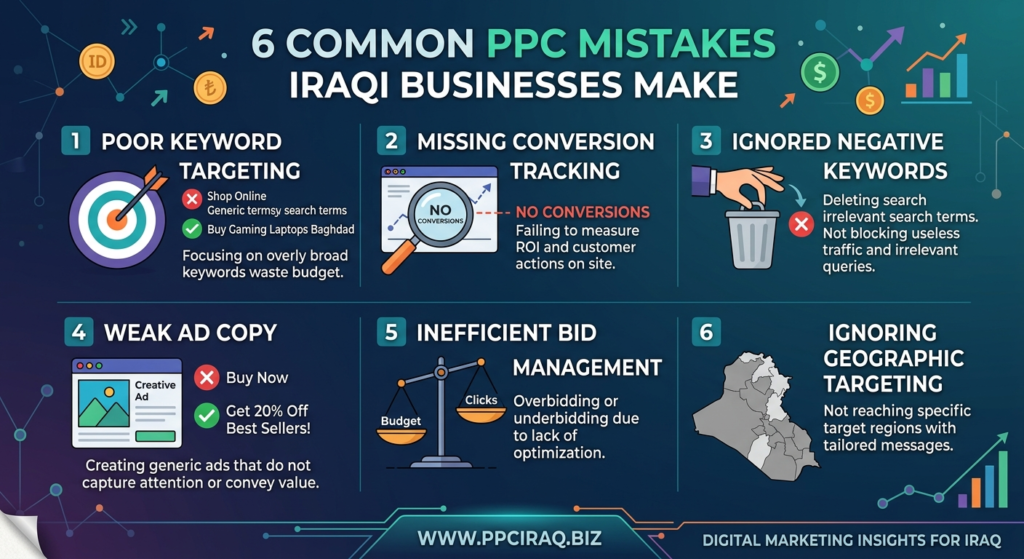
This guide walks through the specific mistakes that quietly drain PPC budgets: poor keyword targeting that wastes spend on irrelevant searches, missing conversion tracking that leaves you flying blind, ignored negative keywords that let irrelevant traffic through, weak ad copy and landing pages that fail to convert even good traffic, and a practical self-audit checklist to diagnose your own campaign right now. If your campaign has been running for months without the results you expected, this guide is built to help you find out exactly why.
Poor Keyword Targeting
Bidding on Keywords That Are Too Broad
Broad match keywords bid on a wide range of related searches, some genuinely relevant and many not, which can generate clicks from searchers with no real interest in what you’re offering. Reviewing search term reports regularly to identify irrelevant queries triggering your ads is essential to catching this before it wastes significant budget.
Targeting Generic Terms Instead of Commercial Intent
Keywords reflecting genuine purchase or inquiry intent — “hire,” “buy,” “services,” “near me” — convert at meaningfully higher rates than purely informational search terms that indicate someone is still researching rather than ready to act. Google Ads mistakes around keyword selection often stem from chasing search volume rather than actual commercial intent.
Not Researching Iraq-Specific Search Behavior
Keyword lists adapted from Gulf-region or global campaigns frequently miss how Iraqi searchers actually phrase queries — including the mix of English and Arabic terms common in Iraqi search behavior — leading to campaigns bidding on keywords that don’t reflect how your actual target customers search.
No Conversion Tracking Set Up
Why This Is the Single Most Costly Mistake?
Without conversion tracking configured, a campaign can generate clicks and spend real budget while providing zero visibility into whether those clicks actually turned into leads or sales. This is arguably the most damaging mistake on this list, since it makes every other optimization decision a guess rather than a data-informed choice.
A Practical Example of This Mistake
Consider a Baghdad-based law firm running a Google Ads campaign for six months, generating steady clicks and spending a consistent monthly budget, without ever configuring conversion tracking. When asked whether the campaign was actually generating clients, the firm could only point to a general sense that “business felt busier” — with no way to confirm whether that increase was actually connected to the campaign, coincidental timing, or referrals unrelated to PPC entirely. Six months of spend had produced six months of data that couldn’t answer the one question that actually mattered: was this working? Proper conversion tracking from day one would have made that question answerable immediately.
What Proper Tracking Should Capture?
Conversion tracking needs to capture the actions that actually matter to your business — a completed contact form, a phone call, a WhatsApp click, a completed purchase — not just website visits or time on page, which don’t reflect whether the campaign is generating real business value.
The Cost of Discovering This Too Late
Businesses often only realize conversion tracking was never properly configured after months of campaign spend, at which point there’s no way to retroactively know which specific keywords or ads actually drove the results that did occur — a genuinely avoidable loss of valuable optimization data.
Ignoring Negative Keywords
What Negative Keywords Actually Do?
Negative keywords explicitly exclude your ads from showing for specific irrelevant searches, preventing wasted spend on clicks that were never going to convert. A business selling premium services, for instance, might add “cheap” or “free” as negative keywords to avoid attracting searchers looking for something the business doesn’t offer.
Why This Gets Overlooked So Often?
Negative keyword lists require ongoing maintenance as new irrelevant search terms appear in reports over time, and campaigns that were properly configured at launch can accumulate significant wasted ad spend months later simply because no one revisited and updated the negative keyword list as new patterns emerged.
An Iraq-Specific Negative Keyword Consideration
Mixed English-Arabic search behavior common in Iraq means negative keyword lists sometimes need attention in both languages, and a campaign focused only on excluding irrelevant English terms while ignoring equivalent Arabic search patterns can still leak budget to searches the English-only negative list never catches.
A Quick Negative Keyword Review Habit
Reviewing search term reports at least monthly and adding clearly irrelevant terms as negative keywords is a simple, low-effort habit that meaningfully protects campaign efficiency over time, yet it’s one of the most commonly skipped ongoing maintenance tasks.
Weak Ad Copy & Landing Pages
Generic Ad Copy That Doesn’t Differentiate
Ad copy that could describe any business in the category — vague claims about quality or service without anything specific — fails to give a searcher a genuine reason to click your ad over a competitor’s. Specific, concrete details about what actually makes your business different perform better than generic reassurances.
Landing Pages That Don’t Match Ad Intent
Sending PPC traffic to a generic homepage rather than a landing page specifically matching what the ad promised creates a disconnect that increases bounce rate and reduces conversion, even when the ad itself performed well in generating the click.
Why Mismatched Expectations Kill Conversion?
A visitor who clicked an ad for a specific service expects to land on a page immediately confirming they’re in the right place — a homepage requiring additional navigation to find that same information introduces friction at exactly the moment conversion should be easiest.
A Quick Self-Audit Checklist
Questions to Ask About Your Own Campaign
Are you regularly reviewing search term reports for irrelevant queries triggering your ads? Is conversion tracking actually configured and capturing the actions that matter to your business? Does your negative keyword list get updated regularly, or was it set once at launch and forgotten? Does your ad copy speak to something genuinely specific about your business, and does your landing page match what each ad actually promised?
What to Do If You Find These Mistakes?
Identifying one or more of these mistakes in your own campaign isn’t necessarily a sign to abandon PPC entirely — most are genuinely fixable without a full campaign rebuild, and addressing even one or two of the most costly issues often produces a meaningful, measurable improvement in performance.
Creative 4 All offers PPC audit services that identify exactly which of these mistakes your specific campaign is making, coordinated with our SEM expertise to fix the underlying issues rather than just flagging surface symptoms.
Request a Free Audit to find out exactly what’s holding your current PPC campaign back, and what to fix first for the biggest improvement.
FAQs
This usually points to one of a few specific issues: conversion tracking not properly configured, a landing page mismatched to ad intent, or keyword targeting attracting visitors without genuine purchase interest.
Review your search term reports regularly — these show the actual searches triggering your ads, and irrelevant terms appearing there signal wasted spend that negative keywords could prevent.
No. Most common PPC mistakes are fixable without a full rebuild, and identifying and correcting even one or two significant issues often produces a meaningful improvement in performance going forward.
A monthly review of search terms, conversion data, and ad performance catches most issues before they become significant wasted spend, though a more thorough audit periodically can catch structural issues a routine check might miss.
Some, like adding negative keywords, are straightforward for a business owner to handle directly. Others, like diagnosing conversion tracking configuration issues or restructuring campaigns for better targeting, often benefit from professional expertise.