
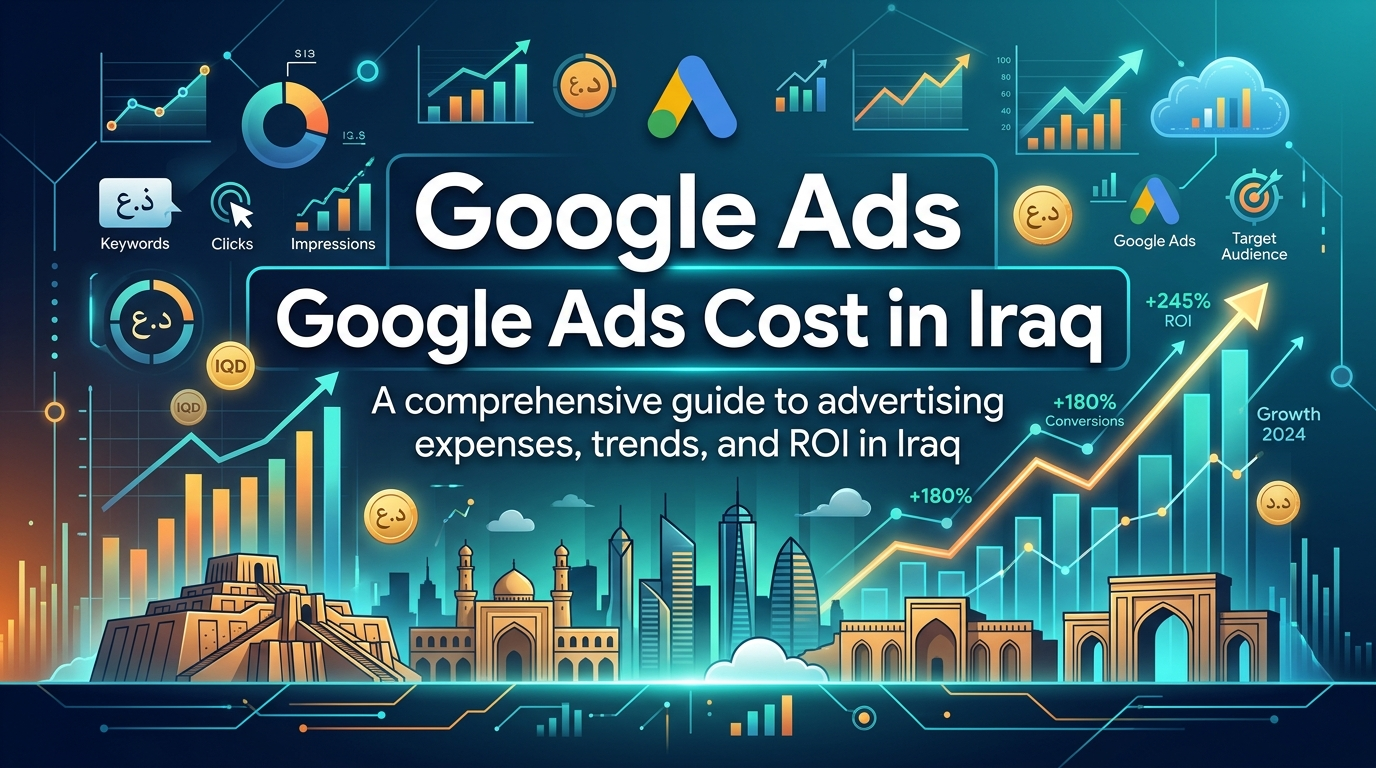
“How much does Google Ads cost?” is one of the most common questions Iraqi businesses ask before launching their first campaign, and it’s also one of the most misleading to answer with a single number, because Google Ads cost Iraq businesses actually pay splits into two genuinely separate components — the ad spend paid directly to Google, and the management fee paid to whoever runs the campaign — that get conflated far too often in casual conversations about PPC pricing.
This guide separates these two cost components clearly, covers what actually drives cost-per-click in specific Iraqi industries, explains typical budget ranges by business type without resorting to made-up figures, flags the hidden costs that catch first-time advertisers off guard, and shows exactly what to ask to get an accurate, honest estimate rather than a number that turns out to exclude half the real cost. If you’ve been quoted a single monthly figure with no breakdown, this guide is built to help you understand exactly what you’d actually be paying for.
What Determines Ad Spend vs Management Fees?
Ad Spend: What Actually Goes to Google
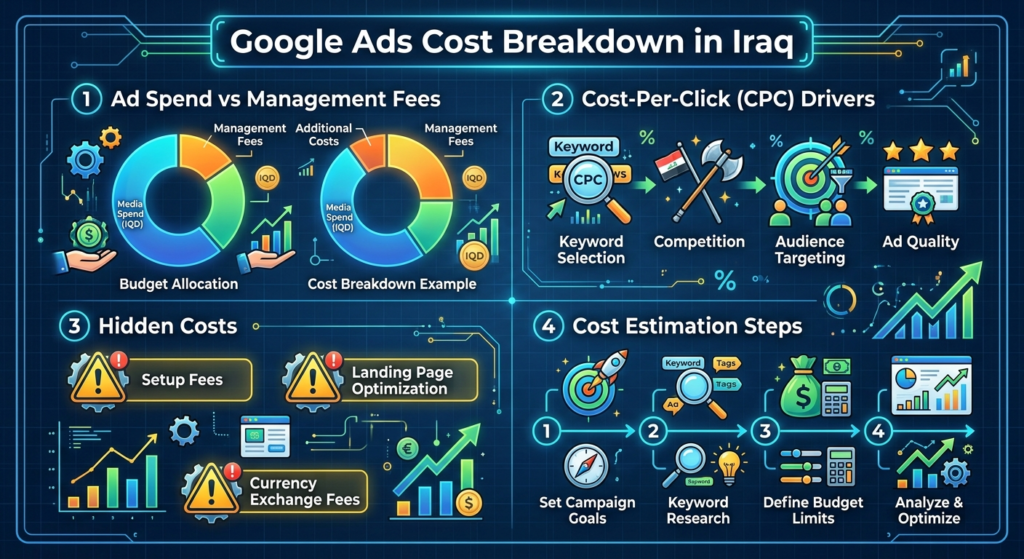
Ad spend is the money paid directly to Google for clicks on your ads, determined by the auction process — how competitive your target keywords are, your bid amount, and your ad quality score. This money goes entirely to Google, not to whoever manages your campaign, and it scales directly with how many clicks your campaign generates.
Management Fees: What You Pay a Provider
Management fees cover the actual work of running a campaign — keyword research, ad copy creation, ongoing optimization, and reporting — paid separately to whichever agency or freelancer manages the account. PPC pricing Iraq businesses encounter should always distinguish clearly between these two costs, since a quote combining them without breakdown makes it impossible to evaluate whether the management fee itself represents fair value.
Why Conflating These Two Costs Causes Problems?
A business quoted “$X per month for Google Ads” without clarity on how much is ad spend versus management fee can’t meaningfully evaluate the offer — a low total that’s mostly management fee with minimal actual ad spend produces very different results than the same total split the other way, even though both might be presented identically in a sales conversation.
A Practical Example of This Confusion
Consider two Iraqi businesses each quoted a similar total monthly figure for Google Ads. The first business’s quote breaks down as mostly ad spend with a modest management fee, meaning most of the money actually reaches potential customers through clicks. The second business’s identically priced quote turns out to be mostly management fee with minimal ad spend, meaning far fewer actual clicks reach the campaign despite paying the same total amount. Without asking for this breakdown explicitly, both businesses would have assumed they were getting equivalent value — when in reality, one is paying substantially more for the same advertising exposure.
Typical Budget Ranges by Industry
Why This Guide Won’t Quote Specific Numbers?
Cost-per-click and appropriate campaign budgets vary enormously by industry competitiveness, and presenting a single average figure would misrepresent the genuinely wide range seen across different Iraqi business categories — a range that would also become outdated as market conditions shift. Rather than a number, this section explains how budgets typically scale by competitive intensity.
Lower-Competition Local Service Categories
Local service businesses competing for less contested, more specific search terms typically see lower cost-per-click and can generate meaningful lead volume on a modest daily budget, since fewer competitors are bidding for the same narrow set of keywords.
Highly Competitive Commercial Categories
Categories where many businesses compete for the same high-value keywords — often those with significant customer lifetime value or high-margin transactions — see meaningfully higher cost-per-click, requiring correspondingly larger budgets to generate comparable lead volume to a less competitive category.
National vs Local Campaign Scale
A campaign targeting a single city with narrow, specific keywords typically costs less overall than one competing nationally across multiple cities for broader commercial terms, since both the competitive intensity and the sheer volume of available search traffic scale up together.
Understanding Cost-Per-Click Locally
What Actually Drives CPC in the Iraqi Market?
Average CPC in Iraq varies by industry competitiveness in the same way it does globally, but the specific competitive landscape — which Iraqi and regional businesses are actually bidding on which terms — determines actual local costs more than any global industry benchmark could predict.
Why Global Benchmarks Mislead Here?
A business researching typical Google Ads costs often finds figures from global or Gulf-region sources that don’t reflect Iraq’s specific competitive landscape. Iraqi search competition for many commercial categories remains comparatively thin relative to more saturated global markets, meaning costs can differ meaningfully from what a generic benchmark would suggest — sometimes lower due to less competition, sometimes higher in categories where a handful of well-funded competitors are actively bidding. The only reliable way to know actual local cost is running a real campaign or requesting genuine data from a provider with direct Iraqi market experience.
Quality Score’s Role in Reducing Cost
A well-structured campaign with tightly themed ad groups, relevant ad copy, and a properly optimized landing page earns a better quality score from Google, which directly reduces cost-per-click compared to a poorly structured campaign bidding on the same keywords. This means campaign quality itself is a genuine cost lever, not just bid amount.
A Quick Cost Evaluation Checklist
- Confirm what percentage of total spend goes to Google as ad spend versus the management fee.
- Ask for actual cost-per-click data from similar past campaigns in your industry, not a generic estimate.
- Evaluate whether campaign structure and quality score improvements could reduce cost before increasing bids.
- Clarify whether the management fee is a flat rate or a percentage of ad spend.
Hidden Costs to Avoid
Landing Page and Creative Development Costs
Some PPC quotes cover only campaign management, assuming a client already has a properly optimized landing page ready to receive traffic. If a business actually needs a landing page built, this can add substantial unplanned cost that should be clarified before committing to a management fee based on the assumption it isn’t needed.
Setup Fees Separate From Ongoing Management
Some providers charge a separate one-time setup fee in addition to ongoing monthly management, which should be disclosed clearly upfront rather than discovered as a surprise addition to the first invoice.
Google Ads Budget for Small Business: A Realistic Starting Framework
A reasonable Google Ads budget for small business planning should account for both components together — a modest ad spend sized to generate enough clicks for meaningful early data, plus a management fee proportionate to the actual complexity of the campaign being run, rather than treating either component in isolation.
Getting an Accurate Estimate
What an Honest Quote Should Include?
An accurate quote should clearly separate estimated ad spend from management fee, specify what’s included in the management scope (keyword research, ad copy, landing page work, reporting), and provide realistic cost-per-click expectations based on your specific industry and target keywords rather than a generic average.
Questions to Ask Before Comparing Providers
Before comparing quotes across providers, ask each one to break down ad spend versus management fee explicitly, clarify whether the management fee is flat or percentage-based, and request actual cost-per-click data from comparable past campaigns rather than accepting a generic industry estimate at face value.
Creative 4 All provides transparent PPC advertising quotes that clearly separate ad spend from management fees, so you can evaluate the actual value of the service being provided.
Get a PPC Quote to receive an honest, itemized breakdown of what a campaign for your specific business would actually cost, and why.
FAQs
No. Ad spend goes to Google based on the auction process, while a separate management fee goes to whoever runs your campaign for the actual work of research, optimization, and reporting. A quote should always distinguish between the two.
It varies enormously by industry competitiveness, so there’s no single reasonable figure. Ask for actual cost-per-click data from similar past campaigns in your specific industry rather than relying on a generic global or regional average.
Often because they cover different scopes — one quote might include landing page development and comprehensive optimization, while a cheaper one covers only basic campaign management, assuming everything else is already in place.
Both structures exist and each has tradeoffs. A flat fee provides cost predictability regardless of spend level; a percentage-based fee scales with campaign size but can create less incentive to keep spend efficient. Clarify which structure applies before committing.
Improving campaign structure and ad relevance to earn a better quality score often reduces cost-per-click more effectively than simply lowering bids, since Google rewards genuinely relevant, well-organized campaigns with lower costs for the same ad position.