
Every Iraqi business owner with a limited marketing budget eventually asks some version of the same question: SEO vs PPC — which one actually deserves the first investment? It’s a reasonable question with no single universal answer, because the right choice depends heavily on how urgently a business needs leads, how much budget is actually available, and how competitive the specific market is.
This guide walks through how SEO and PPC actually differ in practice, which one delivers results faster, how their real costs compare over time, and when running both together makes more sense than choosing one over the other — giving Iraqi business owners a genuine framework for the SEO vs PPC decision rather than a generic answer favoring whichever service happens to be easier to sell.
How SEO and PPC Actually Differ?
Two Fundamentally Different Mechanisms
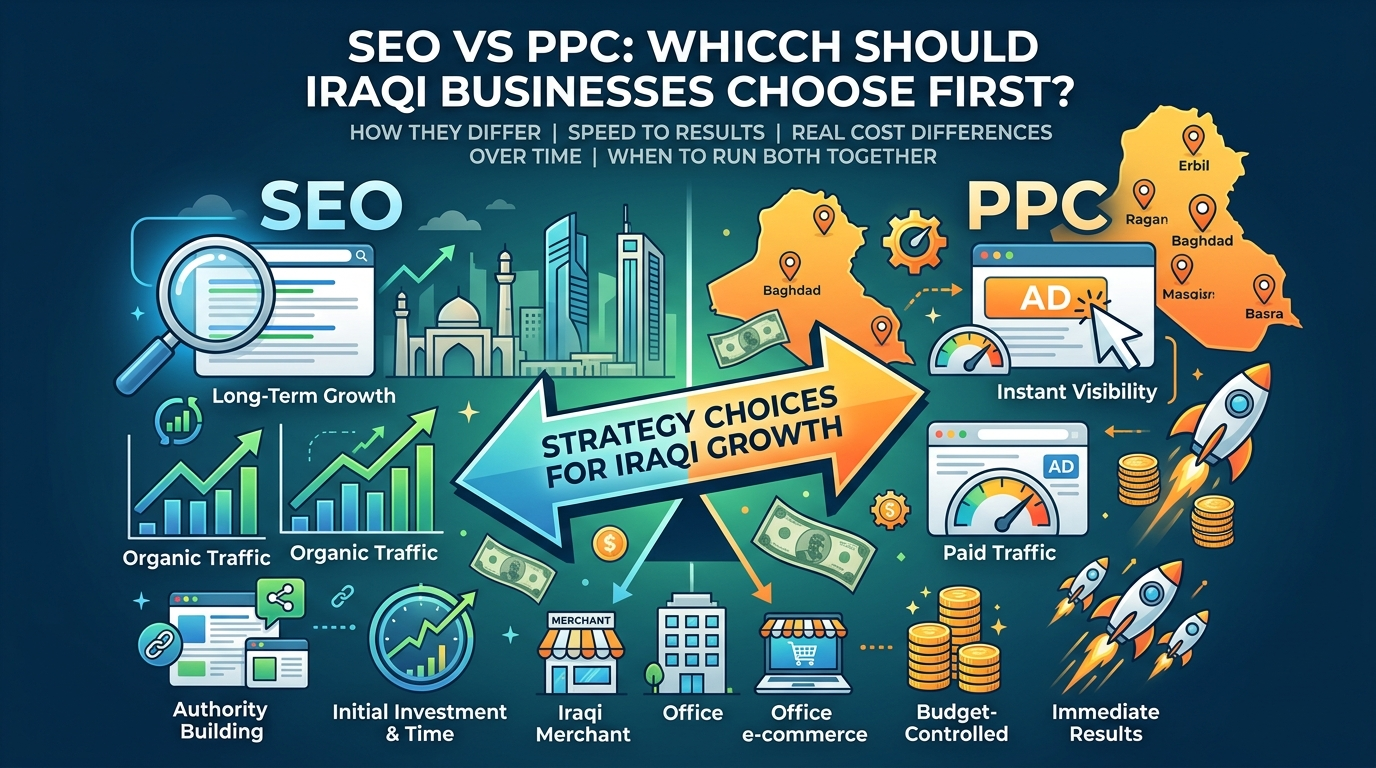
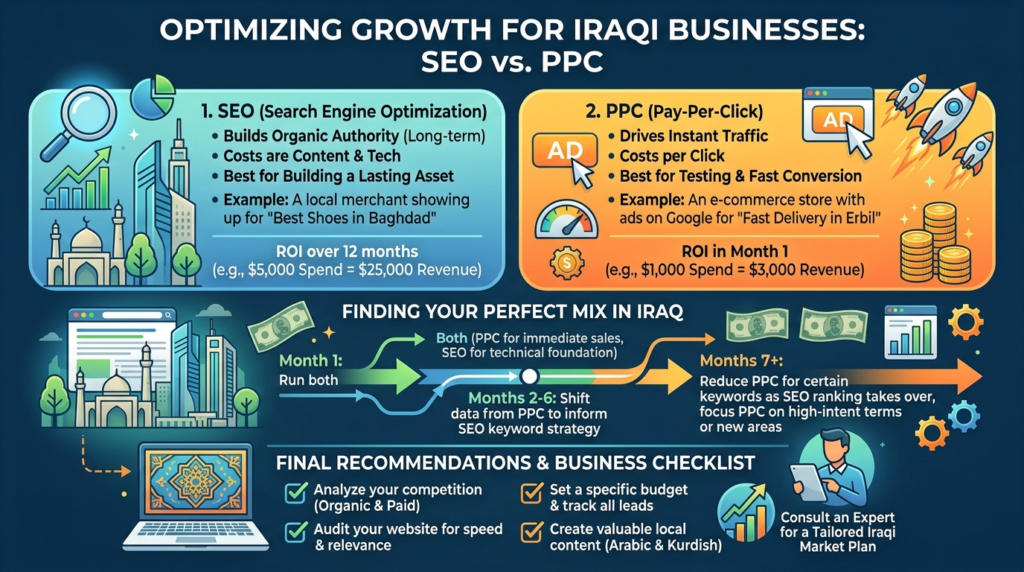
SEO earns visibility in Google’s organic, unpaid results by building a site’s relevance, authority, and technical quality over time. PPC — pay-per-click advertising, most commonly through Google Ads — buys visibility directly, placing a business at the top of search results for as long as it continues paying per click. SEO vs PPC isn’t really a competition between two similar tools; it’s a comparison between an owned, compounding asset and a rented, immediate one.
A Concrete Example of the Difference
Consider two Iraqi furniture retailers targeting the same search term. One runs a PPC campaign and appears at the top of results the same afternoon the campaign launches, paying a set amount for every click that ad receives. The other invests in SEO — restructuring product pages, building genuinely useful buying guides, earning a handful of relevant backlinks — and takes several months before appearing organically for that same term. Once it does, though, it continues appearing there indefinitely without paying per visitor. This single comparison captures the entire SEO vs PPC tradeoff: speed versus durability.
What Each One Actually Controls?
With PPC, a business has direct control over exactly which keywords trigger its ad, the messaging shown, and the budget spent — visibility starts essentially the moment a campaign launches. With SEO, a business influences rankings through content quality, technical health, and authority signals, but Google’s algorithm makes the final ranking decision, and that decision takes time to shift. Understanding this control difference is central to any honest SEO vs PPC comparison, since it explains why the two channels feel so different to manage day-to-day.
Why This Isn’t Really SEO vs Google Ads in Practice?
Framed as SEO vs Google Ads, the comparison can sound like a rivalry, but in practice the two channels serve different moments in a customer’s decision journey. PPC captures someone with immediate, high-intent search behavior right now; SEO builds a durable presence that continues capturing that same behavior for months and years without ongoing per-click cost.
Speed to Results
PPC’s Immediate Visibility Advantage
A PPC campaign can generate clicks, traffic, and leads within hours of launching, since visibility is purchased rather than earned. For a business with an urgent, time-sensitive need — a seasonal promotion, a new location opening, or simply needing leads this month rather than in six months — PPC’s speed is a genuine and legitimate advantage that SEO cannot match, and it’s a major reason the SEO vs PPC question so often gets decided by timeline pressure alone.
Why SEO Takes Longer?
SEO requires Google to crawl, index, and evaluate a site’s content and technical quality before rankings shift meaningfully, and competitive terms require accumulated authority signals that build gradually rather than instantly. Early indexation signals typically appear within two to three months, with meaningful ranking movement building from month four onward — a timeline that reflects how Google’s systems actually evaluate sites, not a limitation specific to any particular SEO provider.
Which Is Better, SEO or PPC, for Time-Sensitive Needs?
For a business asking which is better, SEO or PPC, when the honest answer depends entirely on urgency: if leads are needed within weeks, PPC is the realistic starting point, with SEO built in parallel as a longer-term investment that reduces future dependency on paid spend.
Cost Over Time
PPC’s Recurring Cost Structure
PPC costs scale directly with traffic — every click costs money, and that cost continues indefinitely as long as visibility is needed. Pausing a PPC campaign means visibility disappears essentially immediately, which makes PPC a channel that requires continuous budget to sustain rather than one that builds lasting value on its own.
SEO’s Compounding Value
SEO requires meaningful upfront investment in technical work, content, and authority building, but a page that earns a strong ranking continues generating visits without an ongoing per-click cost. Over a multi-year horizon, this compounding effect typically makes SEO the more cost-efficient channel per visitor, even though the upfront investment and timeline differ significantly from PPC’s immediate-but-recurring cost structure — the central asymmetry at the heart of any long-term SEO vs PPC comparison.
A Practical Way to Think About the Tradeoff
Consider two Iraqi businesses in the same industry, both spending equivalent budgets over eighteen months. The one running PPC exclusively sees consistent traffic exactly proportional to spend, disappearing the moment budget pauses. The one investing in SEO alongside a smaller PPC budget sees organic traffic build gradually, and by month eighteen, a meaningful share of total traffic arrives without any per-click cost at all — a foundation the PPC-only business never builds regardless of how long it continues spending. This is the core of the SEO vs PPC cost conversation: PPC cost is linear, SEO cost curves toward efficiency over time.
When to Use Both Together
Why This Isn’t Always an Either/Or Decision?
For many Iraqi businesses, the strongest approach isn’t choosing between SEO and PPC at all, but sequencing and combining them deliberately. PPC can generate immediate leads while SEO builds in the background, and once organic rankings mature, PPC budget can shift toward defending high-value terms or testing new markets rather than carrying the full weight of lead generation alone.
Complementary Signals Between the Two Channels
PPC campaign data — which keywords actually convert, which ad copy resonates, which landing pages perform — provides genuinely useful intelligence that can sharpen SEO content strategy, since it reflects real searcher behavior rather than estimated search volume alone. Running both channels together, even at modest budgets, often produces better decisions in each individual channel than running either in isolation.
Budget Allocation as Rankings Mature
The right split between SEO and PPC budget isn’t static — it should shift as organic visibility builds. Early on, when a site has little organic presence, PPC often carries most of the lead-generation weight while SEO investment builds toward its eventual payoff. As specific pages begin ranking well organically, budget can gradually shift: PPC spend on those now-ranking terms can be reduced or redirected toward newer opportunities, while the freed budget supports either deeper SEO investment or PPC testing in adjacent markets. This dynamic reallocation is where a genuinely integrated SEO vs PPC strategy outperforms treating the two as permanently separate budget lines.
Our Recommendation Framework for Iraqi SMEs
A Practical Decision Framework
For an Iraqi SME weighing SEO vs PPC with a limited initial budget, a reasonable framework: if the business needs leads within the next one to two months, start with PPC and build SEO in parallel. If there’s no urgent timeline and the goal is sustainable, long-term visibility, prioritize SEO from the outset, potentially supplementing with a modest PPC budget for specific high-value, time-sensitive campaigns. If budget allows for both simultaneously, that combined approach typically outperforms either channel run alone. A trustworthy provider approaching SEO vs PPC for a client should recommend based on this framework, not on which service is more profitable for the agency to sell.
Matching the Decision to Business Reality
The difference between SEO and PPC Iraq businesses should weigh most heavily isn’t which channel is objectively “better” in the abstract — it’s which one matches the specific business’s timeline, budget structure, and competitive situation right now. A newly launched business with no existing traffic has different needs than an established business looking to reduce long-term paid ad dependency.
Creative 4 All helps Iraqi businesses build the right mix of SEO services and PPC advertising as part of comprehensive digital marketing in Iraq engagements, matched to each business’s actual timeline and goals rather than a one-size-fits-all recommendation.
Request a Free Audit to get a clear, honest recommendation on whether SEO, PPC, or a combination of both makes the most sense for your specific business and budget.
FAQs
It depends on urgency. PPC can generate leads immediately while a new site builds the trust and content needed for SEO to gain traction, making a combined approach particularly valuable for businesses starting from zero visibility.
Often, yes, at least partially. As organic rankings mature and start generating consistent traffic, many businesses shift PPC budget away from broad visibility and toward defending specific high-value terms or testing new campaigns, rather than eliminating PPC entirely.
PPC doesn’t directly affect organic rankings — Google’s algorithm treats paid and organic results separately. However, the keyword and conversion data from PPC campaigns can meaningfully inform and improve SEO content strategy.
There’s no universal ratio; it depends on urgency, budget size, and competitive intensity. A business needing immediate leads typically weights budget toward PPC initially, shifting gradually toward SEO as organic visibility builds and reduces dependency on paid spend.
SEO is generally more sustainable long-term, since it builds a compounding asset that continues generating traffic without ongoing per-click cost. PPC remains valuable for immediate, targeted visibility, but it doesn’t build lasting value the way accumulated SEO authority does.