
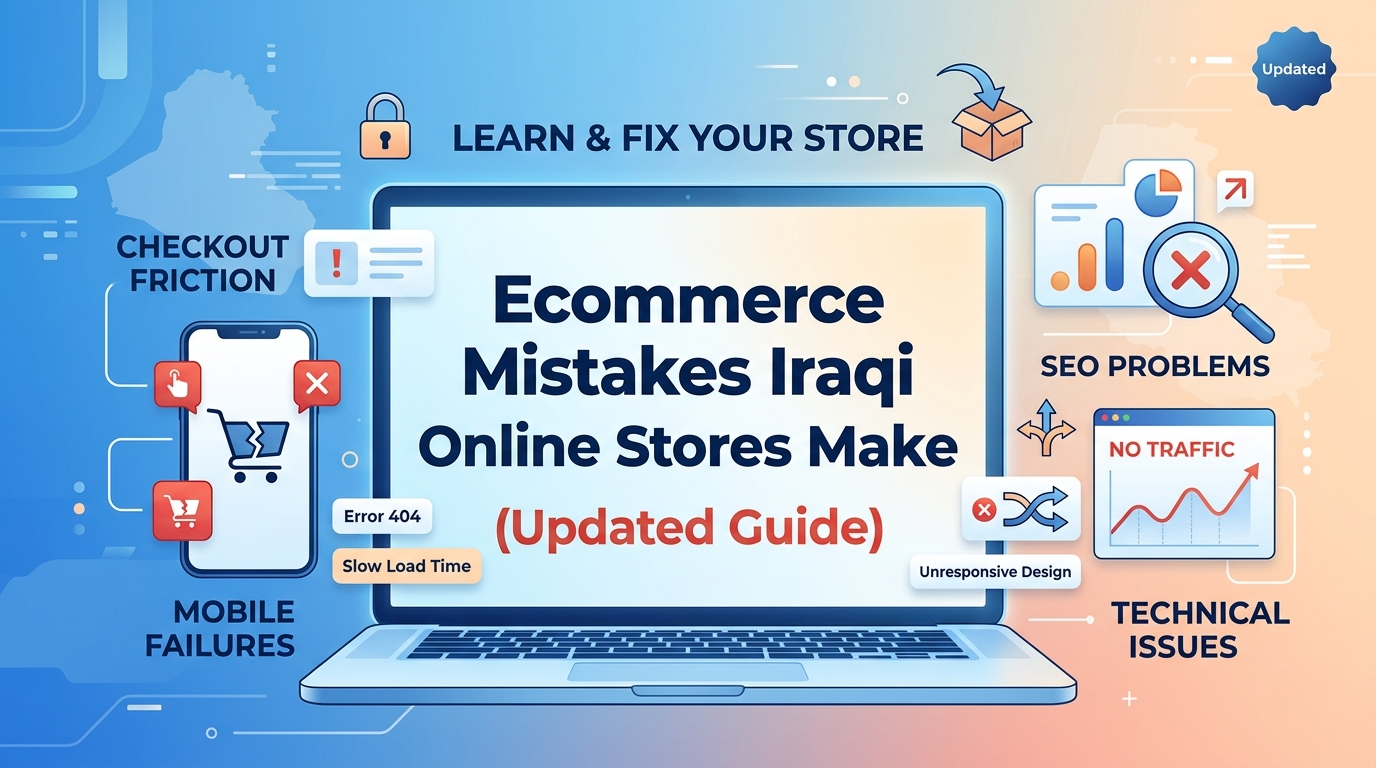
Most lists of ecommerce mistakes read like they were written for a store in a completely different market — mistakes about shipping calculators, tax configuration, or payment gateway checkout abandonment rates that assume infrastructure Iraqi merchants simply don’t have access to. The ecommerce mistakes that actually sink Iraqi online stores look different, rooted in the specific realities of local payment options, trust-building in a market where online purchasing habits are still forming, and mobile-first browsing at a scale most generic guides don’t account for.
This updated guide covers the technical issues quietly undermining otherwise decent Iraqi stores, the trust and checkout friction points specific to Iraqi buyers, mobile experience failures that cost sales directly, the SEO mistakes hiding a store from the customers actively searching for it, and how to actually fix these issues rather than just recognizing them. If your store has traffic but not the sales to match, this guide is built to help you find the specific gap.
Common Technical Mistakes
Payment Integration Left Half-Finished
Since major global payment processors don’t support Iraq directly, many stores launch with an incompletely configured local payment gateway — a checkout flow that technically works in testing but breaks or behaves unpredictably with real transactions, real currencies, or real customer bank cards. Testing the complete payment flow with actual transactions before launch, not just a sandbox environment, catches this before it costs real sales.
A Practical Example of This Mistake
Consider an Iraqi electronics retailer that launched its store after integrating a local payment gateway, testing only with the gateway’s demo credentials rather than a real transaction. Weeks after launch, customers began reporting that payments appeared to succeed but orders never arrived in the store’s system — a mismatch between the gateway’s test environment and its live behavior that basic real-transaction testing would have caught immediately. The store lost weeks of sales and had to individually track down and re-process affected orders, a cost far exceeding what proper pre-launch testing would have required.
Broken or Slow Product Search
A store with more than a handful of products needs functional search, and a search feature that returns irrelevant results or loads slowly frustrates visitors trying to find something specific, pushing them toward a competitor’s site rather than continuing to browse manually.
No Backup or Update Plan
Many first-time Iraqi store owners run their ecommerce platform without a backup strategy or a plan for applying security updates, leaving the store vulnerable to both technical failure and security breaches that could have been avoided with basic, unglamorous maintenance discipline.
Trust & Checkout Friction Specific to Iraqi Buyers
Hiding or Burying Cash-on-Delivery
Given how strongly many Iraqi shoppers still prefer cash on delivery, a checkout flow that makes this option difficult to find or presents it as a secondary afterthought behind a card-focused design actively pushes away the payment method a large share of the addressable market actually wants to use.
No Visible Contact Information or WhatsApp Option
Iraqi buyers frequently want to confirm details or ask questions before completing an online purchase, particularly with a store they haven’t bought from before. A store lacking a visible phone number or WhatsApp contact option removes a trust-building step many Iraqi customers genuinely rely on.
Unclear Delivery Timeframes and Costs
Presenting vague or missing delivery cost and timeframe information until deep into checkout creates the kind of last-minute surprise that drives cart abandonment, particularly in a market where trust in online purchasing is still developing and every unclear detail adds hesitation.
Overpromising on Delivery Speed
Related to unclear timeframes, some stores promise faster delivery than they can consistently achieve simply to appear competitive, then damage trust when actual delivery repeatedly falls short. A realistic, honestly stated delivery window that a store reliably meets builds more long-term trust than an aggressive promise followed by frequent delays.
A Quick Trust-Building Checklist
- Cash on delivery presented as clearly and accessibly as any digital payment option.
- Visible phone number and WhatsApp contact on every key page, not buried in a footer.
- Delivery cost and timeframe shown clearly before the final checkout step.
- Genuine customer reviews displayed where visible, not hidden or absent entirely.
Mobile Experience Failures
Checkout Forms Not Actually Built for Touch
Given how much Iraqi ecommerce traffic arrives via mobile, a checkout form with small, closely spaced fields designed with a mouse cursor in mind — not a thumb — creates exactly the kind of friction that turns a nearly-completed purchase into an abandoned cart.
Product Images That Load Slowly on Mobile Networks
Large, unoptimized product images are one of the most common and most fixable causes of slow mobile loading, directly costing sales among the majority of visitors browsing on mobile connections rather than fast office Wi-Fi.
Why Is My Online Store Not Selling in Iraq: The Mobile Answer?
For store owners specifically asking why is my online store not selling in Iraq, checking the actual mobile shopping experience — not just whether the site technically resizes — often reveals the answer: a desktop-adequate experience that quietly fails the majority of visitors trying to shop on a phone.
SEO Mistakes That Hide Your Store
Missing or Duplicate Product Page Content
Product pages using manufacturer descriptions duplicated across many other stores selling the same item give Google little reason to rank a near-identical page highly, effectively hiding otherwise good products from search visibility.
No Schema Markup on Product Pages
Skipping product schema markup means missing out on rich search result displays showing price, availability, and ratings directly in search results — a meaningful visibility disadvantage compared to competitors who have implemented it correctly.
Poor Site Architecture Burying Products
Products buried several clicks deep in a confusing category structure are harder for both customers and Google’s crawlers to find, undermining both user experience and organic search visibility simultaneously.
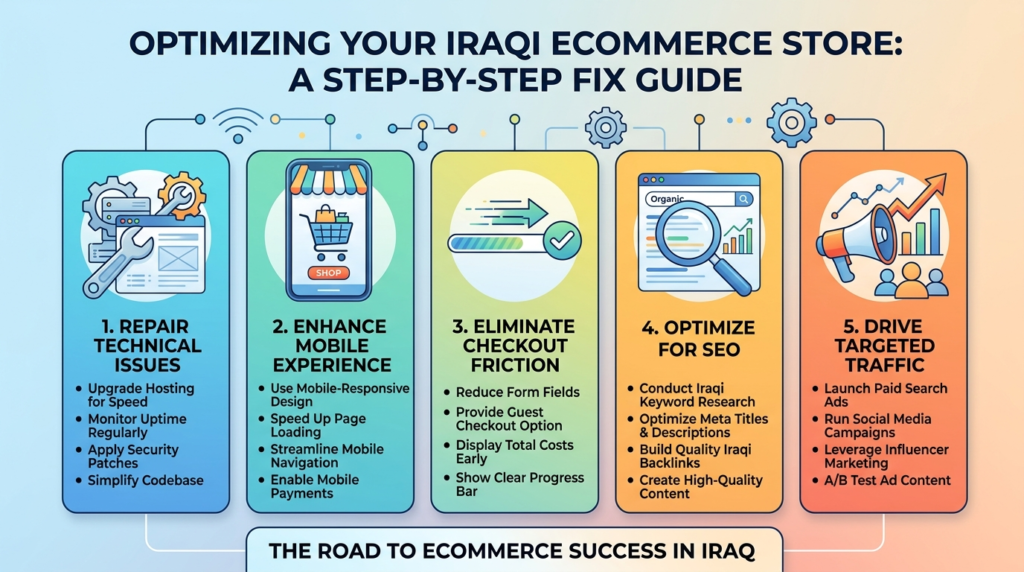
Fixing These Issues
Prioritizing What to Fix First
Not every issue deserves equal urgency — checkout and payment problems that directly block sales should be addressed before secondary SEO refinements, since a technically perfect but unfindable store and a highly visible but broken checkout both fail for different reasons, but the checkout problem costs sales immediately.
Common Ecommerce Mistakes Iraq Stores Can Audit Themselves
Before commissioning outside help, store owners can audit several of these issues directly: completing an actual test purchase on a real phone, checking whether cash on delivery and WhatsApp contact are genuinely visible and accessible, and reviewing whether product pages have unique descriptions rather than manufacturer copy.
When Professional Help Makes the Difference?
Technical issues like payment integration problems, schema implementation, and structural SEO fixes typically benefit from professional diagnosis and correction, since these issues are often invisible to a non-technical store owner until they’ve already cost meaningful sales.
Creative 4 All provides ecommerce optimization services specifically built around the Iraq-specific issues covered in this guide, coordinated with our SEO team to fix both the visible checkout problems and the hidden search visibility issues holding a store back.
Request a Free Audit to identify exactly which of these mistakes your store is making, and what to fix first for the biggest impact.
FAQs
This usually points to checkout or trust friction rather than a visibility problem — check whether cash on delivery is clearly presented, whether contact information is visible, and whether the mobile checkout experience is genuinely usable.
Yes. Many Iraqi shoppers still prefer it while digital payment trust continues developing, so hiding or deprioritizing this option in checkout design actively costs sales rather than modernizing the experience.
Complete a full test purchase on an actual phone over a real mobile connection, rather than relying on a desktop browser’s resize simulator, and check mobile-specific analytics for cart abandonment patterns.
Address checkout and payment friction first, since these directly block sales, before moving to secondary SEO and content improvements that build longer-term visibility rather than immediate conversion.
Some issues — checking cash on delivery visibility, testing mobile checkout, reviewing product descriptions — can be audited directly. Technical issues like payment integration bugs or schema implementation typically benefit from professional diagnosis.