
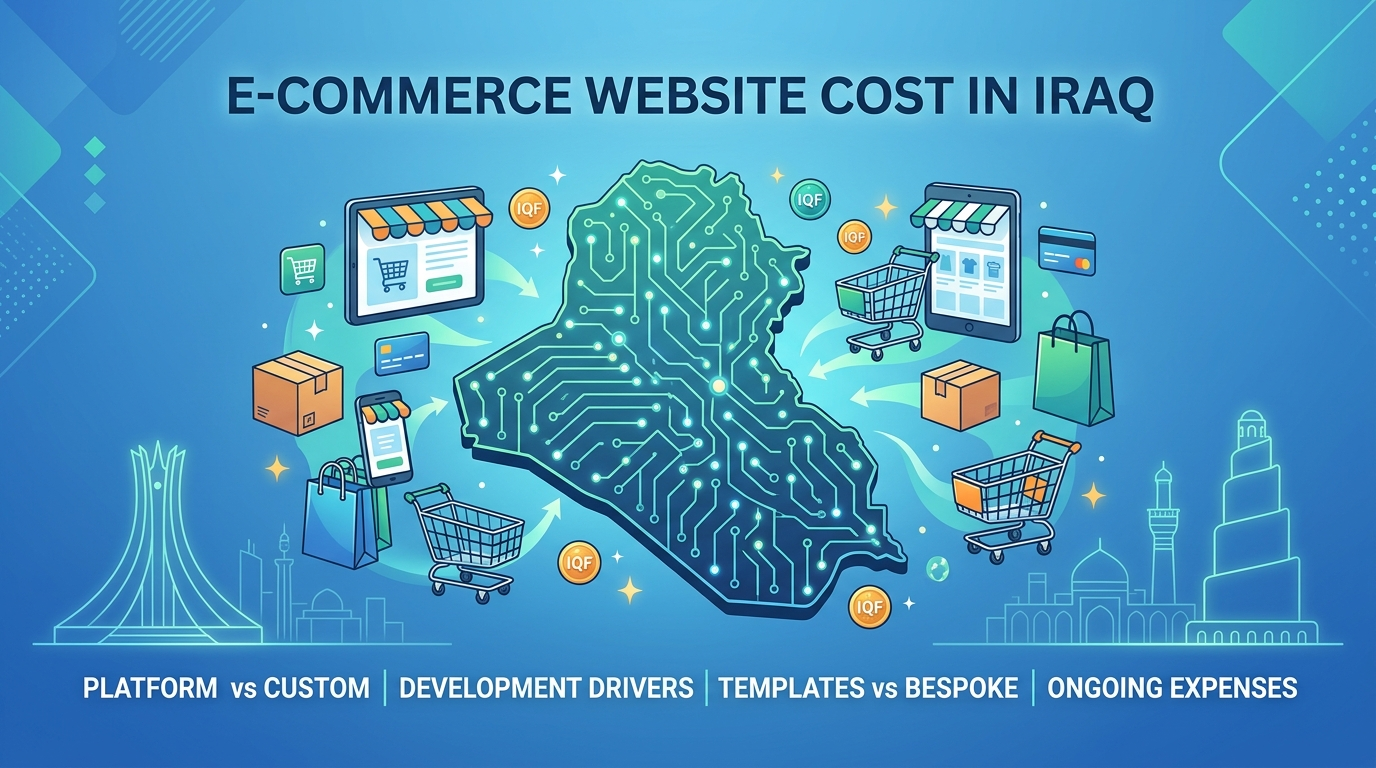
“How much does an online store cost?” is one of the first questions any Iraqi entrepreneur asks before committing to ecommerce, and it’s also one of the hardest to answer with a single figure, because ecommerce website cost Iraq businesses actually pay depends heavily on product catalog size, payment and logistics integration complexity, whether the platform is standard or custom-built, and how much ongoing maintenance is included. A number without that context is close to meaningless.
This guide covers what genuinely drives ecommerce pricing for Iraqi businesses, the real difference between platform costs and development costs, the ongoing expenses that catch many first-time store owners off guard, when a template-based store makes more sense than a custom build, and exactly what to ask to get an accurate quote rather than a number that turns out to exclude half the actual project. If you’re preparing to request quotes from multiple providers, this guide is built to help you compare them meaningfully.
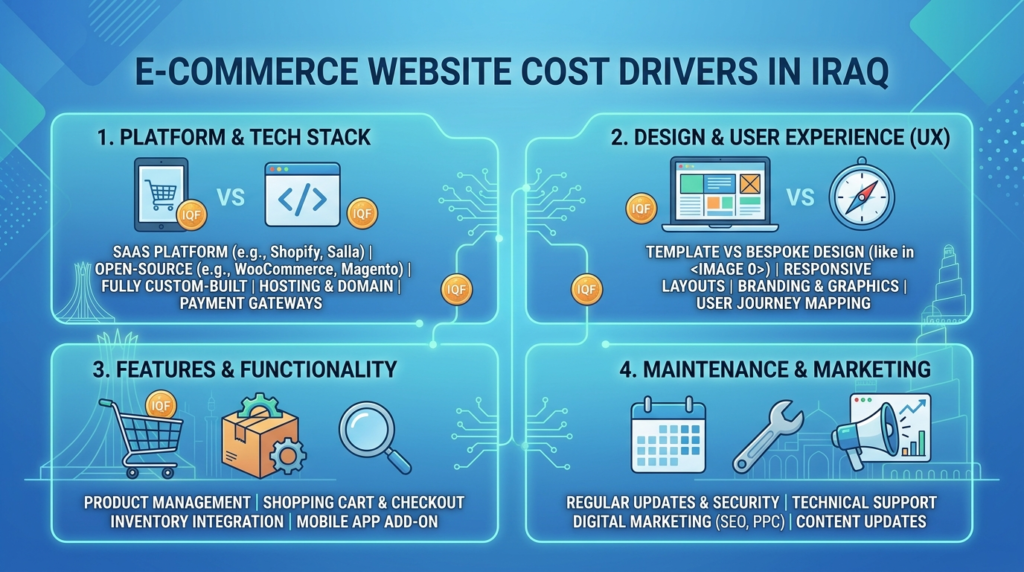
What Drives Ecommerce Website Pricing?
Product Catalog Size and Complexity
A store with a handful of products and simple variations costs meaningfully less to build than one with hundreds of products, multiple variants (size, color, material), and complex inventory relationships. Online store price Iraq businesses encounter scales directly with how much genuine product setup work — descriptions, images, categorization — the catalog actually requires.
Payment and Logistics Integration Complexity
Given that major global payment processors don’t support Iraq directly, integrating local payment gateways and logistics providers requires additional development and configuration work compared to markets where a standard payment plugin works out of the box. This Iraq-specific integration work is a genuine cost driver that generic global ecommerce pricing guides don’t account for.
A Practical Example of How These Factors Combine
Consider two Iraqi businesses commissioning online stores in the same month: a small boutique with twenty products, single-language English content, and cash-on-delivery as its only payment method, and a larger retailer needing a bilingual Arabic-English store with several hundred products, multiple local payment gateway integrations, and logistics API coordination. Both are legitimate ecommerce projects, but the actual scope of design, development, and integration work required differs enormously — which is exactly why a single ecommerce website cost Iraq benchmark figure can’t meaningfully apply to both situations.
Design Customization Level
A store built from a template with light customization costs less than one designed entirely around a unique brand identity with custom layouts and illustrations. Both approaches are legitimate depending on budget and how much visual differentiation a business needs from competitors using similar templates.
Bilingual and RTL Requirements
An Arabic-English bilingual store costs more than a single-language store, since genuine bilingual ecommerce means independently researched product content, properly implemented RTL layout, and correctly configured hreflang — not simply doubling the page count with translated text.
Why This Cost Is Often Underestimated?
Businesses frequently budget for a bilingual store as though it were roughly one and a half times the cost of a single-language version, when the actual scope — separate product descriptions, independent RTL testing, and bilingual customer support content — often more closely resembles building two coordinated stores that happen to share a backend. Clarifying this scope explicitly with a developer before committing avoids a significant and common source of budget overrun partway through the project.
Platform Costs vs Development Costs
What Platform Costs Actually Cover?
Platform costs include the underlying software or service the store runs on — whether a subscription-based hosted platform or the hosting and licensing costs of a self-hosted solution like WooCommerce — plus any transaction fees the platform charges per sale. These costs continue for the life of the store, separate from the one-time cost of building it.
What Development Costs Actually Cover?
Development costs cover the actual work of building the store: design, product setup, payment and logistics integration, testing, and launch. Ecommerce development cost for a standard platform properly configured is typically lower than custom development, since it builds on existing infrastructure rather than creating something from scratch.
Why Separating These Two Matters?
A quote presenting only development cost without clarifying separate, ongoing platform costs can significantly understate the true cost of running the store, since platform fees, transaction fees, and hosting continue indefinitely after the initial build is paid for and delivered.
Ongoing Costs to Budget For
Hosting, Domain, and Platform Fees?
Beyond the initial build, ongoing costs typically include domain renewal, hosting or platform subscription fees, and any per-transaction charges the payment gateway or platform applies to each sale — costs that should be clarified upfront rather than discovered after launch.
Payment Gateway and Logistics Integration Fees
Local payment gateways and logistics providers may charge setup fees, per-transaction fees, or ongoing service fees for their integration and processing services, and these Iraq-specific costs should be confirmed directly with each provider rather than assumed to mirror global platform fee structures.
Content and Maintenance Costs
An ecommerce store needs ongoing content work as the product catalog grows or changes, along with technical maintenance to keep the platform secure and updated. Budgeting only for the initial build while ignoring this ongoing need is one of the most common ways ecommerce budgets fall short after launch.
A Quick Budget Planning Checklist
- Confirm which costs are one-time development versus ongoing platform and transaction fees.
- Ask directly about local payment gateway and logistics integration costs specifically.
- Budget for ongoing content updates as the catalog grows, not just the initial setup.
- Clarify what technical maintenance is included versus billed separately.
Template vs Custom Stores
When a Template-Based Store Makes Sense?
For most Iraqi retailers with standard product catalogs and typical checkout needs, a well-implemented template on an established platform delivers strong value without the additional cost and complexity of custom development, particularly for a first ecommerce venture where validating product-market fit matters more than deep customization.
When Custom Development Is Worth the Cost?
Custom development becomes worthwhile when genuinely unique product configuration, complex pricing logic, or specific integration requirements exceed what standard platforms and their plugin ecosystems can accommodate — a scenario less common than the number of custom ecommerce projects in the Iraqi market might suggest.
Cheap Ecommerce Website Iraq: Understanding the Real Risks
A cheap ecommerce website Iraq quote significantly below what a described scope would realistically require usually means shortcuts somewhere — inadequate payment security, poor mobile optimization, or a platform that can’t scale as the catalog grows. Recovering from a poorly built cheap store frequently costs more in total than investing appropriately from the start.
Getting an Accurate Quote
What a Real Ecommerce Quote Should Include?
An accurate quote should specify catalog size assumptions, which payment gateways and logistics providers are being integrated, ongoing platform and transaction fee structure, content responsibilities, and maintenance arrangements — not a single number with no breakdown of what it actually covers.
Questions to Ask Before Comparing Quotes
Before comparing prices across providers, ask each one to clarify exactly what’s included in the development cost versus what continues as ongoing platform fees, which specific local payment and logistics integrations are covered, and what happens if the product catalog grows significantly beyond initial assumptions.
Creative 4 All provides transparent ecommerce website quotes that clearly separate development cost from ongoing platform and integration expenses, so you can evaluate the actual total cost of ownership rather than comparing incomplete numbers.
Get a Free Quote to receive an honest, itemized breakdown of what your specific online store project would actually require, and why.
FAQs
Because actual cost depends heavily on catalog size, payment and logistics integration complexity, and customization level, a fixed published price would misrepresent either simpler or more complex projects. An accurate quote reflects your specific project rather than a generic average.
For most standard retail catalogs, a well-implemented template on an established platform offers excellent value. Custom development becomes worthwhile only when genuinely unique functional requirements exceed what standard platforms can accommodate.
Hosting or platform subscription fees, domain renewal, payment gateway and logistics transaction fees, and content or maintenance work all continue as ongoing costs, separate from the initial development cost.
Since major global payment processors don’t support Iraq directly, integrating local payment gateways requires additional development and configuration work that markets with standard, plug-and-play payment options don’t need to budget for.
It can be, if the low price reflects cut corners like inadequate payment security, poor mobile optimization, or a platform unable to scale as the business grows. Evaluate price relative to the described scope, not in isolation.