
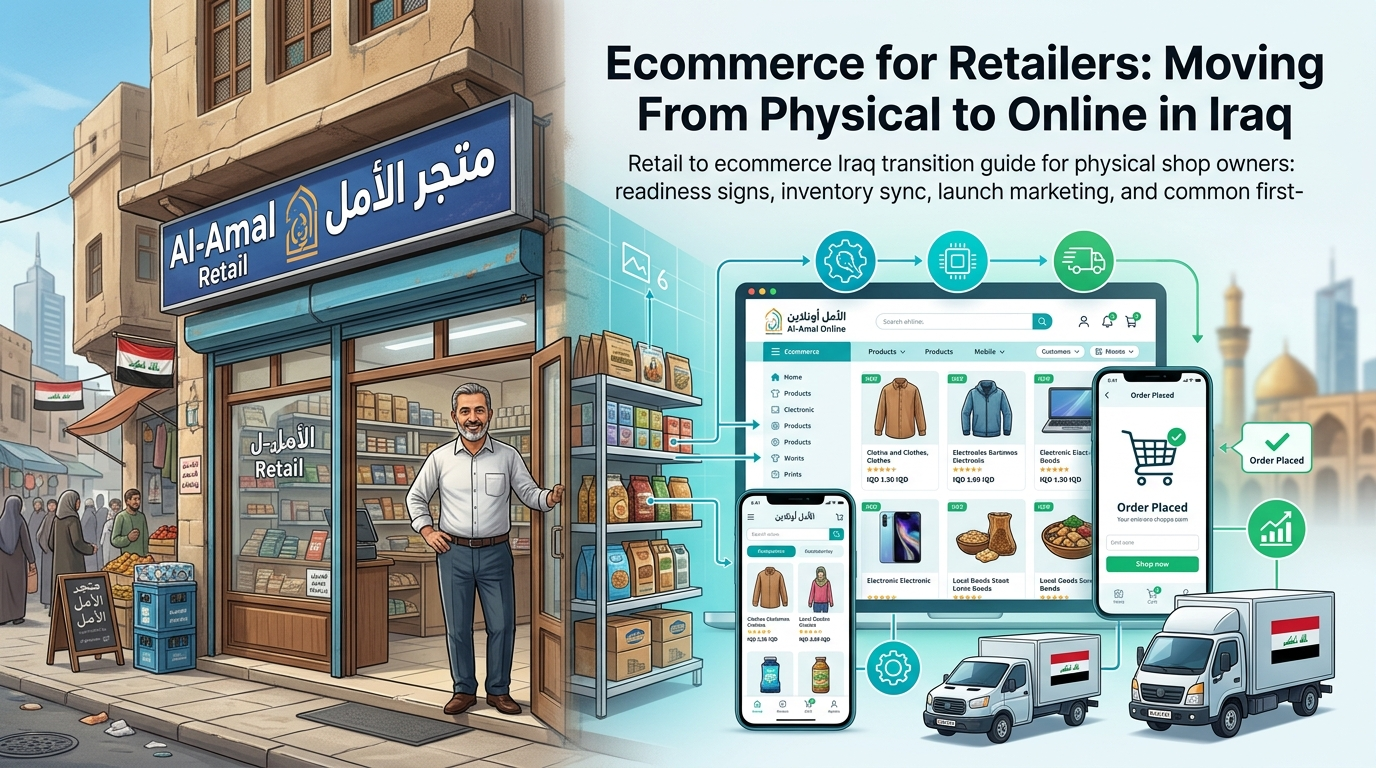
Most content about starting an online store assumes you’re starting from nothing — no existing customers, no inventory system, no brand reputation. That’s not the situation most established Iraqi retailers are actually in. If you’ve run a physical shop for years, built genuine customer trust, and developed real operational habits around your business, the retail to ecommerce Iraq transition looks fundamentally different from a startup launch: you’re not building a business from scratch, you’re extending one that already works.
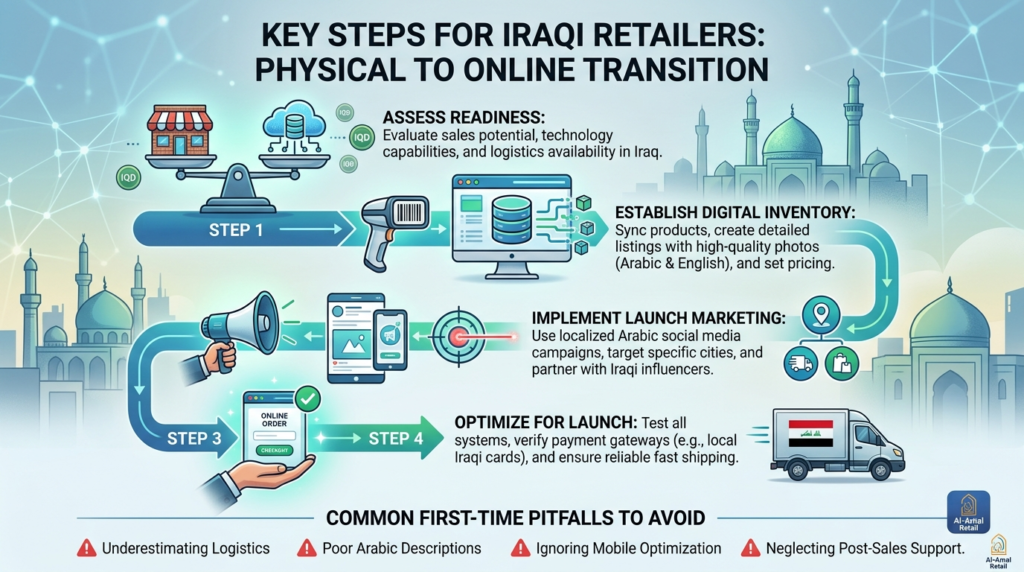
This guide is written specifically for physical retailers considering online expansion — how to recognize genuine readiness signals, what changes operationally once orders start arriving online alongside in-store sales, how to market a launch to customers who already know your shop, the pitfalls that specifically trip up first-time online retailers coming from a physical background, and a framework for evaluating whether the transition is actually working. If you’re weighing whether now is the right time to add an online channel, this guide is built around the questions that actually matter for a business like yours.
Signs Your Retail Business Is Ready to Go Online
Consistent Customer Requests You Can’t Currently Serve
If customers regularly ask whether they can order without visiting in person, whether you deliver, or whether products are available online, these repeated requests are a genuine market signal — you already have demand for online purchasing that your current setup simply isn’t capturing.
Products That Translate Reasonably Well to Online Presentation
Products that can be clearly photographed, accurately described, and don’t require extensive in-person evaluation or fitting translate more readily to online sales than those relying heavily on physical inspection or personalized in-store consultation. This doesn’t rule out harder categories, but it does shape how much additional content and reassurance an online listing needs to compensate for the missing in-person experience.
Operational Bandwidth to Add a New Channel
Adding online sales genuinely adds operational complexity — inventory needs tracking across two channels, orders need fulfillment alongside in-store customer service, and someone needs to manage the online presence itself. A retailer already stretched thin running the physical shop needs a realistic plan for this added capacity, not just enthusiasm about the opportunity.
Inventory & Operations Considerations
Syncing Inventory Across Two Channels
The single most common operational failure for retailers transitioning online is inventory desynchronization — selling a product online that was already sold in-store minutes earlier, or vice versa, leading to cancelled orders and frustrated customers on both channels. Solving this doesn’t necessarily require expensive enterprise software; even a disciplined manual process, if followed consistently, can work for a smaller catalog before investing in automated synchronization becomes necessary.
A Practical Example of the Sync Problem
Consider a home goods shop in Baghdad that had run successfully for over a decade before adding an online store. Within the first month, several customers ordered items online that had already sold in the physical shop that same day, since staff updated the online listing only at closing time rather than throughout the day. The resulting cancellations and apologetic messages damaged exactly the trust the shop had spent years building. Moving to same-day inventory updates — checked at set intervals rather than once daily — resolved the issue, illustrating that the technical fix mattered less than establishing a consistent operational habit around it. This is the kind of retail to ecommerce Iraq transition challenge that has little to do with technology and everything to do with process discipline.
Deciding What to List Online First
Rather than attempting to list an entire physical inventory online immediately, starting with a focused selection of best-selling or most photogenic products lets a retailer learn the operational rhythm of online fulfillment before scaling to the full catalog, reducing the risk of being overwhelmed by online demand before processes are solid.
Fulfillment: In-Store Pickup vs Delivery
Retailers with a physical location have an option online-only sellers don’t: offering in-store pickup alongside delivery. This can reduce delivery logistics complexity initially while still capturing online-originated sales, and it often appeals to local customers who prefer to combine online browsing with a quick in-person pickup.
Marketing an Online Launch
Leveraging Existing Customer Relationships
Unlike a new online-only business starting with zero brand awareness, an established retailer can announce online availability directly to existing customers — through in-store signage, social media accounts already followed by real local customers, and direct outreach to regular buyers — producing faster initial traction than a cold digital launch typically achieves.
Timing the Announcement Around Existing Traffic
Rather than launching quietly and hoping customers discover the online store organically, actively using every point of existing customer contact — a receipt insert, a conversation at checkout, a prominent in-store sign — to announce the new online option converts existing foot traffic into early online adopters far more efficiently than waiting for digital marketing alone to build awareness from zero.
Building Trust Through Continuity, Not From Scratch
Marketing messaging for an online launch should emphasize continuity with the trusted physical business — same products, same quality, same people — rather than presenting the online store as an entirely separate, unproven entity. This continuity is a genuine competitive advantage over online-only competitors who have to build trust from nothing.
Coordinating Online and In-Store Promotions
Running promotions that work across both channels, and making sure in-store staff are aware of and can speak knowledgeably about the online store, prevents customers from receiving inconsistent information or feeling like the two channels are disconnected from each other.
Common Pitfalls for First-Time Online Retailers
Underestimating the Photography and Content Workload
Physical retail doesn’t require product photography or written descriptions the way ecommerce does — a gap that surprises many first-time online retailers who underestimate how much content work is actually involved in listing even a modest product catalog properly.
Treating the Online Store as a Side Project
An online store that receives inconsistent attention — irregular updates, slow response to online inquiries, orders that sit unprocessed because in-store customers take priority — signals to online customers that the channel isn’t taken seriously, undermining the trust advantage an established retailer should otherwise have.
A Quick First-Time Retailer Checklist
- Confirm inventory syncing process, even if manual, before listing products online.
- Start with a focused product selection rather than the entire catalog at once.
- Assign clear responsibility for managing online orders and inquiries promptly.
- Announce the launch directly to existing customers, not just new digital audiences.
Case Framework
What Evidence of a Successful Transition Should Show?
Rather than vague claims about ecommerce success, credible evidence should specify actual metrics before and after the online launch — total revenue by channel, online order volume over time, and customer acquisition specifically attributable to online discovery versus existing customer relationships moving online.
Applying This to Your Own Transition
Online store for retail shop Iraq owners considering should track these same metrics themselves from day one of the transition, since having genuine before-and-after data makes it possible to evaluate whether the online channel is actually adding incremental business, rather than simply shifting existing in-store customers to a different, harder-to-serve channel.
Creative 4 All helps established Iraqi retailers build ecommerce for retailers transitions that extend an existing trusted business online, coordinated with digital marketing in Iraq support to announce the launch effectively to customers who already know your shop.
Request a Free Audit to get an honest assessment of your retail business’s readiness for online expansion, and a realistic plan for the transition.
FAQs
An established retailer already has customer trust, brand recognition, and operational habits that an online-only startup has to build from scratch, which changes both the marketing approach and the realistic timeline for early traction.
No. Starting with a focused selection of best-selling or easily photographed products lets you learn the operational rhythm of online fulfillment before scaling to a full catalog.
Inventory synchronization across in-store and online channels — selling the same item in both places simultaneously is the most common and most disruptive early mistake.
Often, yes. It reduces delivery logistics complexity initially and appeals to local customers who prefer combining online browsing with a quick in-person pickup, taking advantage of an option online-only competitors don’t have.
Announce it directly through in-store signage, existing social media accounts, and direct outreach to regular customers, emphasizing continuity with the trusted physical business rather than presenting the online store as a separate, unproven venture.