
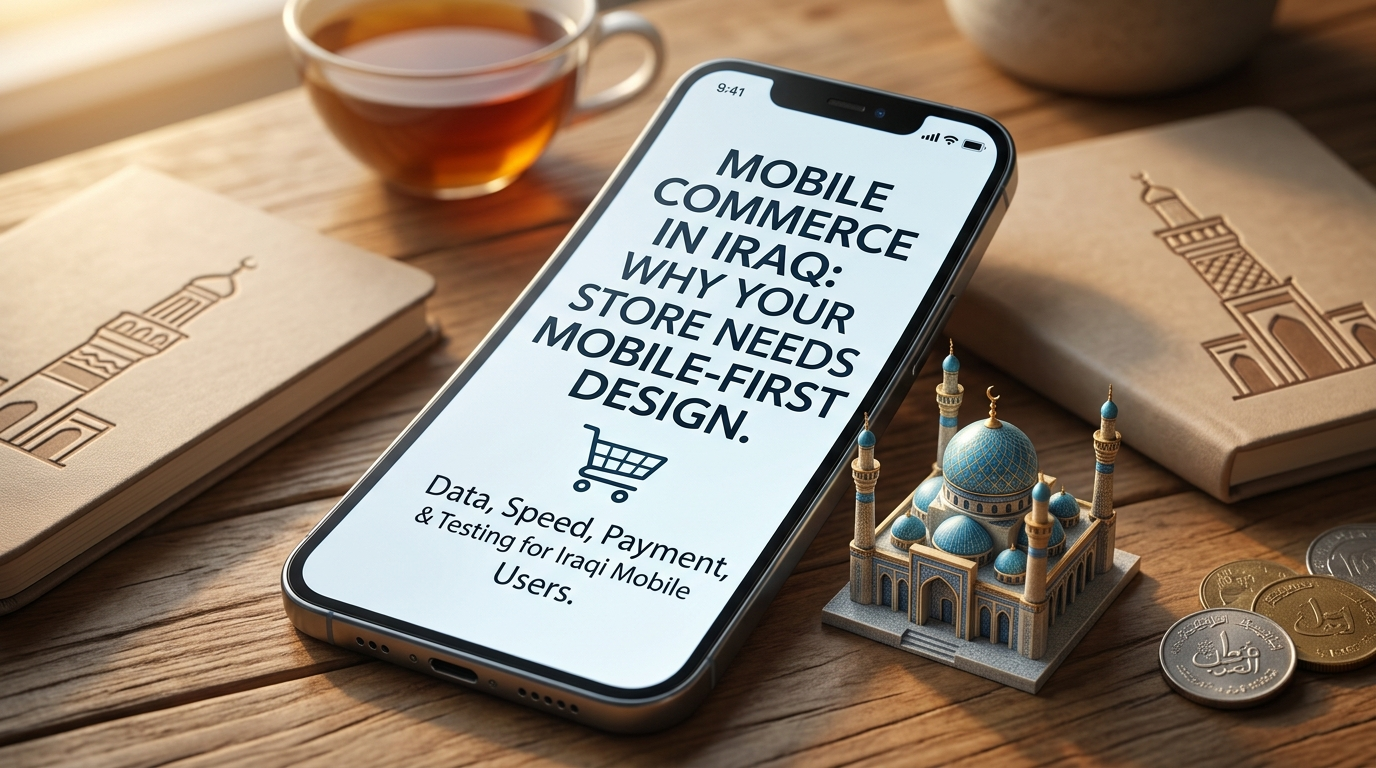
An ecommerce store that isn’t genuinely built mobile-first is turning away the overwhelming majority of its potential Iraqi customers before they ever see a product. According to DataReportal’s Digital 2026 report on Iraq, mobile connections reached 50.8 million by late 2025 — 108 percent of the total population — with GSMA Intelligence data showing 86.2 percent of those connections now classified as mobile broadband. For an online store, mobile commerce Iraq shoppers actually use isn’t a design trend to consider adopting eventually; it’s the default environment your store operates in right now.
This guide grounds the case for mobile-first ecommerce in that verified data, then walks through what mobile-first checkout actually requires, the speed and UX factors that directly affect whether mobile visitors complete a purchase, mobile-specific payment considerations, and how to genuinely test your store’s mobile shopping experience rather than assuming it works. If you’re evaluating whether your store’s mobile experience is actually costing you sales, this guide is built to answer that question directly.
Iraq’s Mobile Shopping Behavior (Verified Data)
The Scale of Mobile Access
Beyond the 50.8 million mobile connections and 86.2 percent broadband classification, mobile internet download speeds in Iraq reached a median of 56.34 Mbps by late 2025, up 71.1 percent year-on-year — a substantial improvement that increasingly supports richer mobile shopping experiences, including product video and image-heavy browsing, without the loading friction that would have limited this even a year or two earlier.
Demographic Context Behind the Numbers
Iraq’s median age of 20.8 as of late 2025, combined with 72.2 percent of the population living in urban centers, points toward a shopping audience skewing young and increasingly urban — a demographic profile strongly associated with mobile-native browsing and purchasing habits rather than desktop-first behavior carried over from an earlier era of internet access.
What This Means for Where Shopping Actually Happens?
With internet users reaching 39.6 million (83.8 percent of the population) and mobile connections exceeding the total population, the practical reality for any Iraqi ecommerce business is straightforward: most product discovery, browsing, and purchasing decisions are happening on a phone, not a desktop. A store optimized primarily for desktop is optimizing for a shrinking minority of its actual traffic.
Why This Matters More for Ecommerce Specifically?
Mobile-first design matters for every type of website, but it carries particular weight for ecommerce, where the entire business outcome — a completed purchase — depends on a multi-step process (browsing, product evaluation, cart, checkout) working smoothly on the device most customers are actually using. A content site with a clunky mobile experience loses some engagement; an ecommerce site with the same problem loses sales directly.
A Practical Example of the Stakes
Consider two competing Iraqi online clothing retailers with comparable product quality and pricing. One built its store primarily for desktop, with mobile handled as an afterthought — small tap targets, a checkout requiring extensive scrolling, and unoptimized images that load slowly on mobile networks. The other invested specifically in mobile-first design, with a streamlined mobile checkout and fast-loading product pages. Given that the large majority of Iraqi shopping traffic arrives on mobile devices, the second retailer captures a meaningfully higher share of the same addressable market, converting visitors the first retailer’s mobile experience actively loses before they ever reach checkout.
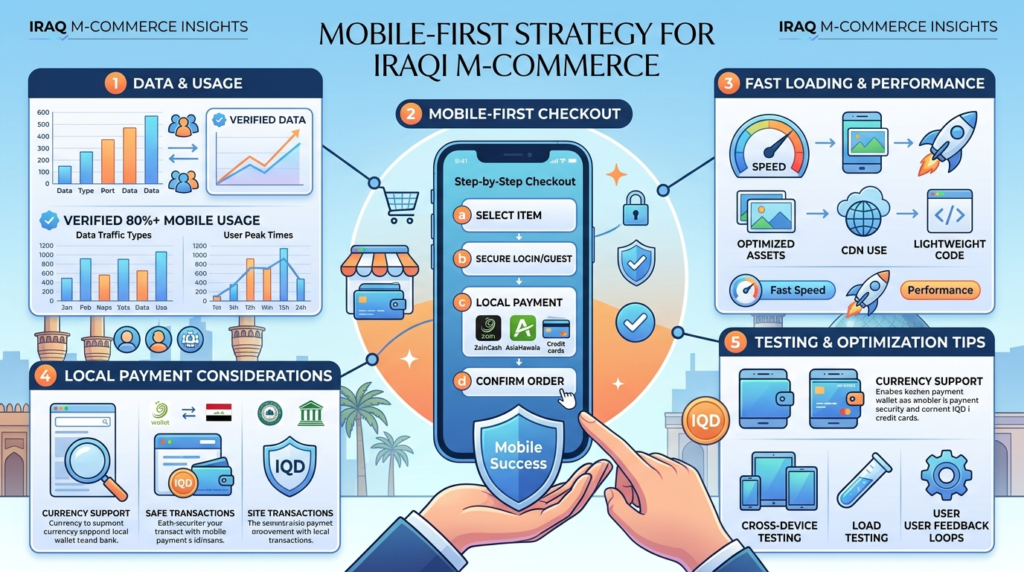
What Mobile-First Checkout Requires?
Minimizing Steps and Required Fields
Every additional field or step in a mobile checkout flow increases abandonment, since typing on a small screen carries more friction than on a desktop keyboard. Reducing required information to the genuine essentials, and offering guest checkout without forcing account creation, meaningfully improves mobile completion rates.
Touch-Friendly Form Design
Form fields, buttons, and selection elements need to be sized and spaced appropriately for touch interaction — small, closely spaced elements that work fine with a precise mouse cursor become a source of frustrating mis-taps on a touchscreen, particularly during the sensitive final steps of checkout.
Autofill and Payment Shortcuts
Supporting browser and device autofill for address and payment information reduces typing burden significantly, and where available, mobile payment shortcuts that avoid manual card entry entirely reduce checkout friction even further, directly improving the odds a mobile visitor completes their purchase.
Speed & UX on Mobile
Why Every Second of Load Time Matters More on Mobile?
Mobile visitors abandon slow-loading pages faster than desktop visitors, particularly on product and checkout pages where impatience compounds with the friction of mobile networks. A product page that loads quickly and clearly shows price, availability, and a prominent “add to cart” action converts meaningfully better than one requiring extensive scrolling or waiting to reach the same information.
Image Optimization Without Sacrificing Quality
Product photography needs to be genuinely optimized for mobile network conditions — compressed appropriately without becoming so degraded that product quality perception suffers — since large, unoptimized images are one of the most common causes of slow mobile loading on ecommerce sites specifically.
Sticky Navigation and Cart Access
Keeping key navigation elements — search, cart, primary categories — easily accessible without excessive scrolling helps mobile shoppers move fluidly between browsing and purchasing intent, rather than losing their place in a longer, unstructured scroll.
Mobile Payment Considerations
Digital Wallets and Mobile-Native Payment Methods
Mobile shoppers increasingly expect payment methods that work naturally on a phone — digital wallets, one-tap payment options, and payment links shareable through messaging apps — rather than only a traditional card entry form better suited to desktop typing.
WhatsApp’s Role in Mobile Commerce?
Given how central WhatsApp is to Iraqi commerce, and how naturally it integrates into mobile browsing behavior specifically, offering a direct WhatsApp contact or payment confirmation option within the mobile shopping experience often converts better than assuming a fully self-service checkout flow alone will satisfy every mobile shopper’s needs.
Cash on Delivery in a Mobile Context
For the many Iraqi shoppers still preferring cash on delivery, the mobile checkout flow needs to make this option just as clear and accessible as any digital payment method, rather than burying it as a secondary option behind a primarily card-focused mobile checkout design.
Testing Your Store on Mobile
Testing on Real Devices Over Real Networks
A desktop browser’s mobile simulator provides a starting reference but doesn’t accurately replicate real mobile network conditions or actual touch interaction. Testing the complete shopping and checkout flow on an actual phone over an actual mobile connection catches usability issues a simulator consistently misses.
A Quick Mobile Commerce Testing Checklist
- Complete a full test purchase on an actual phone, not just a desktop browser resize.
- Check product page load speed specifically under mobile network conditions.
- Verify all checkout form fields are appropriately sized and spaced for touch.
- Confirm cash on delivery and any local payment options are equally accessible to card payment.
Monitoring Real Mobile Performance Over Time
Beyond one-time testing, tracking mobile-specific conversion rate, cart abandonment, and checkout completion in analytics reveals whether real-world mobile shopping behavior matches what testing suggested, since actual customer behavior is the ultimate measure of whether m-commerce Iraq experience is genuinely working.
Creative 4 All builds mobile commerce services around genuine mobile-first design, working closely with our responsive design team to ensure the entire shopping journey — not just the homepage — performs well on the devices most Iraqi customers actually shop on.
Read More on the Ecommerce Blog — or subscribe for future insights on building stores that genuinely work for mobile-first Iraqi shoppers.
FAQs
Given that mobile connections in Iraq (50.8 million) exceed the total population and internet users reached 39.6 million as of late 2025 according to DataReportal, the large majority of ecommerce browsing and purchasing activity happens on mobile devices.
Basic responsiveness handles layout resizing, but genuine mobile commerce also requires touch-friendly checkout design, mobile-optimized images, and payment methods that work naturally on a phone — a more complete standard than resizing alone.
Common reasons include slow loading on mobile networks, checkout forms poorly suited to touch and small-screen typing, and unclear pricing or shipping information requiring excessive scrolling to find.
Yes. Many Iraqi mobile shoppers still prefer cash on delivery, so mobile checkout design needs to present it as clearly and accessibly as any digital payment method, not as a secondary or hidden option.
Complete an actual purchase on a real phone over a real mobile connection, and review mobile-specific analytics for cart abandonment and checkout completion rates rather than relying solely on desktop testing or overall conversion averages.