In Iraq, a surprising amount of business is won before anyone visits your website. A procurement officer asks for your company profile by email. A developer’s project manager wants something to forward to the owner. A tender committee flips through a stack of submissions, comparing contractors side by side. In each case, a single document has to explain who you are, what you have done, and why you can be trusted with the next job. Many Iraqi companies treat that document as an afterthought, a few pages assembled years ago and never updated. That is a missed opportunity, because a strong company profile often decides who gets shortlisted.
This guide explains how to plan, write, and design a company profile that works for Iraqi clients and tender committees: which sections to include, how to handle Arabic and English, how to present projects credibly, how print and digital versions differ, and how the profile connects to your website and wider brand.
What a Company Profile Is and Why Iraqi Businesses Need One?
A company profile is a structured document, usually a PDF and sometimes a printed brochure, that introduces your business to clients, partners, investors, and procurement teams. It summarizes your history, services, capabilities, experience, and credentials in a format that is easy to share and easy to compare.
Where Company Profiles Are Used in Iraq?
Contractors, engineering firms, suppliers, consultancies, logistics companies, and service providers use a company profile constantly: attached to quotation emails, submitted with tender documents, handed out at exhibitions, sent through WhatsApp to decision-makers, and printed for meetings. B2B companies working with international organizations or oil and gas operators are often asked for one before any conversation begins.
A Company Profile Is Not a Replacement for Required Documents
Tender submissions in Iraq usually require specific legal and financial documents, such as registration certificates and other papers listed in the tender requirements. A company profile supports those documents; it does not replace them. Always follow the exact list in the tender documents, and treat the profile as the part that persuades rather than the part that qualifies.
The Sections Every Company Profile Should Include
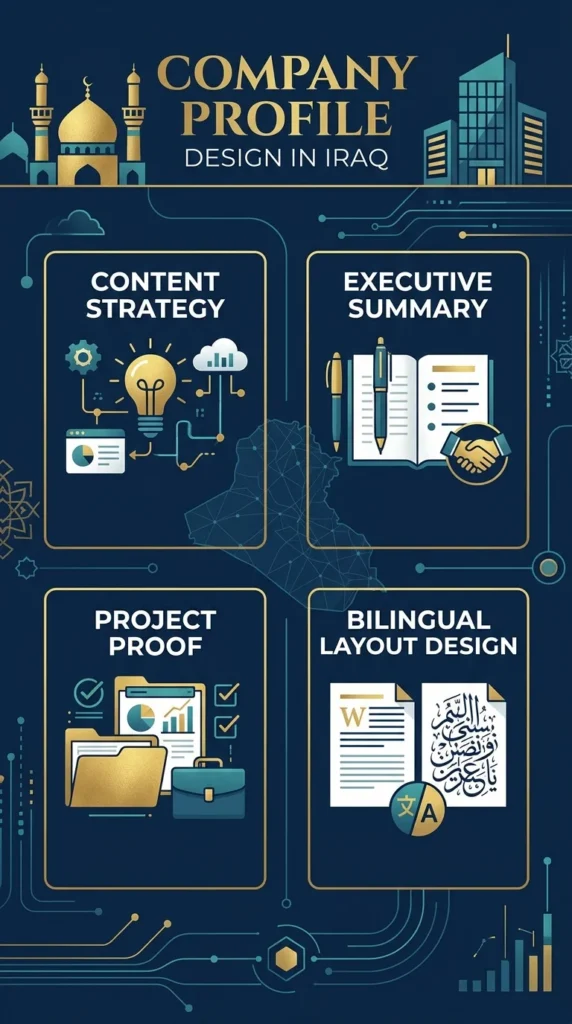
The best profiles answer the reader’s questions in the order they ask them. Most readers want to know who you are, what you do, what you have done, and how to contact you.
Cover and Introduction
The cover should carry your logo, company name in Arabic and English, a short descriptive line, and the year or edition. The introduction page explains in a few paragraphs what the company does, for whom, and since when. Avoid opening with a long message from the chairman full of general statements. Readers skim; give them facts first.
About the Company
Here you describe your history, legal status, locations, team size, and the markets you serve. Mention the cities where you operate and whether you work across Iraq or in specific regions. If you have offices in Baghdad, Erbil, or Basra, say so clearly. A company profile that is vague about where the company actually operates raises questions for procurement teams.
Services and Capabilities
List your services with short, specific descriptions. “Civil works, MEP installation, and fit-out for commercial buildings” is more useful than “integrated solutions for all your needs.” If you have equipment, facilities, or specialist capabilities, describe them here. Capabilities are often what separates one contractor from another in a tender comparison.
Projects and Experience
This is usually the most important section of a company profile. Present selected projects with the client name (where permitted), location, scope, year, and a photo. Group them by sector if you work across several. Quality matters more than quantity: five well-documented projects are more convincing than forty names in a list.
Certifications, Partnerships, and Team
Include certifications you genuinely hold, such as ISO standards, safety accreditations, or manufacturer partnerships, with dates where relevant. Introduce key team members with their roles and experience. Never list certifications that have expired or that belong to a partner rather than your company; procurement teams check.
Contact Details
End with complete contact information: address, phone numbers, email, website, and a WhatsApp number if that is how clients reach you. Make sure every detail matches your website and Google Business Profile. Inconsistent contact information in a company profile looks careless.
Arabic, English, or Both?
Language is a practical decision that depends on who reads your profile.
Match the Language to the Reader
Iraqi government bodies and many local clients expect Arabic. International organizations, foreign partners, and oil and gas operators usually expect English. Many companies need both. Some Kurdistan Region businesses also need Kurdish. Before designing, list your most important audiences and decide which language each one needs.
Separate Versions or a Bilingual Document?
A side-by-side bilingual layout can work for short documents, but it often becomes crowded and hard to read. For most companies, separate Arabic and English versions of the company profile are cleaner, easier to update, and easier to send to the right audience. If you choose separate versions, keep the structure and design identical so they clearly belong to the same company.
Write Each Version Properly
A literal translation of an English profile into Arabic, or the reverse, usually reads awkwardly. Have each version written or edited by someone fluent in that language and familiar with business writing. Terminology matters especially in technical sectors: use the terms your clients use. Our article on bilingual website design covers similar challenges for websites.
Presenting Projects and Credentials Credibly
Credibility is the whole point of a company profile. Everything in this section should be specific, verifiable, and honest.
Use Real Photos Wherever Possible
Photos of your actual projects, team, equipment, and facilities are far more persuasive than stock images. A procurement officer can spot stock photography immediately, and it makes them wonder what you are hiding. If project photography is weak, invest in a professional photographer for your best sites before redesigning the profile.
Be Careful With Client Names and Logos
Only display client names and logos where you have permission or the relationship is public. Some clients, especially in government or security-sensitive sectors, do not want to be named. In those cases, describe the project by sector and scope instead. Overstating relationships is a fast way to lose trust if the reader knows the client.
Show Numbers You Can Support
Figures such as years of experience, completed projects, team size, or project values strengthen a company profile, but only if they are accurate. Avoid vague superlatives like “the leading company in Iraq” unless you can prove them. Specific, modest facts persuade experienced buyers more than big claims.
Design and Layout That Make a Company Profile Easy to Read
Good design is not decoration. It helps busy readers find information fast and makes your company look organized.
Follow Your Brand Identity
The profile should use your logo, colors, and typography consistently. If your brand guidelines are weak or missing, the company profile is often where inconsistency becomes most visible. Our guide to branding for Iraqi businesses explains why a consistent identity matters across every document and channel.
Structure for Skimming
Use clear headings, short paragraphs, generous white space, and a consistent grid. Put key facts, such as years of operation, sectors served, and major projects, where the eye lands first. A reader comparing ten submissions will not read every paragraph, so make the important points impossible to miss.
Arabic Typography and Right-to-Left Layout
For Arabic versions, choose a professional Arabic font that is readable in print and on screens, and make sure layouts, page numbering, and image placement follow right-to-left logic. Poorly handled Arabic typography is one of the most common weaknesses in Iraqi company profiles, and it undermines an otherwise strong document.
Print and Digital Versions
Most companies need a company profile in more than one format.
The Digital PDF
The PDF is what you will send most often, by email and WhatsApp. Keep the file size reasonable so it opens quickly on mobile data and passes through email attachment limits. Add clickable links to your website, email, and WhatsApp. Name the file clearly, for example with your company name and the year, so it is easy to find in a crowded inbox.
The Printed Brochure
Printed profiles still matter at exhibitions, meetings, and formal submissions. Print versions need higher-resolution images, correct bleed and margins, and good paper. Ask your designer to prepare separate print-ready files rather than printing the email PDF.
Keep One Master Version Updated
Decide who owns the profile and how often it is reviewed. Updating projects, team, and certifications once or twice a year keeps the company profile current. An outdated profile listing a manager who left two years ago tells the reader your company does not pay attention to detail.
How Your Company Profile Connects to Your Website?
Most serious buyers who receive your company profile will also look at your website before shortlisting you. If the two tell different stories, trust drops.
Keep Content and Design Consistent
Your services, projects, and contact details should match across the profile and the website. Ideally, the website’s projects section expands on the profile’s highlights with more photos and detail. A downloadable profile on your website is also useful for visitors who need to forward something internally.
Use the Website for What a PDF Cannot Do
A website can be updated instantly, found through search, and tracked. A PDF cannot. Use the profile as a concise, shareable summary and the website as the living, detailed version. If your website does not yet support this role, our web design and development services in Iraq can help align both.
Frequently Asked Questions About Company Profiles
For most Iraqi companies, a profile of roughly 8 to 20 pages works well: long enough to show capability and projects, short enough to read quickly. Large contractors with many sectors may need more, but every page should earn its place.
A template can help with structure, but a profile built entirely from a generic template often looks like everyone else’s. Use templates for inspiration and build the final design around your own brand and content.
Review it at least once or twice a year, and immediately after major projects, certifications, or team changes. An up-to-date company profile signals an active, well-run company.
Usually not. Prices change and depend on project scope. Include them in quotations and proposals instead, and keep the profile focused on capability and credibility.
Make Your Company Profile Work as Hard as Your Team
A strong company profile helps Iraqi businesses get shortlisted, win tenders, and earn trust before the first meeting. Focus on clear sections, honest projects and credentials, the right languages, professional design, and versions that work both on screen and in print. Then keep it updated and consistent with your website.
If your current profile no longer reflects your company, Creative 4 All can help you plan the content and design it in Arabic and English. Explore our graphic design services in Iraq