A furniture company in Baghdad launches a new website, runs its first Instagram campaign, and watches the site slow to a crawl the moment traffic arrives. A clinic in Najaf pays for an expensive server it barely uses. An online store in Erbil keeps getting “resource limit reached” emails from its host during evening sales. All three have the same underlying problem: the hosting does not match the business. Choosing between shared hosting, a VPS, cloud hosting, and a dedicated server sounds technical, but the decision comes down to a few practical questions about traffic, budget, security, and who will manage the server.
This guide compares the four main hosting types in plain terms for Iraqi businesses. You will learn how each works, how they differ in performance and security, why server location matters for visitors in Iraq, what drives the cost, and the signs that tell you it is time to move from shared hosting to a VPS or beyond.
The Four Hosting Types in Plain Terms
Think of hosting like renting space for your business. The options range from a desk in a shared office to your own building.
Shared Hosting
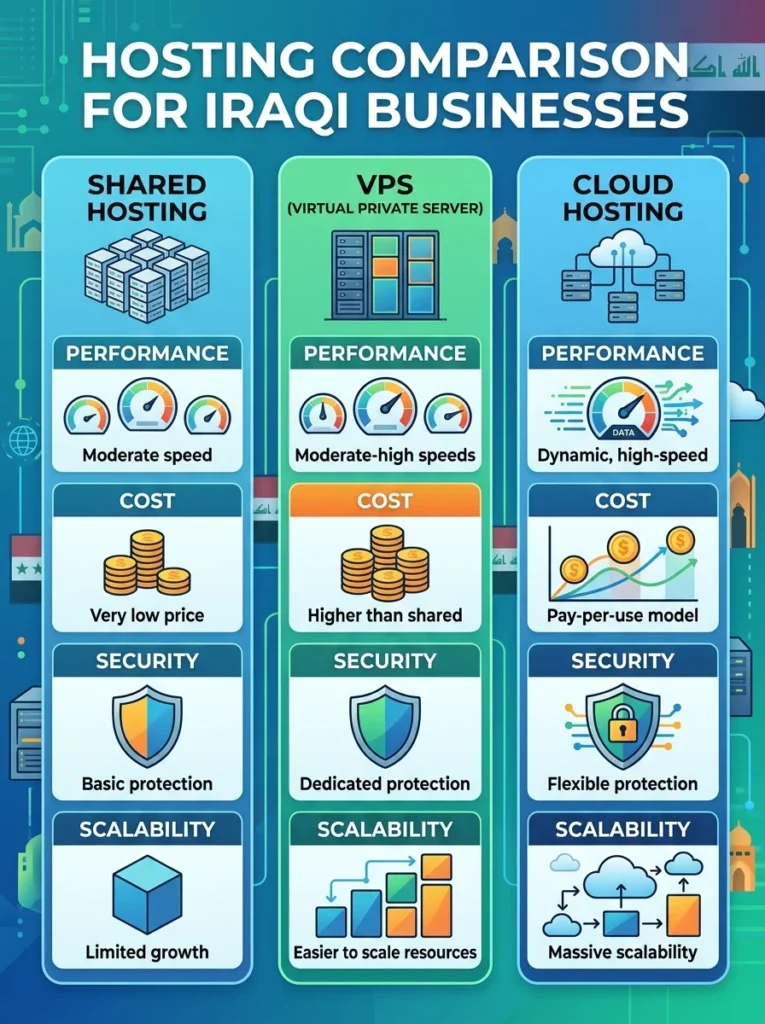
With shared hosting, your website lives on a server alongside many other websites, all sharing the same processor, memory, and storage. It is the cheapest and simplest option, and the hosting company handles almost all technical management. For a small company website with modest traffic, it is often enough. The downside is that you share resources: if another site on the server gets a traffic spike or is poorly built, your site can slow down too.
VPS Hosting
A VPS, or virtual private server, divides one physical server into several isolated virtual servers. Each VPS has guaranteed resources, such as a set amount of memory and processor power, and its own operating system. Your site is no longer affected by your neighbors’ activity in the same way. A VPS offers more control and better performance than shared hosting, but it usually needs more technical management unless you choose a managed VPS plan.
Cloud Hosting
Cloud hosting runs your site across a network of servers rather than one machine. Resources can often be increased quickly when traffic grows, and many cloud setups are billed according to usage. Cloud hosting suits sites with unpredictable traffic, such as stores running big campaigns, but it can be complex to configure and its costs can be harder to predict without monitoring.
Dedicated Servers
A dedicated server is an entire physical machine reserved for your business. You get all its resources and full control. It suits large, high-traffic platforms, demanding applications, or organizations with specific compliance or configuration needs. It is also the most expensive option and requires serious technical expertise to manage securely.
Performance: What Iraqi Visitors Actually Experience
Hosting affects how quickly your pages load, how many visitors your site can handle at once, and how it behaves during traffic spikes.
Resources and Traffic Spikes
On shared hosting, a sudden surge from a successful ad campaign can hit resource limits, slowing the site or triggering temporary errors exactly when interest is highest. A VPS gives you dedicated resources to absorb normal spikes. Cloud hosting can scale further when configured correctly. If your business depends on campaigns, seasonal sales, or Ramadan promotions, plan hosting for your busiest day, not your average one.
Server Location and Latency
Physical distance between the server and the visitor affects response time. Many Iraqi websites are hosted in Europe or the Gulf rather than inside Iraq, and the right choice depends on the provider’s network quality, reliability, and support as much as on geography. Rather than assuming, test real load times from Iraq on mobile connections. A content delivery network (CDN) can also serve images and static files from locations closer to your visitors, which helps regardless of where the main server sits.
Hosting Is Only Part of Speed
Even the best server cannot rescue a site with huge images, dozens of plugins, and heavy scripts. Moving from shared hosting to a VPS improves the foundation, but you still need an optimized website. Our older article on how hosting affects SEO explains how server performance and search visibility connect.
Security and Isolation
Security differs significantly between hosting types, and so does responsibility.
Shared Hosting Security
Reputable shared hosts isolate accounts reasonably well, but you still share a server with many other sites. A vulnerability on the server or poor isolation can create risks. You also have limited control over server-level security settings, so you depend heavily on the host’s standards.
VPS and Dedicated Security
A VPS or dedicated server isolates your environment much more strongly, but security becomes partly your responsibility. Someone must apply operating system updates, configure firewalls, manage access, and monitor for threats. An unmanaged VPS that nobody maintains can be less secure than good shared hosting. That is why managed plans, where the provider or an agency handles server security, are often the sensible choice for businesses without in-house system administrators.
Backups Regardless of Hosting Type
Whatever you choose, keep independent backups stored away from the server and test restoring them. Hosting type changes how you back up, not whether you need to. Our guide to website maintenance in Iraq covers backup routines in detail.
Cost Drivers, Not Price Lists
Hosting prices change constantly and vary by provider, so a price list would be out of date quickly. What matters is understanding what drives cost.
Resources
Memory, processor cores, storage type and size, and bandwidth allowances are the main factors. Fast SSD or NVMe storage costs more than older drives but noticeably improves performance. Our explainer on bandwidth and disk space helps you understand what these limits actually mean.
Management Level
Managed hosting, where the provider handles updates, security, and support, costs more than unmanaged hosting but saves staff time and reduces risk. When comparing a cheap unmanaged VPS with a managed plan, include the cost of someone’s time to manage it, or the cost of problems if nobody does.
Support, Location, and Extras
Responsive support, data center location, backups, staging environments, control panels, and licenses for software such as cPanel can all add cost. Support in Arabic, or at least during Iraqi working hours, has real value when something breaks on a busy day.
Managed vs Unmanaged VPS: The Choice That Matters Most
Once you decide a VPS is right, the next decision is often more important than the server size: who will manage it?
What You Get With an Unmanaged VPS?
An unmanaged VPS gives you the server and little else. You or your developer install and configure the web server, database, security tools, backups, and monitoring, and you keep them updated. It is the cheapest way to get dedicated resources, and it suits teams with real system administration experience.
What You Get With a Managed VPS?
A managed VPS includes server setup, security patching, monitoring, and support from the provider or your agency. You focus on the website; someone else keeps the server healthy. For most Iraqi businesses without in-house system administrators, a managed VPS is the safer and, once staff time is counted, often the more economical choice.
Which Hosting Type Fits Your Business?
There is no universally best option, only the best fit for your current stage.
Small Company Websites
A brochure-style company site with a few pages, a contact form, and moderate traffic usually runs well on quality shared hosting. Choose a reputable host with good performance and support rather than the cheapest plan available.
Growing Businesses and Busy Content Sites
If your site runs regular ad campaigns, publishes frequently, or has started hitting resource limits, a managed VPS is often the natural next step. You get predictable resources and better performance without having to become a server expert.
Online Stores and Web Applications
Ecommerce sites, booking systems, and custom applications usually need at least a VPS, and sometimes cloud hosting if traffic swings sharply during campaigns. Checkout speed and reliability directly affect revenue, so under-powered hosting is a false saving.
Large Platforms and Specialized Needs
High-traffic platforms, large organizations, or applications with special requirements may justify dedicated servers or carefully architected cloud setups, typically managed by an experienced technical team.
Signs It Is Time to Move From Shared Hosting to a VPS
Most businesses start on shared hosting, and many should. The question is recognizing when you have outgrown it.
Warning Signs on Shared Hosting
Watch for regular slowdowns at busy times, emails from your host about resource limits, errors during campaigns, slow admin dashboards, and difficulty installing the software versions you need. Any of these suggests your site has outgrown its environment and a VPS may be the right move.
Plan the Migration Carefully
Moving to a new server should not cost you rankings or downtime. Back up everything, test the site on the new server before switching DNS, schedule the move for a quiet period, and check forms, SSL, email, and redirects immediately afterward. A careful migration from shared hosting to a VPS is usually invisible to visitors.
A Quick Hosting Decision Table
Use this summary as a starting point:
| Hosting type | Best for | Main trade-off |
|---|---|---|
| Shared hosting | Small company sites, low traffic | Shared resources, less control |
| Managed VPS | Growing businesses, campaigns, small stores | Higher cost than shared |
| Cloud hosting | Unpredictable traffic, scaling needs | Complexity, variable costs |
| Dedicated server | Large platforms, special requirements | Highest cost and expertise needed |
The right choice often changes as your business grows, so review hosting at least once a year.
Frequently Asked Questions About Hosting Types
A VPS offers dedicated resources, better isolation, and more control, so it usually performs better under load. But for a small, low-traffic site, quality shared hosting can be perfectly adequate and simpler to manage.
Not necessarily. Network quality, reliability, support, and security matter as much as location. Test actual load times from Iraq, consider a CDN, and choose the provider that performs best for your visitors.
An unmanaged VPS requires server administration skills. A managed VPS shifts most of that work to the provider or your agency, making it practical for businesses without technical staff.
Yes. Websites can be migrated between hosting types without rebuilding, as long as the move is planned, tested, and done with full backups.
Choose Hosting for the Business You Are Building
The best hosting is the one that matches your traffic, your growth plans, and your team’s capacity to manage it. Shared hosting suits many small sites; a managed VPS fits most growing businesses; cloud and dedicated options serve larger or more demanding platforms. Whatever you choose, pair it with backups, monitoring, and a well-optimized website.
If you are unsure which option fits, Creative 4 All can review your site’s traffic and needs and recommend the right setup. Explore our web hosting and domain services in Iraq, see our web design and development services, or get a free quote for your hosting.