
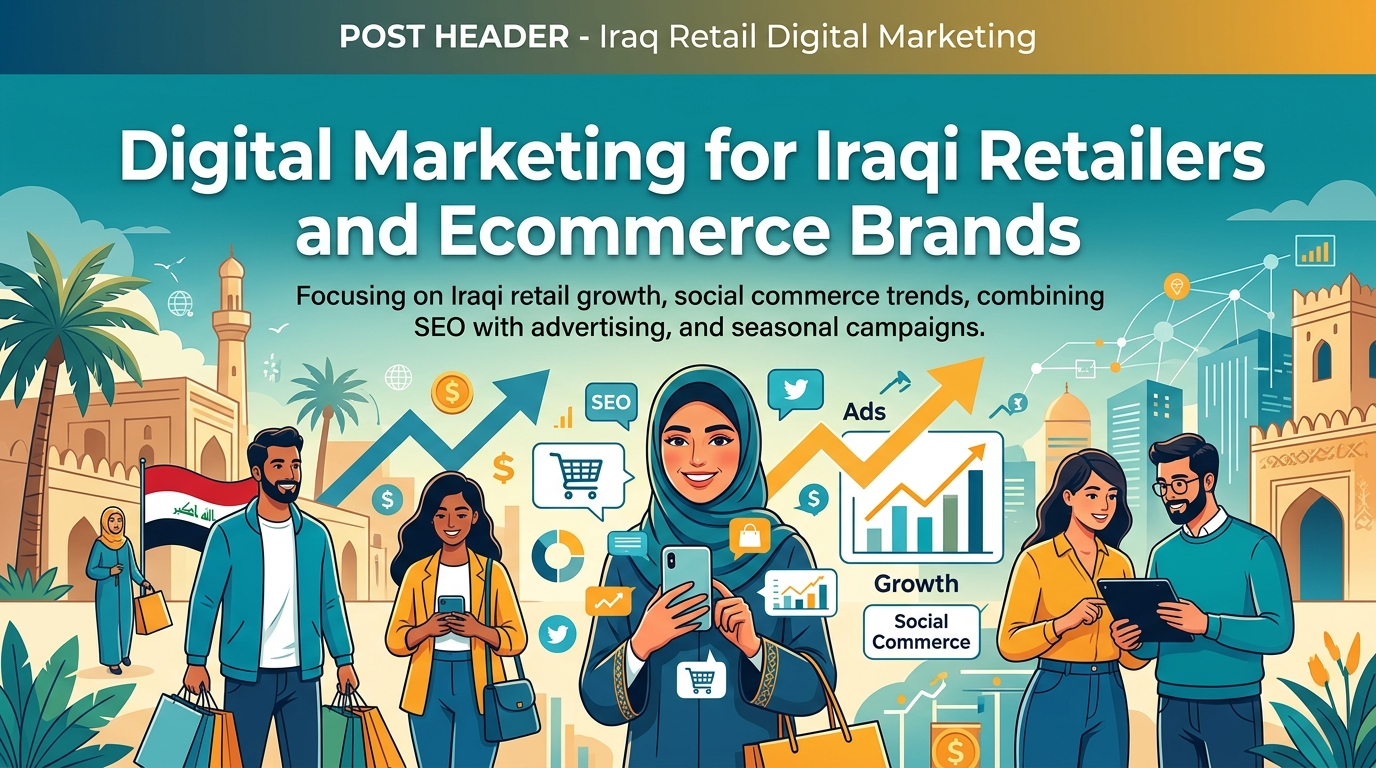
Iraq’s retail industry is projected to grow at a compound annual rate of 6.7% between 2024 and 2030, according to market research firm 6Wresearch, with the online distribution channel expected to grow faster than any other segment as e-commerce continues gaining ground alongside traditional retail formats. That combination — steady overall retail growth plus a disproportionately fast-growing online channel — makes digital marketing for retail Iraq businesses invest in one of the more data-backed, verifiably strong opportunities covered in this content series.
This guide covers what retail and ecommerce businesses in Iraq specifically need from their digital marketing: how the shift toward online retail is playing out, social commerce trends worth acting on now, how to combine SEO, paid ads, and social media into one coherent retail strategy, seasonal campaign planning, and a framework for building the kind of case evidence that actually demonstrates results. If you run a retail or ecommerce business trying to decide where to invest next, this guide is built to answer that question with actual market data behind it, not general assumptions.
Why Retail Marketing in Iraq Is Shifting Online?
The Data Behind the Shift
Beyond the overall 6.7% projected retail growth, the underlying drivers are worth understanding directly: rising disposable income, growing urbanization, and improving internet penetration are together pushing more retail activity toward digital channels, with the online distribution channel specifically singled out as the fastest-growing segment within Iraq’s broader retail market. Retail marketing Iraq strategies built without accounting for this online shift are positioning for a market that’s already changing underneath them.
What This Means Practically for Retailers?
A retailer that treats its digital presence as secondary to physical stores is underinvesting in the channel projected to grow fastest. This doesn’t mean physical retail is becoming irrelevant — Iraq’s retail growth is broad-based across formats — but it does mean a digital marketing strategy built only to support foot traffic, rather than to compete for online-native purchase decisions, is leaving meaningful growth on the table.
A Practical Example of the Shift in Action
Consider a Baghdad-based home goods retailer with a strong physical store but a minimal online presence. As online distribution grows faster than the overall retail market, this retailer’s competitors investing properly in ecommerce, social commerce, and SEO capture a growing share of the same customer base — not because the physical store lost appeal, but because more of that customer’s actual purchase journey now starts and often completes online. A retailer positioned only for foot traffic is competing for a shrinking share of a growing market, which is a structurally weaker position than it might initially appear.
Omnichannel as the Realistic Target
Rather than treating online and offline retail as competing channels, the strongest positioning treats them as connected: a customer might discover a product on social media, research it further through a Google search, and complete the purchase either online or in-store. Digital marketing for retail Iraq brands build increasingly has to support this connected journey rather than optimizing for a single channel in isolation.
Social Commerce Trends
Why Social Platforms Are Becoming Storefronts?
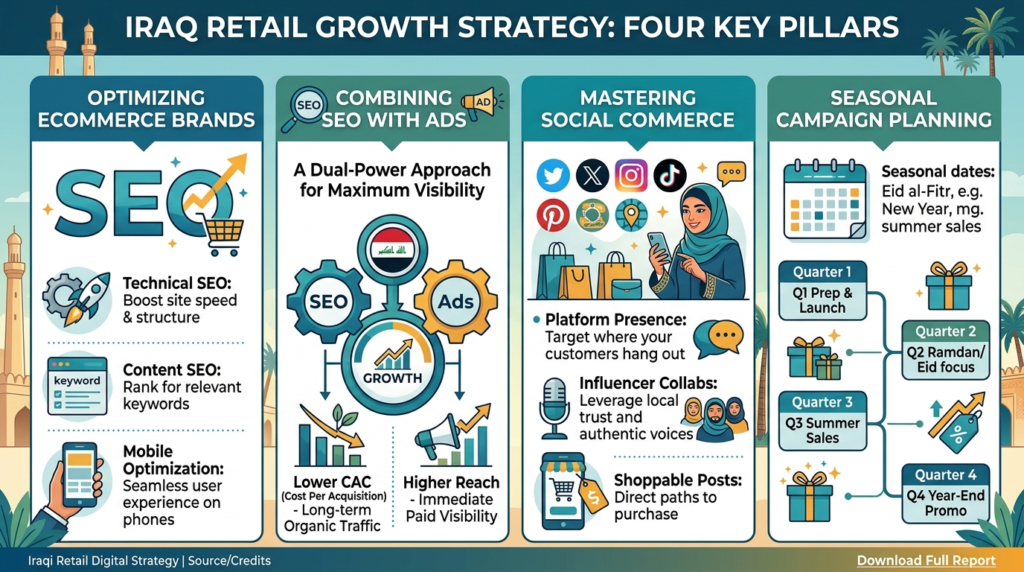
Social commerce — discovering and purchasing products directly through social media platforms, rather than social media simply driving traffic to a separate website — is an increasingly significant behavior pattern for Iraqi consumers, particularly for visually driven product categories like fashion, home goods, and beauty. Ecommerce marketing Iraq strategies that treat social media purely as a top-of-funnel awareness channel, without a direct path to purchase, are missing where a meaningful share of actual buying decisions now happen. This shift toward social-native purchasing is one of the fastest-moving parts of the broader retail transition already underway.
What This Requires Practically?
Supporting social commerce well means product tagging and shopping features enabled where platforms support them, consistent and current product information across social channels and the primary website, and a checkout or inquiry process that doesn’t require excessive friction to move from social discovery to completed purchase. For many Iraqi retailers, WhatsApp remains a critical bridge in this process, since a social media discovery frequently converts through a direct WhatsApp conversation rather than an online checkout flow.
User-Generated Content and Social Proof
Real customer photos, reviews, and organic mentions carry outsized trust value for retail purchases, particularly for categories where quality or fit is hard to judge from a product photo alone. Actively encouraging and showcasing genuine customer content, rather than relying solely on professional product photography, builds the kind of social proof that increasingly influences Iraqi purchase decisions.
Combining SEO, Ads and Social for Retail
Why Retail Needs All Three Working Together?
A retail business relying on only one channel typically leaves meaningful opportunity uncaptured: SEO builds durable, high-intent organic traffic for specific product and category searches, paid ads capture immediate demand and support seasonal pushes, and social media builds brand awareness and drives discovery earlier in the purchase journey. Treating these as one integrated retail strategy consistently outperforms running them as disconnected activities, and it’s the core principle behind effective digital marketing for retail Iraq brands should adopt as the market’s online channel continues to grow.
Product-Level SEO as the Foundation
Individual product and category pages need genuine optimization — unique descriptions, proper schema markup, and clean site architecture — since this technical and content foundation is what paid and social traffic ultimately lands on. Strong upstream marketing driving traffic to poorly optimized product pages wastes much of that investment at the final, most important step.
Layering Paid and Social on the SEO Foundation
Once product pages are properly optimized, paid campaigns can target the same high-intent terms SEO is building toward, accelerating visibility for competitive terms while organic rankings mature, and social campaigns can drive awareness and discovery that eventually convert through either paid or organic search. This layered approach makes each channel’s contribution measurable rather than blending into an undifferentiated marketing spend.
Seasonal Campaign Planning
Planning Around Iraqi Shopping Patterns
Retail demand in Iraq follows predictable seasonal patterns tied to religious observances, national holidays, and back-to-school periods, each representing a distinct planning window with its own timeline and messaging needs. Building a content and campaign calendar around these known patterns, rather than reacting to them as they arrive, gives enough lead time to prepare product pages, inventory-aware promotions, and campaign creative properly.
Balancing Evergreen and Seasonal Content
While seasonal campaigns capture concentrated demand spikes, evergreen product and category content continues working year-round, meaning a retail content strategy needs both: dedicated seasonal campaign pages and promotions timed to specific periods, alongside consistently maintained core product content that doesn’t depend on any particular calendar moment.
A Quick Seasonal Planning Checklist
- Map major Iraqi shopping periods well in advance rather than planning reactively.
- Prepare seasonal landing pages and promotions with enough lead time for proper SEO indexing.
- Coordinate inventory planning with marketing timing to avoid promoting out-of-stock products.
- Review post-season performance to refine timing and messaging for the following year.
Case Framework
What Retail Success Evidence Should Actually Show?
Rather than vague claims about improved retail performance, credible evidence should specify the actual starting metrics (organic traffic, conversion rate, or revenue by channel before changes), the specific work implemented (product page optimization, schema addition, social commerce setup, paid campaign structure), and the measured outcome over a defined, realistic timeframe — sourced from analytics and sales data rather than approximated.
Applying This Framework to Your Own Business
Digital marketing for retail Iraq businesses evaluating any provider’s claimed results should ask for exactly this level of specificity, and should expect the same standard applied to their own reporting once a campaign is underway — retail marketing performance is measurable enough that vague, high-level summaries shouldn’t be the norm.
Creative 4 All builds digital marketing for retail Iraq strategies as part of comprehensive digital marketing in Iraq engagements, working closely with the ecommerce team and social media marketing specialists to build the connected SEO, ads, and social strategy modern retail requires.
Request a Free Audit to see how your retail or ecommerce brand’s current digital presence stacks up, and where the biggest opportunities lie given Iraq’s growing online retail channel.
FAQs
According to market research firm 6Wresearch, Iraq’s retail industry is projected to grow at a 6.7% compound annual rate between 2024 and 2030, with online retail specifically expected to be the fastest-growing distribution channel within that broader growth.
It depends on the product category and customer behavior. Visually driven categories often see faster traction on social media, while SEO builds more durable, long-term visibility for specific product searches. Most retailers benefit from starting both, even at a modest scale, rather than choosing one exclusively.
Very important. Many Iraqi retail purchase journeys move from social media discovery to a direct WhatsApp conversation rather than a fully online checkout, making WhatsApp integration a practical necessity rather than an optional add-on.
Planning reactively rather than well in advance, which leaves insufficient time for proper SEO indexing of seasonal pages and for inventory planning to align with promotional timing.
Look for reporting tied to specific, measurable outcomes — organic traffic to product pages, conversion rate, and revenue by channel — with a documented starting point and timeframe, rather than vague claims of improvement without verifiable detail.