
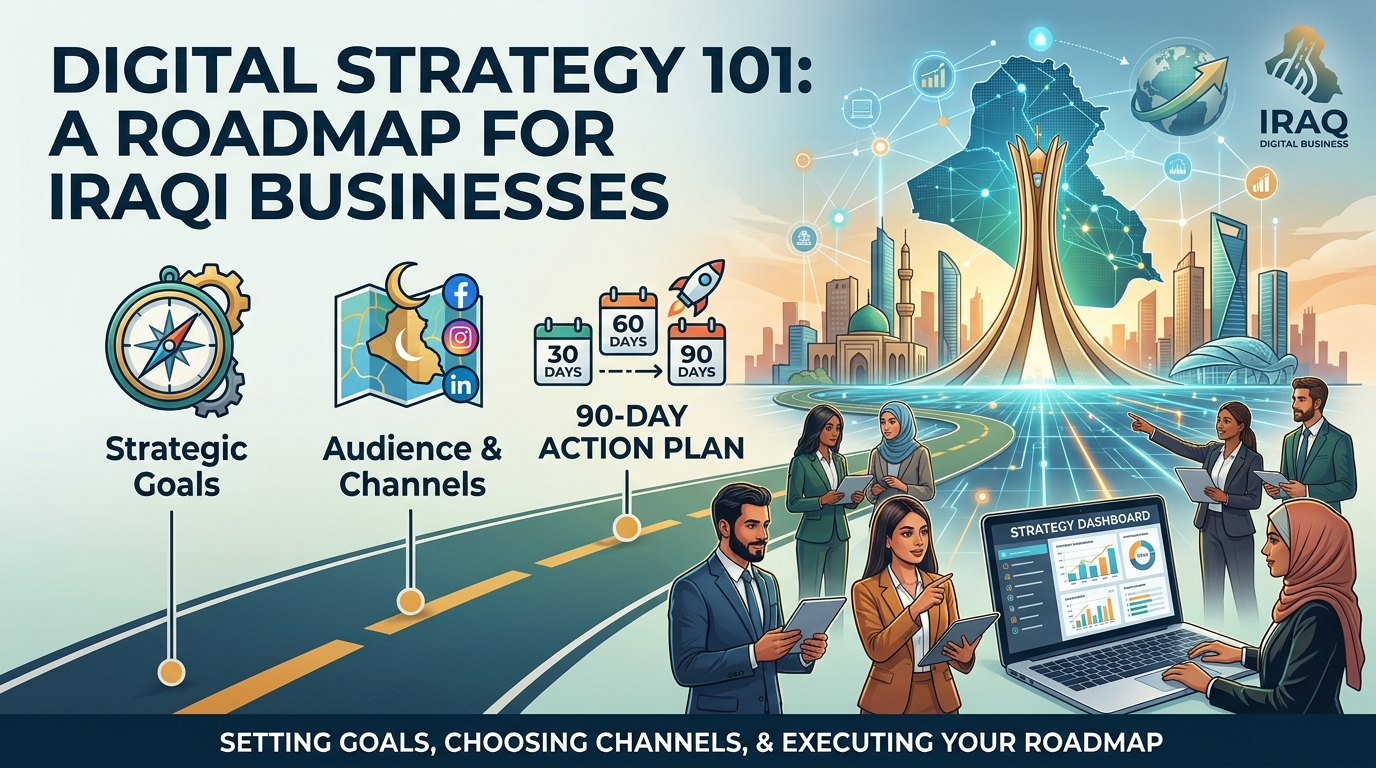
Most businesses don’t fail at digital marketing because they picked the wrong channel — they fail because they never had a strategy connecting the channels to a clear goal in the first place. A digital strategy Iraq business owners actually need isn’t a list of tactics to execute; it’s the reasoning that decides which tactics matter, in what order, and how success will actually be measured. Without that reasoning, even well-executed individual tactics tend to pull in different directions rather than building toward anything cumulative.
This guide walks through what a genuine digital strategy includes, how to set goals that are actually achievable rather than aspirational guesses, how to choose channels based on where your specific audience actually is, and how to build a concrete 90-day roadmap you can start executing this week — not another list of tactics, but the strategic thinking that should come before any of them. Whether you’re a founder building your first strategy or a manager reassessing one that’s lost direction, the same framework applies.
What a Digital Strategy Actually Includes?
Strategy Versus Tactics
A tactic is a specific action — publish a blog post, run a PPC campaign, post on Instagram. A strategy is the reasoning that determines which tactics to use, in what sequence, and why. Many Iraqi businesses jump straight to tactics because they feel more concrete and immediately actionable, but tactics chosen without an underlying strategy tend to be inconsistent, hard to evaluate, and prone to abandonment the moment one doesn’t show quick results.
A Practical Example of the Difference
Consider two Iraqi businesses in the same industry. One decides to “do social media and maybe some SEO” and starts posting inconsistently while occasionally publishing a blog article, with no clear sense of what either activity is meant to accomplish. The other defines a specific goal — a target number of qualified leads within a defined timeframe — identifies that its audience researches purchases primarily through Google search before contacting a business directly, and builds a strategy prioritizing SEO and Google Business Profile optimization accordingly, with social media playing a smaller supporting role. Six months later, the second business has a clear picture of what’s working and why; the first has activity to point to but no real way to evaluate whether any of it mattered. This is the practical difference between digital strategy Iraq businesses build deliberately and marketing activity that simply accumulates without direction.
The Core Components of a Real Strategy
A genuine digital strategy Iraq businesses can actually execute includes a clear definition of the business outcome being pursued, an honest assessment of current digital assets and competitive position, a prioritized set of channels matched to where the target audience actually spends attention, and a realistic timeline with defined checkpoints for evaluating whether the approach is working. Missing any one of these components turns a strategy document into a wish list rather than a genuine digital strategy Iraq businesses can actually follow through on.
Why This Matters More for a Growing Business Than a Static One?
A business that’s actively growing, adding services, or expanding into new locations needs its digital strategy to evolve alongside it, rather than treating an initial plan as fixed indefinitely. Digital transformation Iraq businesses go through as they modernize their operations and customer engagement should be reflected in a strategy that’s revisited and adjusted, not a one-time document filed away after the first planning session. Any digital strategy Iraq business builds for a growth phase should explicitly plan for its own revision, not just its initial execution.
Setting Realistic Goals
Why Vague Goals Undermine Everything Downstream?
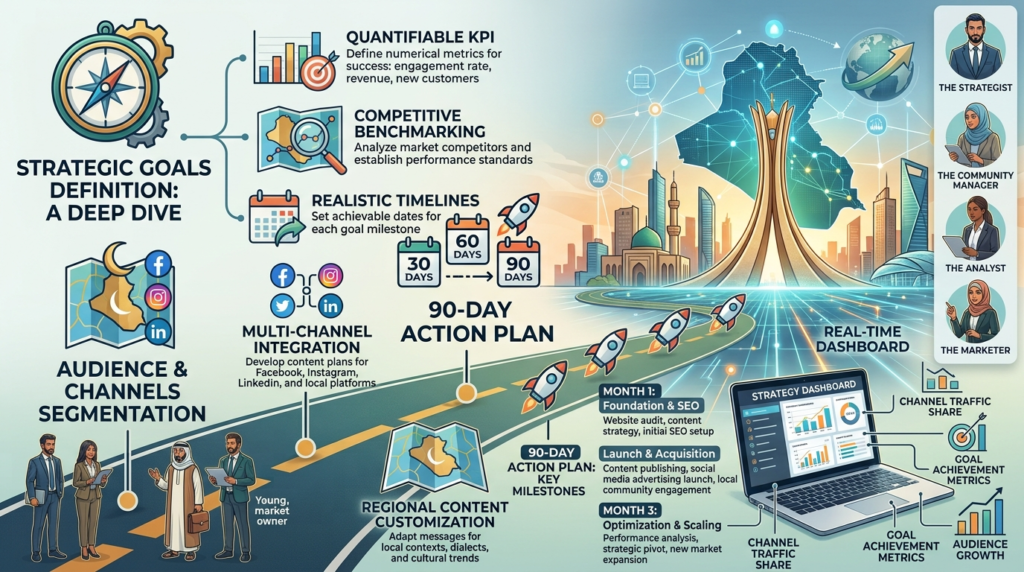
“Get more customers” or “increase online visibility” sound like goals, but they don’t provide enough specificity to guide channel selection, budget allocation, or success measurement. A goal needs a specific, measurable target and a timeframe — “generate 20 qualified leads per month through the website within four months” gives a strategy something concrete to be built toward and measured against.
Aligning Goals With Actual Business Capacity
A goal is only useful if the business can actually handle the outcome it describes. A goal to dramatically increase inquiries only creates a problem if the business can’t respond to or fulfill that increased demand — realistic goal-setting accounts for operational capacity, not just marketing ambition, so growth targets and the ability to actually serve that growth move together.
A Quick Goal-Setting Checklist
- State the specific, measurable outcome the strategy is meant to achieve, not a vague direction.
- Set a realistic timeframe based on which channels are involved, not an arbitrary deadline.
- Confirm the business can operationally handle the outcome if the goal is achieved.
- Define in advance what a checkpoint for “on track” versus “off track” actually looks like.
Choosing Channels Based on Audience
Start With Where Your Audience Actually Is
Channel selection should follow from a clear picture of the target audience’s actual behavior — where they search, which platforms they use, how they make purchase decisions — rather than defaulting to whichever channel is currently popular or easiest to start with. A B2B professional services business and a consumer-facing retail brand have fundamentally different audience behavior, and a shared, generic channel strategy serves neither well.
Matching Channel Timeline to Business Urgency
Some channels, like PPC, can produce visibility within days; others, like SEO, require months to build meaningful traction. A marketing roadmap built without accounting for this timeline difference risks abandoning a slower channel too early, before it’s had a fair chance to work, or over-relying on a faster channel that stops producing results the moment spending pauses.
Avoiding the Trap of Doing Everything at Once
A limited budget and team capacity spread across every available channel simultaneously usually produces mediocre results across the board rather than strong results anywhere. A sound digital strategy typically concentrates initial effort on the one or two channels most likely to reach the target audience effectively, expanding to additional channels only once the initial ones are working and generating enough return to fund further expansion.
Building a 90-Day Roadmap
Why 90 Days Is a Useful Planning Horizon?
Ninety days is long enough to see meaningful early signals from most digital channels, but short enough to stay focused and avoid drifting without checkpoints. A roadmap built around this horizon forces specific, near-term commitments rather than vague long-term intentions that never get broken down into actual next steps.
Month One: Foundation
The first month typically focuses on foundational work: auditing current digital assets, finalizing goals and target audience definition, and setting up the technical or content groundwork needed before growth-focused activity can begin — a website fix, a Google Business Profile setup, or an initial content plan, depending on what the audit reveals is missing.
Month Two: Execution Begins
The second month shifts into active execution on the prioritized channels: publishing initial content, launching a PPC campaign, or beginning consistent social media activity, depending on which channels the strategy prioritized. This is also when initial performance data starts accumulating, even if it’s too early to draw firm conclusions.
Month Three: Evaluation and Adjustment
By the third month, enough data should exist to evaluate whether the initial channel choices and messaging are working, and to make informed adjustments — doubling down on what’s showing promise, adjusting what isn’t, and setting goals for the next 90-day cycle based on what’s actually been learned rather than the original assumptions alone.
Measuring Progress
Choosing Metrics That Actually Matter
Vanity metrics like impressions or follower counts feel like progress but don’t necessarily reflect whether the strategy is achieving its actual goal. Progress should be measured against the specific outcome defined during goal-setting — leads generated, inquiries received, revenue attributable to specific channels — not surface-level activity metrics that can look active without producing real business results.
Building in Regular Review Points
A strategy without scheduled review points tends to drift, continuing tactics that aren’t working simply because no one paused to evaluate them. Building monthly or quarterly review checkpoints into the roadmap from the outset makes course correction a planned part of the process rather than a reactive scramble after a strategy has clearly stopped working.
Creative 4 All offers digital strategy services built around exactly this kind of structured planning — starting with goals and audience, not a generic tactic list — supported by SEO expertise once the roadmap identifies organic search as a priority channel.
Read More on the Digital Marketing Blog — or subscribe for future strategic insights as your business’s digital presence grows.
FAQs
A digital strategy is the underlying reasoning connecting business goals to channel choices and priorities. A marketing plan is the more detailed, tactical execution of that strategy — the specific content, campaigns, and activities scheduled to carry out the strategic direction.
Yes, though it doesn’t need to be an elaborate document. Even a small business benefits from clearly defining its goal, target audience, and channel priorities before spending time or budget on execution, since this prevents scattered, inconsistent effort across too many channels.
A quarterly review, aligned with a 90-day roadmap cycle, works well for most businesses — frequent enough to course-correct based on real data, but not so frequent that the strategy never has time to actually show results.
Jumping straight to tactics — picking channels and starting campaigns — before clearly defining the specific goal being pursued and confirming the business can operationally support that goal if achieved.
Yes, particularly for a smaller business with straightforward goals. The core discipline — defining a specific goal, understanding the target audience, and choosing channels deliberately rather than by default — can be applied by any business owner willing to invest the planning time upfront.