
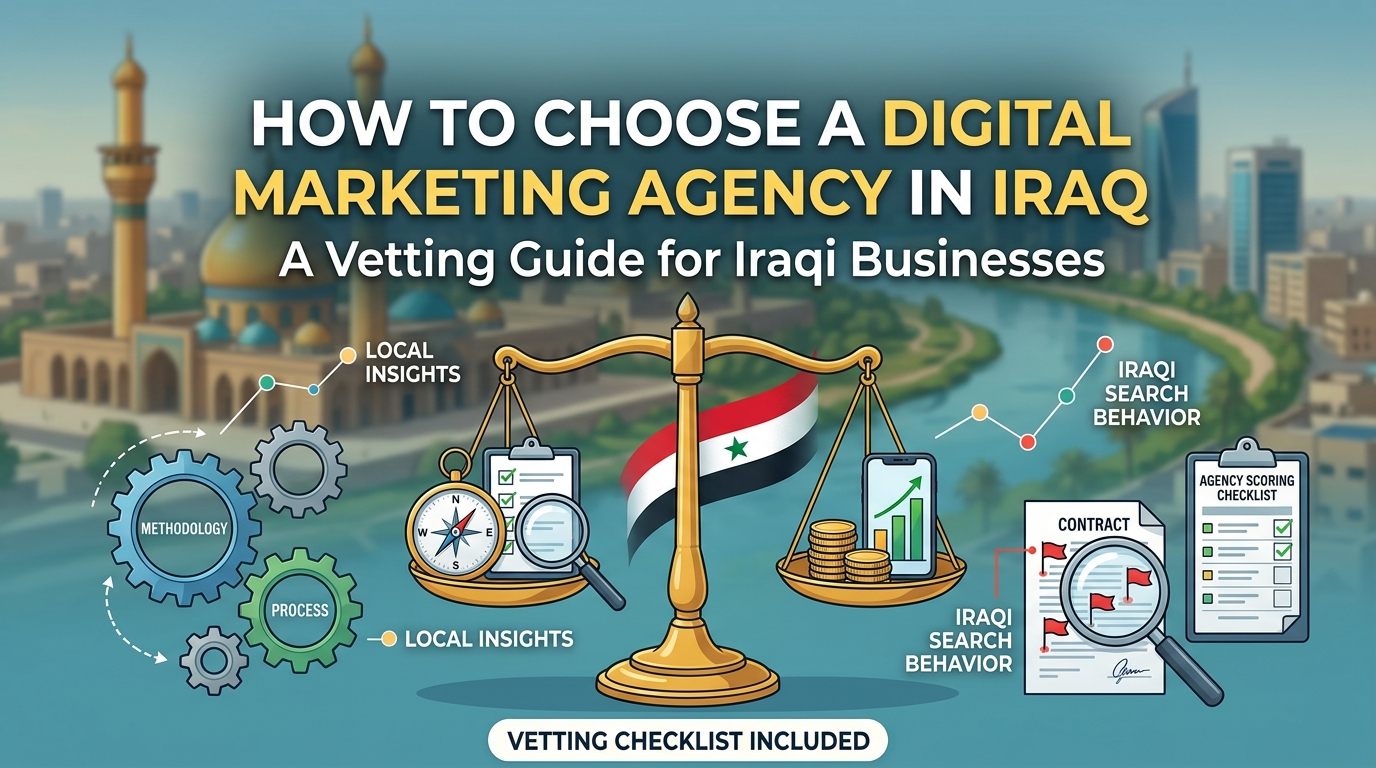
Most advice on choosing a marketing agency stops at generic reassurances — “look for experience,” “check their portfolio,” “make sure they communicate well.” None of that actually helps when you’re sitting across from a digital marketing agency Iraq salesperson who sounds confident, has a polished deck, and is telling you exactly what you want to hear. This guide skips the generic advice and goes straight to the specific questions, red flags, and scoring framework that actually separate a genuinely capable digital marketing agency Iraq businesses can trust from one that just presents well.
If you’re comparing multiple agencies right now, this is built to be used during that process — not read once and forgotten, but pulled up during actual sales calls to ask the questions that get past the pitch. Think of it less as background reading and more as a working tool for the specific decision in front of you.
Why Agency Choice Matters More Than It Seems?
The Cost of a Wrong Decision Isn’t Just Money
A poor agency choice doesn’t just waste a marketing budget — it can actively damage a site through manipulative link building, thin AI-generated content that triggers quality issues, or a mismanaged Google Business Profile that takes months to untangle. Recovering from bad agency work frequently costs more, in both time and money, than the original engagement, which makes the vetting process itself a meaningful risk-reduction step, not just due diligence. Treating this decision with the same rigor as any other significant vendor selection pays off well beyond the initial marketing budget at stake.
Why Iraqi-Market Experience Specifically Matters?
A digital marketing agency Iraq businesses should genuinely consider needs to demonstrate real understanding of Iraqi search behavior, the WhatsApp-driven buyer journey, and the specific competitive landscape in Baghdad, Erbil, or wherever the business operates — not a generic international strategy with Iraqi city names inserted. Agencies without direct Iraqi market experience often default to tactics that work in Gulf or global markets but underperform in Iraq’s distinct search and buying environment.
A Practical Illustration of the Difference
Imagine two agencies pitching the same Erbil-based retail business. One presents a generic global framework, swapping “Erbil” into slide templates originally built for a completely different market. The other explains, unprompted, how Erbil’s mixed Kurdish and international business community affects local search behavior, why the retailer’s specific product category performs differently on social media in Iraq than in Gulf markets, and which local citation sources are actually worth pursuing. The second conversation reveals genuine expertise the first cannot fake, regardless of how polished either presentation looks on the surface.
Questions to Ask Before Signing
Questions About Strategy and Process
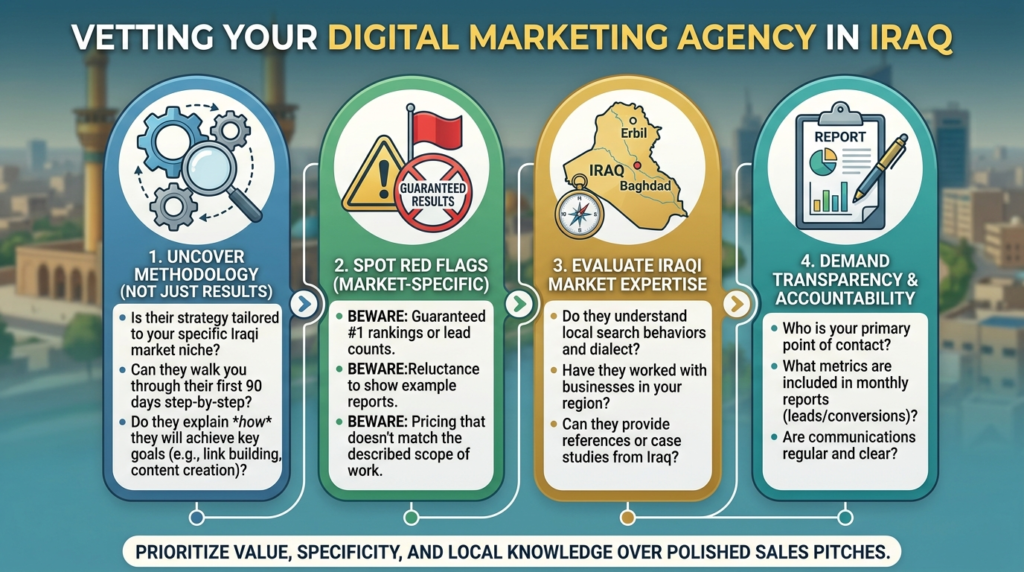
Ask directly: how do you research keywords specifically for the Iraqi market, rather than reusing regional or global keyword lists? What does a typical first 90 days look like, and what specifically happens in each month? How do you decide which channels to prioritize for a business like mine? Vague or evasive answers to any of these are more informative than the answer itself, since a genuine digital marketing agency Iraq provider should be able to walk through this reasoning without hesitation.
Questions About Reporting and Accountability
Ask: what exactly will I see in monthly reports, and does it tie to actual business outcomes like leads and conversions, or only to surface metrics like impressions and rankings? Who is my actual point of contact, and how often will we communicate? Can I see an example of a real client report, with identifying details removed if necessary?
Questions About Past Work
Ask for a specific example of a client in a similar industry or facing a similar challenge, and what was actually done — not just the end result claimed. A credible agency can walk through the specific tactics used and explain why they were chosen for that situation, rather than offering only a vague success story.
Red Flags in the Iraqi Market
Guaranteed Rankings or Results
No legitimate provider of digital marketing agency Iraq services can guarantee a specific ranking position or a specific number of leads, since Google’s algorithm and market conditions aren’t within any agency’s direct control. A guarantee is either a sign of inexperience or a sales tactic that sets up an excuse-filled relationship later, and it’s often the single fastest way to disqualify a digital marketing agency Iraq option from serious consideration.
Reluctance to Explain Methodology
If an agency can’t or won’t explain what they’ll actually do to earn a specific result — which keywords, what content, what technical changes, what link-building approach — treat that as disqualifying rather than a minor gap to overlook. Legitimate methodology can always be explained in plain terms, even if the execution itself is technical, and vague “trust us, we know what we’re doing” answers are worth taking seriously as a warning sign.
Pricing That Doesn’t Match the Described Scope
A price significantly below what a described scope of work would realistically require usually means corners are being cut somewhere, often in ways invisible until months later — thin content, spammy link building, or a Google Business Profile approach that risks a policy violation. Evaluate price relative to scope, never in isolation, and be especially cautious of a quote that seems too good to be true relative to competitors describing similar work.
No Iraq-Specific Case Examples or Understanding
An agency that can’t speak specifically to Iraqi market dynamics — Baghdad versus Erbil differences, the WhatsApp-driven conversion path, Arabic-English mixed search behavior — beyond generic digital marketing language is likely applying a template rather than genuine local expertise.
Pressure to Sign Quickly
Legitimate agencies expect a business to compare options and take time deciding. Heavy pressure to commit immediately, “limited-time” discounts tied to an immediate signature, or discouraging a business from talking to other providers are sales tactics, not signs of confidence in the work itself.
Portfolio & Case Study Evaluation
What a Real Case Study Should Include?
A credible case study names the actual starting point (traffic, rankings, or leads before the engagement), the specific work done, and the actual outcome with a real timeframe — not vague language like “significantly improved” without any specific, verifiable numbers or dates attached. An agency confident in genuine results has no reason to hide behind vague success language when describing past work.
Verifying Claims Independently
Where possible, ask to speak briefly with a past or current client, or ask for a case study you can verify independently — checking whether a claimed ranking improvement is visible in a tool like Google’s own Search Console data the client is willing to share, for instance. An agency confident in its results shouldn’t resist reasonable verification requests, and hesitation here is itself useful information.
Evaluating Portfolio Relevance, Not Just Quality
A polished portfolio in an unrelated industry or market tells you less than a modest but genuinely relevant example from a similar business type or competitive situation to your own. Prioritize relevance to your specific situation over general production quality in the portfolio — a beautifully designed case study from an unrelated industry says little about how an agency would actually perform for your business.
A Simple Vetting Checklist
Score Each Agency Against These Criteria
Before making a final decision, score each agency you’re considering against a consistent set of criteria:
- Iraqi market understanding — can they speak specifically to your city, industry, and competitive landscape without generic language?
- Methodology transparency — do they explain exactly what they’ll do and why, rather than offering vague reassurances?
- Verifiable past results — can they provide specific, checkable examples rather than only broad success claims?
- Reporting clarity — will reporting tie to actual business outcomes, and is a sample report available to review?
- Realistic expectations — do they explain likely timelines and what won’t happen quickly, rather than promising fast guaranteed results?
An agency that scores well across all five is worth serious consideration. One that struggles on more than one or two is a real risk regardless of how strong the sales pitch sounds.
Creative 4 All is happy to be evaluated against exactly this checklist. Our approach to digital marketing in Iraq starts with the same transparency this guide recommends — real methodology explanations, verifiable past work, and honest timelines from the first conversation.
Request a Consultation to see how our approach holds up against this exact vetting framework, with no pressure and no guaranteed-results sales pitch.
FAQs
Comparing at least two or three gives enough basis for meaningful comparison without dragging the decision out indefinitely. What matters more than the number is asking the same specific questions of each one.
No — it’s actually the opposite. Legitimate agencies avoid guaranteeing specific rankings or lead volumes because genuine SEO and marketing results depend on factors outside any provider’s full control. A guarantee is the actual warning sign.
Not automatically. A smaller, honestly scoped engagement matched to a tighter budget can be reasonable, but the risk isn’t small budgets themselves — it’s providers promising a large scope of work at a price that can’t realistically cover it.
Ask them to explain, in specific and plain terms, exactly what they’ll do in the first 90 days and why. The quality and specificity of that answer reveals more about genuine capability than any other single question.
Ask for specific, checkable details — actual timeframes, actual metrics, and where possible, a willingness to let you verify results directly through tools like Google Search Console rather than relying solely on the agency’s own summary.