
“How much should I budget for digital marketing?” is one of the most common questions Iraqi business owners ask, and it’s also one of the hardest to answer with a single number, because digital marketing cost Iraq businesses actually pay varies enormously based on channel mix, competition level, industry, and whether the work is handled in-house or through an agency. Any source offering a flat, universal number is oversimplifying a decision that genuinely depends on your specific situation.
This guide covers what actually drives digital marketing cost Iraq businesses should expect, how budgets typically scale with business size, an honest in-house versus agency comparison, and a practical framework for allocating whatever budget you do have across channels — giving you the tools to build a realistic digital marketing cost Iraq budget rather than relying on a single misleading figure.
What Influences Digital Marketing Costs?
Channel Mix and Competitive Intensity
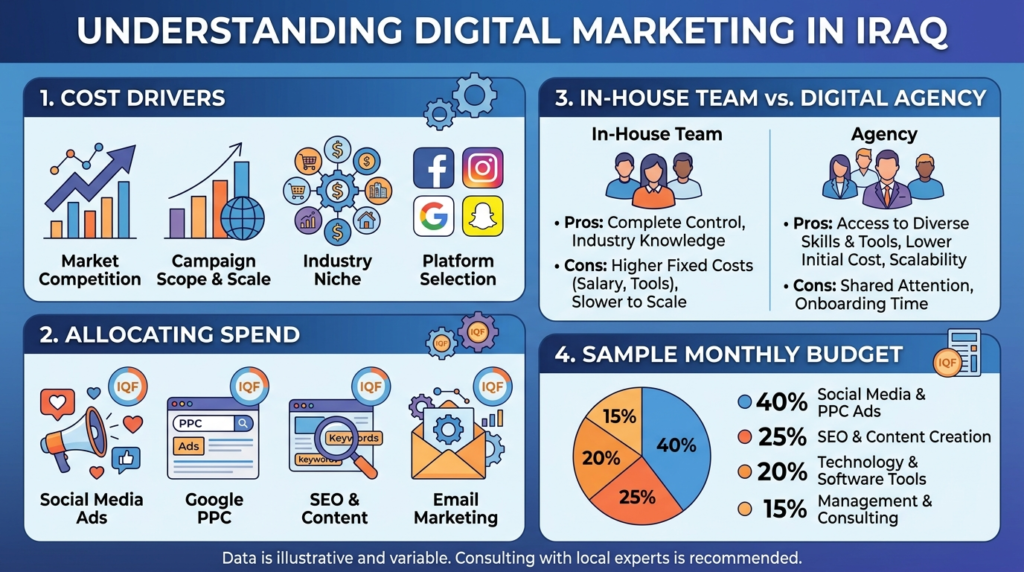
The single biggest cost driver is which channels a strategy includes and how competitive the specific market is. A business relying primarily on organic SEO and modest social media management has a fundamentally different cost structure than one running aggressive PPC campaigns across multiple competitive commercial terms simultaneously. Digital marketing budget Iraq planning has to start with which channels are actually needed, not a generic total figure applied regardless of strategy.
Business Size and Complexity
A single-location local service business with one or two core services requires meaningfully less marketing investment than a multi-location business, an ecommerce operation with a large product catalog, or a company competing across multiple cities simultaneously. Complexity, not just company size in employees or revenue, drives much of the cost difference in marketing agency pricing across different Iraqi business types.
Industry Competitiveness
Some industries face inherently more expensive competition for visibility than others — a category with many well-funded competitors bidding on the same PPC terms or competing for the same organic rankings requires more sustained investment to achieve meaningful visibility than a less crowded category, regardless of business size.
A Practical Example of How Cost Drivers Combine
Consider two Iraqi businesses budgeting for digital marketing in the same month: a small neighborhood bakery and a national real estate developer competing across Baghdad, Erbil, and Basra. The bakery’s realistic budget concentrates on local SEO and a modest social presence — a genuinely small, focused investment matched to a narrow competitive need. The developer’s realistic budget spans technical SEO across a large site, sustained content production, PPC across multiple cities, and ongoing digital PR — an entirely different scale of investment, not because one provider charges more than another, but because the actual scope of work required differs enormously. This is why digital marketing cost Iraq businesses should expect can’t be reduced to a single meaningful benchmark figure.
In-House Capability and Existing Assets
A business with an existing website in reasonable technical condition, some prior content, and internal staff capable of handling basic tasks needs a different budget allocation than one starting from a broken or nonexistent digital presence requiring substantial foundational work before growth-focused activities can even begin.
Typical Budget Ranges by Business Size
Why This Guide Won’t Quote Specific Numbers?
Rather than presenting specific dollar or dinar figures that would misrepresent the genuinely wide range seen across the Iraqi market — and that would become outdated the moment market conditions shift — this section explains how budgets typically scale by business tier, so you can evaluate any quote against a realistic framework rather than an isolated number.
Small, Single-Location Businesses
At this scale, budgets typically concentrate on a narrow set of high-value activities: local SEO and Google Business Profile management, modest content production, and light social media presence. The goal at this tier is usually capturing local, high-intent search demand efficiently rather than broad brand-building.
Growing Businesses With Multiple Service Lines or Locations
As a business expands its service offering or geographic footprint, digital marketing cost Iraq budgets typically scale to cover broader content production, a more substantial technical SEO foundation, and often the addition of PPC to capture demand faster than organic growth alone can deliver. This tier represents the point where a genuinely coordinated, multi-channel strategy starts to outperform a single-channel approach.
Larger or Highly Competitive Businesses
At the largest scale, or in especially competitive categories, budgets typically support continuous content production across multiple topic clusters, sustained link-building and digital PR, ongoing technical monitoring, and meaningful PPC spend across multiple campaigns — reflecting the sheer volume of ongoing work required to compete and maintain visibility.
In-House vs Agency Cost Comparison
What In-House Really Costs?
Building an in-house digital marketing capability means budgeting for salaries, software and tool subscriptions, ongoing training to keep skills current as platforms and algorithms evolve, and the time cost of hiring and managing a team. These costs are often underestimated because they’re spread across multiple budget lines rather than appearing as a single visible marketing expense, which makes true in-house cost comparisons against agency marketing agency pricing harder than they first appear.
What Agency Retainers Typically Cover?
An agency retainer typically bundles strategy, execution, tools, and expertise across multiple disciplines into a single ongoing cost, which can be more cost-efficient than building equivalent in-house capability, particularly for a business that doesn’t need full-time dedicated marketing staff across every channel.
When Each Approach Makes More Sense?
In-house capability tends to make more sense for larger businesses with sustained, high-volume marketing needs across a long time horizon, where the fixed cost of a team is justified by ongoing volume. An agency relationship tends to make more sense for SMEs needing specialized, cross-channel expertise without the overhead of building and managing an internal team from scratch.
Budget Allocation Across Channels
A General Starting Framework
While exact allocation should be based on your specific goals and competitive situation, a reasonable starting framework weights budget toward whichever channel best matches your timeline: a business needing immediate leads typically allocates more heavily toward PPC initially, while a business prioritizing long-term, sustainable visibility allocates more toward SEO and content, with social media and email marketing supporting both approaches. This isn’t a rigid formula, but it’s a sound starting point for any business without existing performance data to guide the split.
Adjusting Allocation as Results Build
Budget allocation shouldn’t stay static. As SEO investment begins producing organic visibility for specific terms, PPC spend on those same terms can often be reduced or redirected toward new opportunities, gradually shifting the overall mix toward more cost-efficient organic channels over time. Reviewing this allocation regularly, rather than setting it once and leaving it unchanged for years, is one of the simplest ways to improve overall marketing efficiency without necessarily increasing total spend.
A Quick Budget Planning Checklist
- Identify which specific business outcomes (leads, brand awareness, retention) the budget needs to achieve.
- Match channel allocation to urgency: PPC for immediate needs, SEO for long-term efficiency.
- Reserve a portion of budget for measurement and optimization tools, not just execution.
- Revisit allocation quarterly based on actual performance data rather than locking in a static split.
Getting an Accurate Quote
How Much Should I Spend on Digital Marketing in Iraq
Businesses asking how much they should spend on digital marketing in Iraq are understandably looking for a simple benchmark, but an accurate answer requires understanding your specific competitive landscape, current digital assets, and business goals — which is exactly why a proper strategy conversation should precede any budget commitment, not follow a generic package price.
What a Trustworthy Budget Conversation Looks Like?
A provider offering honest marketing agency pricing will typically ask detailed questions about your goals, competitive situation, and current assets before recommending a specific budget and channel mix, rather than presenting a fixed menu disconnected from your actual business. This consultative approach is the clearest signal that a proposed digital marketing cost Iraq figure actually reflects your situation rather than a generic starting point applied to everyone.
Creative 4 All builds digital marketing cost Iraq proposals around your specific goals and competitive situation as part of comprehensive digital marketing in Iraq engagements, so your budget is matched to a genuine strategy rather than a generic package price.
Get a Digital Marketing Quote to receive an honest, itemized recommendation for what your specific business should realistically budget, and why.
FAQs
Because actual costs depend heavily on channel mix, competition level, and business complexity, a fixed published price would misrepresent either simpler or more complex cases. An accurate quote reflects your specific situation rather than a generic average.
Starting smaller and scaling as results validate the approach is often the more prudent path for a business new to digital marketing, though certain channels like SEO benefit from sustained investment rather than frequent starts and stops.
It depends on your business size and needs. In-house capability suits businesses with sustained, high-volume marketing needs justifying a dedicated team, while an agency relationship typically suits SMEs needing specialized, cross-channel expertise without building an internal team from scratch.
It depends on urgency and goals. A business needing immediate leads typically weights budget toward PPC initially, shifting gradually toward SEO as organic visibility builds and reduces dependency on paid spend over time.
A typical retainer usually bundles strategy development, execution across agreed channels, tool and software access, and regular reporting into a single ongoing cost — though the exact scope should always be clarified explicitly before signing.