
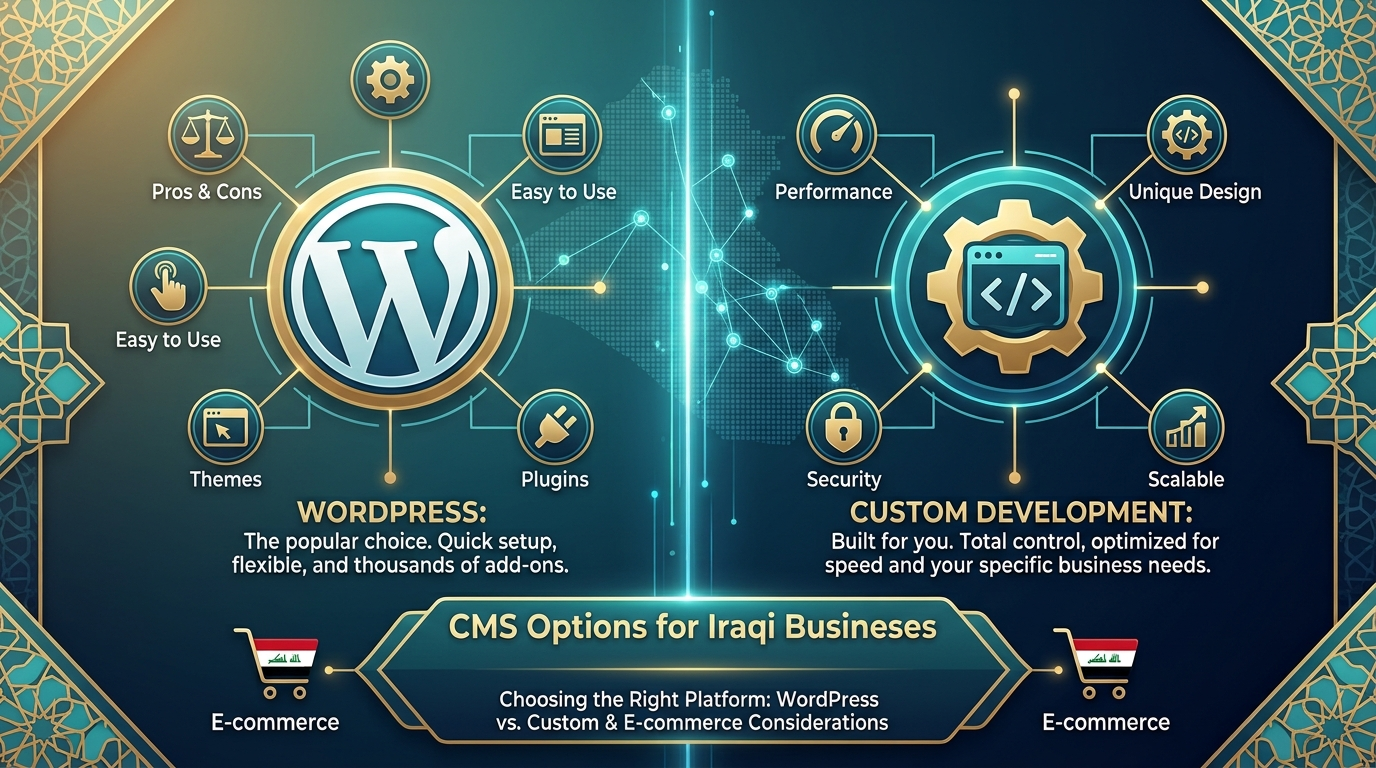
Choosing a content management system is one of the most consequential decisions in a website project, and it’s also one most Iraqi business owners never actually make deliberately — a web design agency simply picks one, and the business lives with that choice for years without understanding what the alternatives would have offered. CMS Iraq businesses select shapes how easily content gets updated, how the site scales as the business grows, and how much ongoing dependency exists on whichever agency built it.
This guide covers what a CMS actually does, the genuine pros and cons of WordPress for Iraqi businesses specifically, when custom development is actually worth its additional cost, ecommerce-specific platform considerations, and a practical framework for making this decision rather than defaulting to whatever a provider happens to prefer building. Whether you’re launching a first website or frustrated with a current platform, this guide is built to make this decision deliberately rather than by default.
What a CMS Does?
The Basic Function
A content management system is the software layer that lets a business update website content — text, images, pages — without needing to write code for every change. Behind the scenes, it also handles how content is stored, organized, and displayed, and it typically manages user permissions for who can edit what.
Why This Choice Matters Beyond Launch Day?
The CMS decision affects far more than the initial build: how easily staff can make routine content updates, how the site handles growth in pages or products over time, how straightforward it is to add new functionality later, and — critically — how dependent the business remains on its original developer for even minor changes. A content management system comparison done properly weighs all of these factors, not just which platform is fastest to launch initially. Businesses that skip this comparison entirely often discover the consequences only years later, once switching costs have grown substantially.
Ongoing Ownership and Flexibility
A well-chosen CMS gives a business genuine ongoing control: the ability to update content, add pages, and make routine changes internally rather than paying an agency for every small edit. A poorly chosen or poorly implemented CMS can create the opposite — a site technically owned by the business but practically controlled by whoever built it, since only they understand how to make changes.
A Practical Example of Getting This Wrong
Consider an Erbil-based retail business whose original developer built the site on an obscure, custom-coded system with no documentation and no other local developers familiar with it. When the business wanted to add a new product category two years later, the original developer had moved on, and no one else could safely modify the system without risking breaking it entirely. The business ended up rebuilding the entire site on a standard platform just to regain basic ongoing control — an expensive lesson in why CMS Iraq decisions deserve real consideration upfront rather than being left entirely to whoever happens to build the first version.
WordPress: Pros and Cons for Iraqi Businesses
Why WordPress Is a Reasonable Default for Many Businesses?
WordPress powers a substantial share of websites globally, which means an enormous ecosystem of themes, plugins, and developers familiar with the platform — a real practical advantage when a business eventually needs to find help, switch developers, or add functionality without depending on a single provider’s proprietary knowledge. WordPress Iraq businesses adopt benefits from this ecosystem directly: a wide range of local developers can typically support a WordPress site, unlike a fully custom platform only its original builder understands.
Genuine Limitations Worth Understanding
WordPress’s flexibility comes with tradeoffs: a poorly maintained WordPress site accumulating outdated plugins can become a genuine security risk, and heavy plugin use to add functionality can slow performance if not managed carefully. WordPress also requires regular updates and maintenance to stay secure, which is sometimes underestimated by businesses assuming a CMS is a “set it and forget it” solution.
When WordPress Is the Right Choice?
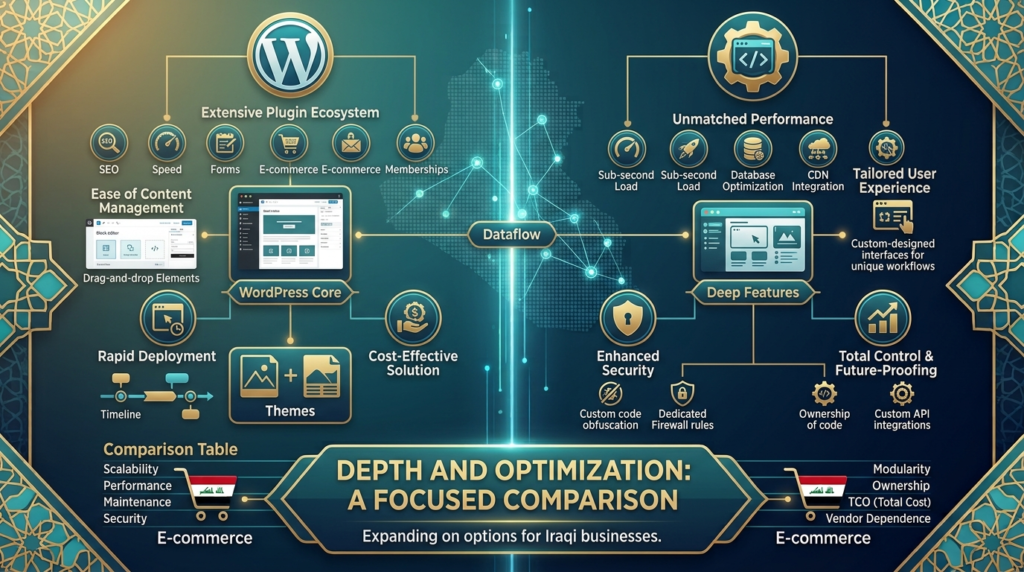
WordPress suits businesses needing standard functionality — informational sites, blogs, straightforward service pages, and even moderate ecommerce through plugins like WooCommerce — where the platform’s proven track record and wide support ecosystem outweigh the benefits a fully custom build would offer.
Custom CMS: When It’s Worth It
What Custom Development Actually Solves?
A custom-built content management system makes sense when a business has specific functional requirements that don’t map cleanly onto WordPress’s plugin-based architecture — complex business logic, unusual content relationships, or performance requirements at a scale where a general-purpose CMS becomes a genuine constraint rather than a convenience. Genuine cases like this exist, but they’re less common than the number of custom-built sites in the Iraqi market might suggest.
The Real Cost of Custom Development
Custom CMS development requires more upfront investment in both time and cost, and critically, it creates dependency on whoever builds it for future changes, since a custom system doesn’t benefit from the wide developer familiarity WordPress offers. This tradeoff is worth accepting when the functional need is genuine, but it shouldn’t be the default choice simply because it sounds more sophisticated than a standard platform.
Best CMS for Small Business Iraq: A Practical Reality Check
For the vast majority of small and growing Iraqi businesses, the best CMS for small business Iraq questions usually resolve toward WordPress or a similarly established platform, not custom development — genuine custom-build needs are the exception, not the norm, and most businesses overestimate how unique their functional requirements actually are.
Ecommerce CMS Considerations
WordPress Plus WooCommerce
For moderate ecommerce needs, WordPress combined with WooCommerce offers a proven, well-supported path that handles product catalogs, payment processing, and inventory management without requiring fully custom development, while still benefiting from WordPress’s broad support ecosystem.
Dedicated Ecommerce Platforms
For businesses with more complex ecommerce needs — large catalogs, complex product configurations, or specific integration requirements — dedicated ecommerce platforms built specifically for online retail sometimes offer better out-of-the-box functionality than a general-purpose CMS adapted for ecommerce, at the cost of a more specialized (and sometimes pricier) hosting and development ecosystem.
A Quick Ecommerce CMS Checklist
- Does the platform support the specific payment methods and currencies your business needs?
- Can it scale to your realistic product catalog size without significant performance issues?
- Is there adequate local developer support available if you need ongoing help?
- Does the platform integrate with inventory or accounting systems already in use?
Our Recommendation Framework
WordPress vs Custom CMS: A Decision Framework
For most Iraqi businesses weighing WordPress vs custom CMS, the practical framework is: start by identifying genuinely unique functional requirements a standard platform can’t accommodate. If none exist, WordPress or a similarly established platform is very likely the more cost-efficient, better-supported choice. If specific requirements genuinely exceed what standard platforms offer, custom development becomes justified — but this should be the exception reached through elimination, not the default assumption.
Matching the Platform to Long-Term Business Needs
The right CMS choice also depends on how the business expects to grow — a platform that handles current needs well but can’t scale to future plans creates a costly migration down the road, while over-investing in custom complexity for a business that will never need it wastes budget that could go toward marketing or other growth investments.
Creative 4 All helps Iraqi businesses choose and implement the right CMS services for their actual needs, as part of comprehensive web design and development engagements that prioritize genuine long-term ownership over vendor lock-in.
Request a Free Audit to get an honest recommendation on which CMS approach actually fits your business, rather than whichever platform happens to be easiest for a given provider to build.
FAQs
WordPress powers websites for organizations of every size and industry; the platform itself has no bearing on how professional a site looks or performs. Design quality and proper implementation matter far more than which CMS underlies the site.
If you can clearly articulate a specific functional requirement that standard platforms and their plugin ecosystems genuinely can’t accommodate, custom development may be justified. If the reasoning is more about wanting something “unique” without a concrete functional need, a standard platform is likely the better choice.
Yes, though migration involves real cost and effort. Starting with WordPress doesn’t lock a business in permanently, but it’s worth choosing thoughtfully upfront rather than assuming a switch later will be simple or free.
Yes, when properly maintained — kept updated, using reputable plugins, and following basic security practices. Most WordPress security issues stem from neglected maintenance rather than an inherent flaw in the platform itself.
Indirectly, yes. A well-implemented CMS on either WordPress or a custom platform can support strong SEO; a poorly implemented one on either platform can undermine it. The CMS itself matters less than how well it’s configured and maintained.