
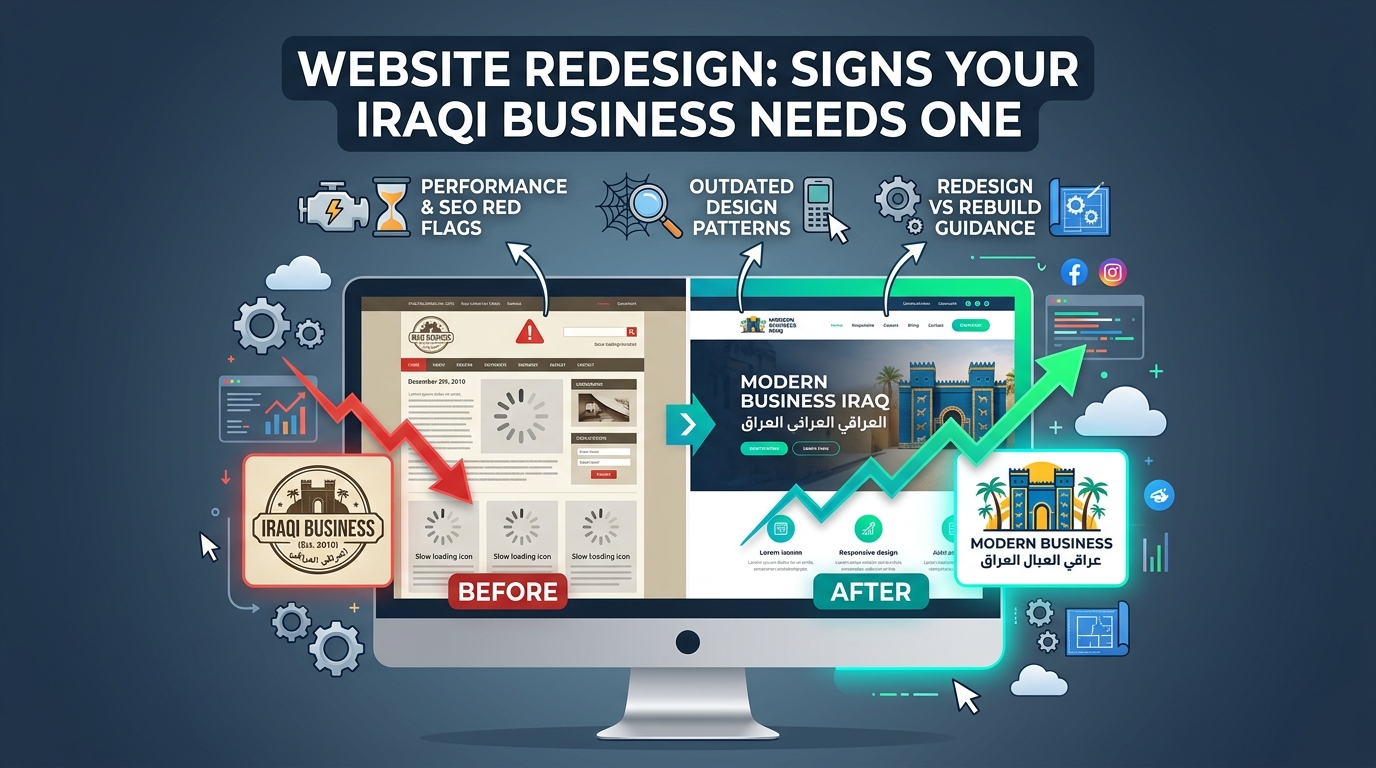
Most Iraqi businesses redesign their website for the wrong reason — because it “feels old” — while missing the actual signals that indicate a redesign is genuinely overdue: a rising bounce rate, declining mobile conversions, or search rankings quietly slipping because the site’s technical foundation hasn’t kept pace with how Google evaluates sites today. Website redesign Iraq decisions made on gut feeling alone often result in a fresh coat of paint over the same underlying problems, while decisions grounded in actual performance data address what’s really costing the business customers.
This guide covers the concrete signs that indicate a redesign is genuinely needed, the specific performance and SEO red flags worth checking directly, how design expectations have shifted in ways that make some sites look dated even when nothing is technically broken, the real difference between a redesign and a full rebuild, and how to plan a redesign without losing the SEO value an existing site has already built. If your site hasn’t been touched in years and you’re wondering whether it’s time, this guide is built to replace that guesswork with a concrete answer.
Signs Your Website Is Costing You Business
Declining Inquiries Despite Steady or Growing Traffic
If a site’s traffic has held steady or grown but the number of actual inquiries or leads has declined, something in the conversion path itself — navigation confusion, unclear calls-to-action, a broken or overly complicated contact process — is likely losing visitors who would otherwise have converted. This gap between traffic and results is one of the clearest signs a redesign should focus on conversion, not just appearance.
A Practical Example of This Pattern
Consider a Baghdad-based construction company whose website traffic grew steadily over two years while inquiries stayed flat, then began declining. Analytics revealed visitors were reaching the services page in high numbers but rarely continuing to the contact page — the site had accumulated an extra navigation step during a series of small updates over time, and the contact information itself had been pushed below the fold on mobile. Once the redesign restored a direct, single-click path from any service page to contact, inquiry volume recovered within weeks, without any change to the traffic driving visitors there in the first place. This illustrates why website redesign Iraq decisions should start with diagnosing exactly where the conversion path breaks down, not with a general sense that the site “needs refreshing.”
High Bounce Rate on Key Pages
A bounce rate that’s meaningfully higher on specific important pages — service pages, the homepage — than on the rest of the site often indicates those pages aren’t delivering what visitors expect quickly enough, whether due to slow loading, confusing layout, or content that doesn’t match what brought the visitor there in the first place.
Visitors Struggling on Mobile
If analytics show mobile visitors leaving faster or converting at a meaningfully lower rate than desktop visitors, this is a strong signal that the site’s mobile experience — regardless of whether it’s technically “responsive” — isn’t actually serving mobile users well, which matters enormously given how much Iraqi traffic arrives via mobile.
Performance & SEO Red Flags
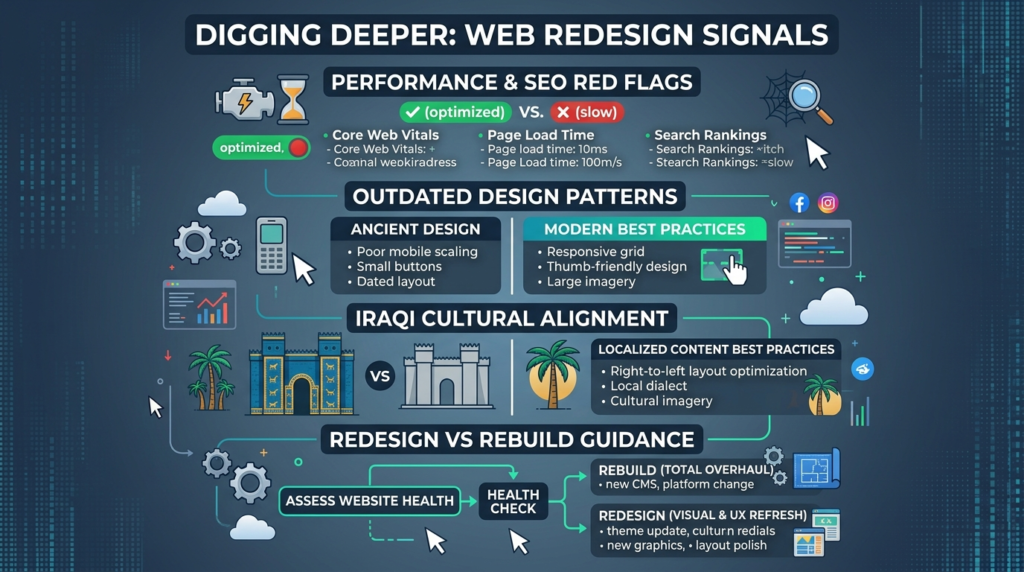
Core Web Vitals Scores That Have Slipped
A site that performed acceptably on Core Web Vitals a year or two ago may have quietly degraded as content, images, and third-party scripts accumulated without corresponding technical maintenance. Checking current PageSpeed Insights scores against what the site achieved previously reveals whether performance has genuinely declined or simply feels that way.
Rankings That Have Plateaued or Declined
If organic rankings for previously strong terms have plateaued or started slipping without an obvious external cause, an aging technical foundation — outdated site architecture, accumulated technical debt, content that hasn’t kept pace with what’s now ranking — is a common underlying reason. When to redesign a website for SEO reasons specifically often comes down to this kind of quiet erosion rather than a single dramatic event.
Outdated Website Signs Worth Checking Directly
Beyond analytics, a handful of direct checks reveal genuine outdated website signs: does the site render correctly on current browser versions, does it use HTTPS properly, does structured data validate without errors, and does the site’s information architecture still reflect the business’s current services rather than an outdated version of the offering?
A Quick Red Flag Checklist
- Bounce rate meaningfully higher on key pages than sitewide average.
- Mobile conversion rate noticeably lower than desktop conversion rate.
- Core Web Vitals scores that have declined without a clear technical cause.
- Organic rankings for previously strong terms plateauing or slipping.
Design Trends That Have Shifted
Why “It Looks Fine” Isn’t the Same as “It Performs Well”?
Design expectations shift over time in ways that are easy to miss when looking at a site every day. Visual patterns that felt current five years ago — certain navigation styles, image treatments, typography choices — can now read as dated to a first-time visitor comparing it against more modern competitor sites, even if nothing about the site is technically broken.
The Cost of Looking Outdated
A visitor comparing several businesses’ websites before making a decision often uses visual polish as a proxy for how current and credible the underlying business is, fairly or not. A site that looks noticeably older than competitors can quietly undermine trust before a visitor even reads the actual content.
Distinguishing Trend-Chasing From Genuine Improvement
Not every visual trend is worth chasing — redesigning simply to match whatever style is currently popular, without a clear connection to usability or conversion, risks repeating the same mistake in reverse. The goal is closing a genuine gap between how the site currently performs and how it could perform, not fashion for its own sake.
Redesign vs Rebuild
What a Redesign Typically Involves?
A redesign typically means refreshing visual design, improving user experience, and updating content within the existing technical platform and content structure, without necessarily changing the underlying CMS or site architecture. This is usually faster and less expensive than a full rebuild, and it’s often sufficient when the core technical foundation is sound but the visual and usability layer has fallen behind — the most common scenario behind a typical website redesign Iraq businesses commission.
When a Full Rebuild Is Actually Necessary?
A full rebuild — migrating to a new platform or fundamentally restructuring the site’s architecture — becomes necessary when the underlying technical foundation itself is limiting what’s possible: an outdated CMS that can’t support modern functionality, a site architecture too tangled to reorganize incrementally, or accumulated technical debt severe enough that patching individual issues is no longer cost-effective compared to starting fresh.
How Often Should I Redesign My Website?
There’s no fixed universal answer to how often should I redesign my website, but a reasonable guideline is a meaningful design and usability review every two to three years, with more frequent smaller updates addressing specific performance or conversion issues as they’re identified, rather than waiting for a complete overhaul to become unavoidable.
Planning a Redesign Without Losing SEO
Preserving URL Structure and Redirects
A redesign that changes URL structures without properly implementing redirects from old URLs to new ones can lose accumulated ranking value overnight. Mapping every existing URL to its new equivalent, and implementing proper 301 redirects, is one of the most critical and most commonly mishandled parts of any website redesign Iraq project, and it’s worth confirming explicitly with any agency before a rebuild begins.
Maintaining Content That’s Already Ranking
Pages that are already ranking well for valuable terms shouldn’t be redesigned into oblivion — their core content, headings, and keyword targeting should generally be preserved or carefully improved, not replaced wholesale with generic new copy that discards what’s already working.
Testing Before and After Launch
Benchmarking current performance — rankings, traffic, Core Web Vitals scores, conversion rates — before a redesign begins gives a clear baseline for measuring whether the redesign actually improved things, rather than assuming improvement based on how the new design looks.
Creative 4 All approaches website redesign services with SEO preservation built into the process from the start, coordinating closely with our SEO team so a redesign improves performance without sacrificing the organic visibility a site has already earned.
Request a Free Audit to find out whether your current website shows genuine signs of needing a redesign, and what specifically should be prioritized if it does.
FAQs
If the issues are isolated — one slow page, one confusing form — targeted fixes are usually sufficient. If problems are widespread across bounce rate, mobile performance, and conversion simultaneously, a more comprehensive redesign is likely the more efficient path.
It can, if URL structure changes without proper redirects or if well-performing content is replaced without care. A redesign planned with SEO preservation in mind — proper redirects, maintained content strategy — should protect or improve rankings, not damage them.
A redesign that keeps the existing technical platform is typically less expensive than building an entirely new site from scratch, since it reuses existing infrastructure rather than starting over. A full rebuild costs closer to a new website project when the underlying platform itself needs replacing.
Failing to properly map and redirect old URLs to their new equivalents, which can silently erase years of accumulated SEO value even when the new design itself is a genuine improvement.
Timeline varies with scope, but a redesign that preserves the existing technical platform typically takes less time than building a new site from scratch, since much of the underlying infrastructure doesn’t need to be rebuilt.