
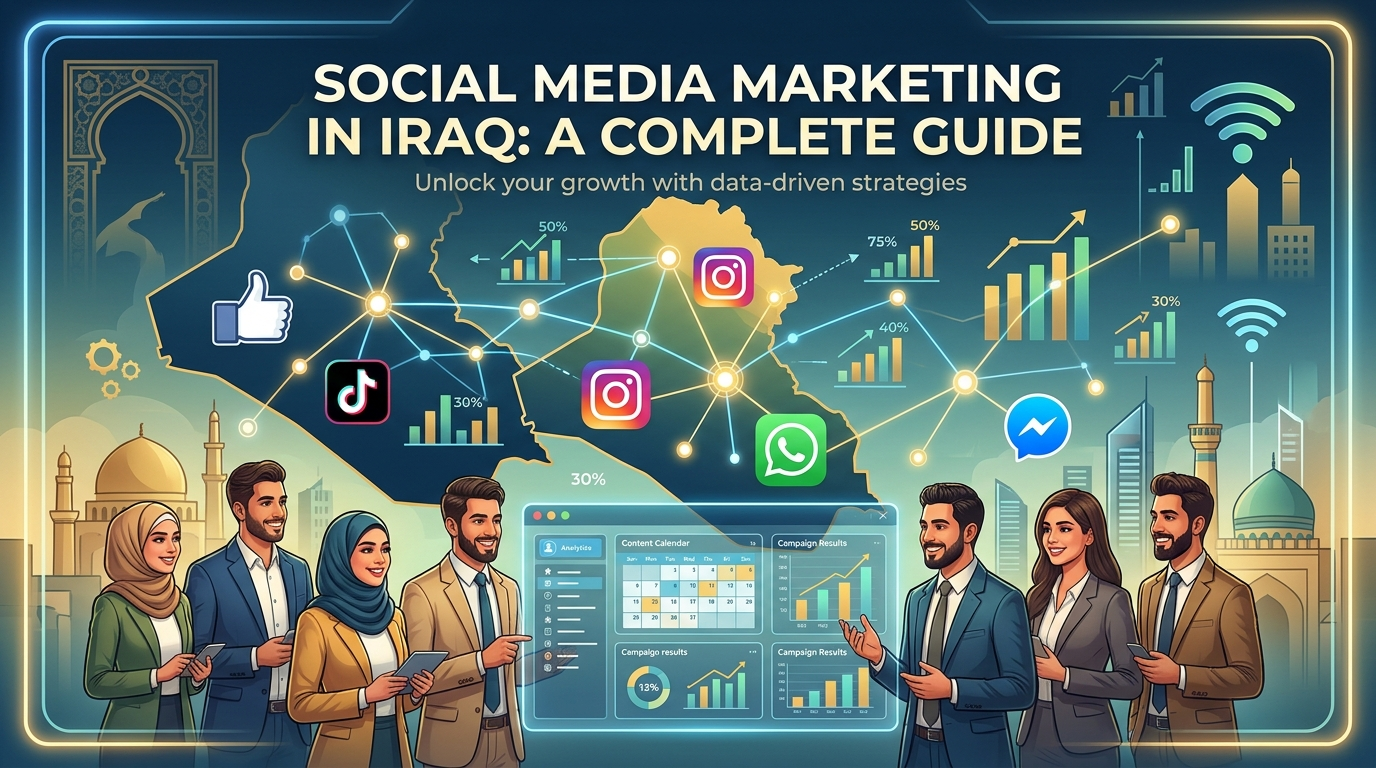
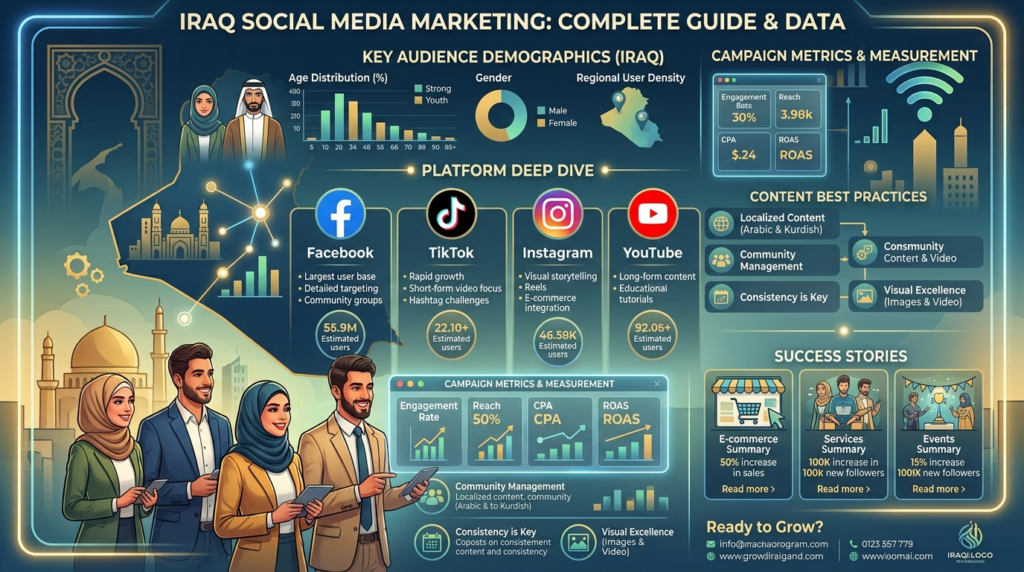
Generic social media advice assumes a market where platform popularity looks roughly the same everywhere, which simply isn’t true for Iraq. Facebook alone reached 34.5 million users in Iraq as of August 2026 — 72.1 percent of the total population — according to NapoleonCat’s advertising audience data, while TikTok’s ad reach among users 18 and older hit 40.1 million by late 2025, growing 17 percent year-on-year, per DataReportal’s Digital 2026 report. Social media marketing Iraq businesses actually need has to be built around this specific platform landscape, not a generic global playbook adapted with Iraqi city names inserted.
This guide covers why social media marketing genuinely works differently in Iraq, how to choose the right platforms based on actual usage data rather than assumption, the content strategy fundamentals that matter most, the real tradeoffs between organic and paid social, and what results a business should realistically expect from a properly run social media program. Whether you’re launching a first social presence or reassessing one that isn’t delivering, this guide is built around genuine Iraqi platform data rather than assumptions carried over from other markets.
Why Social Media Marketing Works Differently in Iraq?
Platform Usage That Doesn’t Match Global Defaults
Iraq’s social media landscape shows genuinely distinctive patterns: an unusually large Facebook user base relative to population, strong and rapidly growing TikTok reach, and Instagram usage that, while smaller than Facebook’s, still represents nearly half the country’s population. A strategy built assuming global platform popularity rankings apply here would misallocate effort from the outset.
The WhatsApp-Driven Conversion Path
Across nearly every platform, Iraqi social media engagement frequently converts through a WhatsApp conversation rather than a native in-app purchase or contact form. Social media agency Iraq businesses work with should build this behavior into strategy from the start, ensuring WhatsApp contact options are prominent and genuinely integrated into the customer journey rather than treated as an afterthought.
A Practical Illustration of This Difference
Consider a furniture retailer running the same product ad in an international market and in Iraq. In the international market, the ad might drive traffic to an ecommerce checkout, completing the entire transaction natively within the platform’s ad ecosystem. In Iraq, that same ad more typically drives a WhatsApp message asking about availability, delivery, and price confirmation before any purchase decision is finalized. A campaign structured only for the first behavior, without a genuinely accessible WhatsApp path, misses how a substantial share of interested Iraqi customers actually prefer to complete their decision.
Mobile-First Consumption as the Default
Given how overwhelmingly mobile-first Iraqi internet usage is, social content needs to be genuinely designed for mobile viewing and interaction from the outset — vertical video formats, fast-loading images, and touch-friendly interactive elements — rather than adapted from desktop-first content after the fact.
Choosing the Right Platforms
Reading the Actual Usage Data
Facebook’s massive reach (72.1 percent of the population per NapoleonCat) makes it a near-default consideration for most Iraqi businesses, while TikTok’s rapid growth (17 percent year-on-year per DataReportal) signals a platform that shouldn’t be treated as experimental or secondary anymore. Instagram’s reach, while smaller than Facebook’s, still represents a substantial and highly engaged audience, particularly for visually driven product categories.
A Practical Illustration of Platform Selection
Consider two Iraqi businesses evaluating social platforms: a home appliance retailer and a fashion boutique targeting younger customers. The appliance retailer, needing broad demographic reach and established advertising infrastructure, finds Facebook’s scale and targeting maturity a natural fit. The fashion boutique, with visually striking product photography and a younger target audience skewing toward the 25-to-34 age group that dominates both Instagram and TikTok usage in Iraq, finds much stronger organic engagement on those platforms instead. Neither business is wrong to prioritize differently — the right platform choice follows from actual audience and content fit, not a one-size-fits-all ranking of platform popularity.
Matching Platform to Content Type and Audience
A business with strong visual or video content and a younger target audience often finds TikTok and Instagram deliver strong engagement, while Facebook’s broader demographic reach and its established advertising infrastructure make it a reliable choice across a wider range of business types and audience ages.
Avoiding the Trap of Trying to Be Everywhere
Attempting a strong presence across every platform simultaneously with limited resources usually produces mediocre results everywhere rather than strong results anywhere. Concentrating effort on one or two platforms genuinely matching where your specific audience spends attention consistently outperforms diluted effort spread thin.
Content Strategy Basics
Content That Reflects Genuine Iraqi Context
Content referencing real Iraqi cities, cultural context, and locally relevant occasions performs better than generic content translated or adapted from international campaigns, since it signals genuine local understanding rather than a copy-paste approach to the market.
Balancing Promotional and Value-Driven Content
Social media accounts posting only promotional content tend to see declining engagement over time, while a mix incorporating genuinely useful, entertaining, or interesting content alongside promotional posts builds a following more likely to stay engaged and eventually convert.
Consistency Over Sporadic Bursts
A steady, sustainable posting cadence — even a modest one — consistently outperforms sporadic bursts of high activity followed by long silence, since platform algorithms and audience expectations both favor consistent presence over unpredictable activity patterns.
Organic vs Paid Social
What Organic Social Can Realistically Achieve?
Organic social media builds genuine community, brand awareness, and engagement without direct ad spend, but reach is typically limited by platform algorithms that favor paid content, meaning organic alone often isn’t sufficient for businesses needing to reach beyond an existing following.
When Paid Social Becomes Necessary?
Paid social advertising extends reach beyond existing followers, enables precise audience targeting based on interests and demographics, and can drive specific business outcomes like website visits or inquiries far more directly than organic posting alone typically achieves.
A Quick Organic vs Paid Decision Checklist
- Is your goal building long-term community, or generating specific near-term business results?
- Do you have an existing engaged following, or are you starting from limited reach?
- Can you sustain the content creation organic strategy requires, or would paid amplification of fewer, stronger pieces work better?
- Does your budget allow testing paid social before committing to a larger ongoing spend?
What Results to Expect?
Realistic Timelines for Organic Growth
Organic social media growth typically builds gradually over months rather than weeks, with meaningful audience and engagement growth usually becoming apparent after several months of consistent, quality content rather than immediately after launch.
Measuring What Actually Matters
Follower counts and likes feel like progress but don’t necessarily reflect business impact. Tracking actual outcomes — website visits, WhatsApp inquiries, direct sales attributable to social media — provides a genuine measure of whether social media management Iraq efforts are producing real business value.
Creative 4 All provides social media marketing services Iraq businesses can trust, grounded in Iraq’s actual platform usage data rather than generic global strategy, as part of comprehensive digital marketing in Iraq engagements.
Request a Free Audit to get an honest assessment of which platforms and content strategy would actually work for your specific business and audience.
FAQs
Facebook’s reach (72.1 percent of Iraq’s population per NapoleonCat) makes it a near-default consideration for most businesses, but the right platform ultimately depends on your specific audience and content type — TikTok’s rapid growth and Instagram’s visual strength make both worth serious consideration too.
A consistent, sustainable cadence outperforms sporadic high-activity bursts. The specific frequency matters less than maintaining steady, predictable presence that platform algorithms and audiences both respond well to.
It depends on your goals and resources. Organic builds long-term community but has limited reach without paid amplification; paid social extends reach and targeting precision but requires ongoing budget. Many businesses benefit from combining both.
Organic growth typically builds gradually over several months of consistent effort, while paid social can generate faster, more immediate results, though sustainable long-term presence usually requires both approaches working together.
Many Iraqi customers prefer confirming details or completing an inquiry through direct WhatsApp conversation rather than an in-app purchase or contact form, making WhatsApp integration a practical necessity for converting social media engagement into actual business results.