
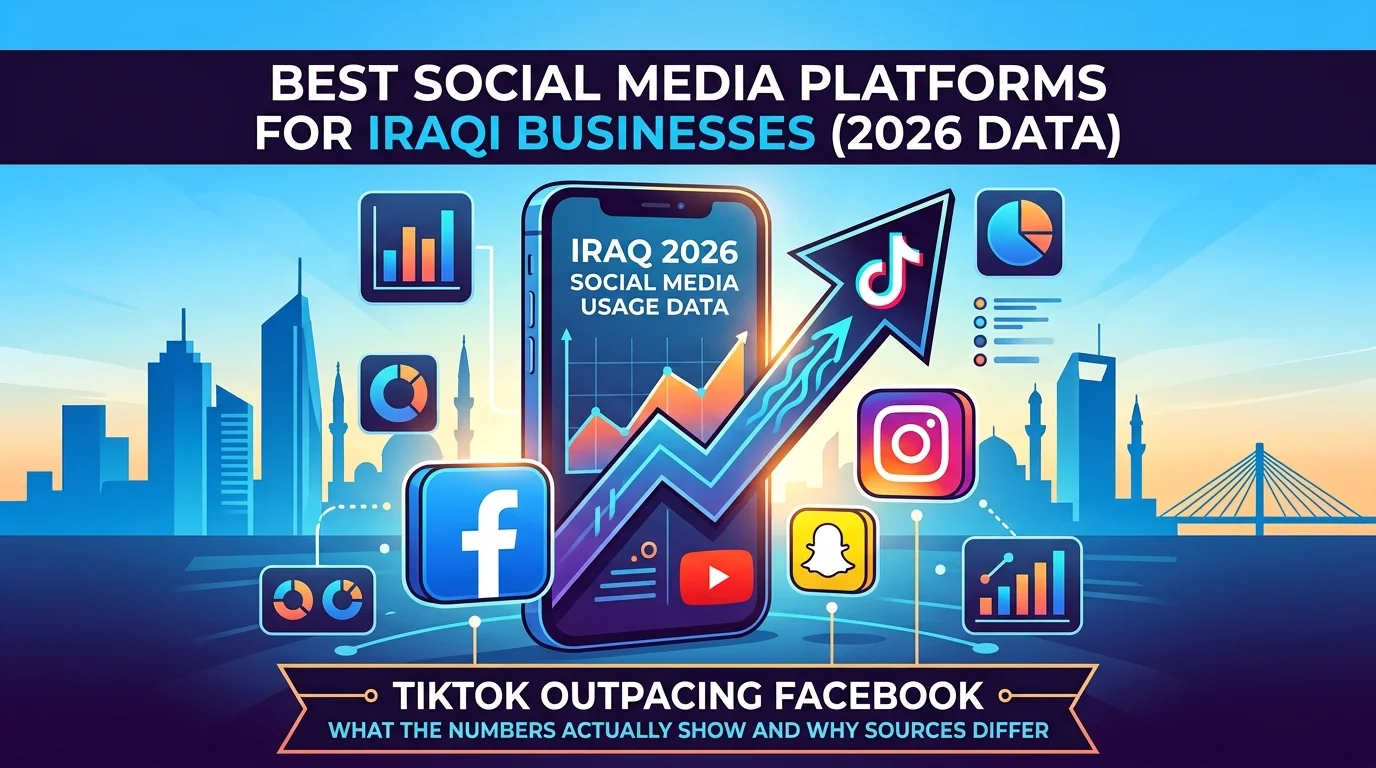
According to Iraq’s own Digital Media Center (DMC), TikTok has overtaken Facebook as Iraq’s most-used social media platform — 34.3 million users versus Facebook’s 20.1 million, based on data the DMC compiles from We Are Social and Meltwater. That’s a genuinely striking finding, and one that conflicts with the figures published through Meta’s own advertising platform tools, which show Facebook’s reach in Iraq considerably higher. Understanding social media platforms Iraq businesses should actually prioritize requires looking at both sources honestly, not picking whichever number is more convenient.
This guide walks through what Iraq’s Digital Media Center actually reported, why platform data sources can disagree so significantly, what TikTok’s rapid growth means either way, current Facebook and Instagram demographic patterns, and how to choose platforms for your specific business and industry despite the genuine uncertainty in the underlying numbers. If you’ve seen conflicting social media statistics for Iraq and weren’t sure which to trust, this guide is built to explain why they differ rather than simply picking a side.
Iraq’s Platform Landscape (Two Sources, Different Pictures)
What Iraq’s Digital Media Center Reported?
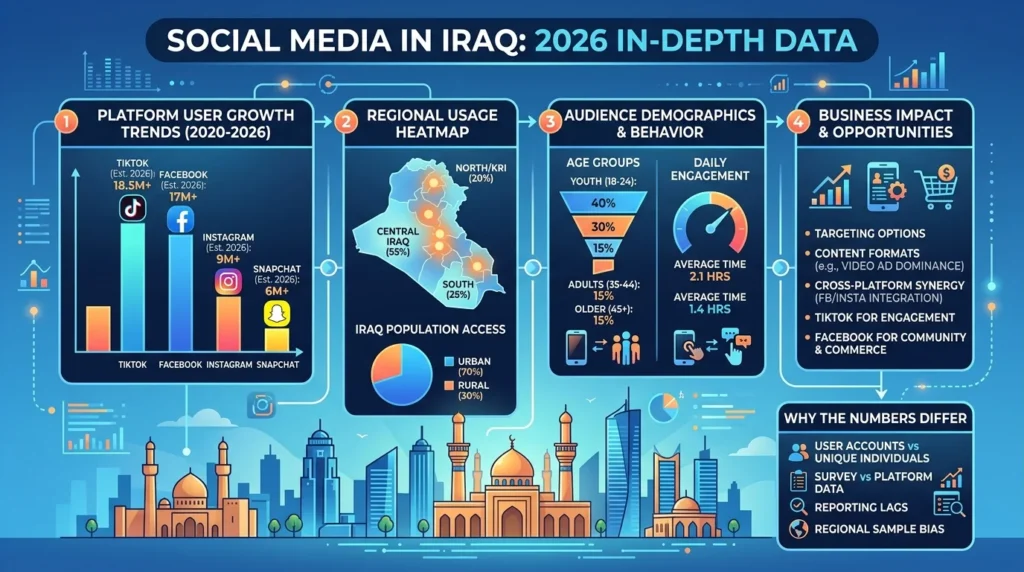
Iraq’s Digital Media Center, a government-linked body that publishes annual social media statistics compiled from industry analytics firms We Are Social and Meltwater, reported TikTok reaching 34.3 million users in Iraq, up from 31.95 million the prior year — while Facebook reached 20.1 million, Instagram 19.0 million, YouTube 22.3 million, and Snapchat 18.5 million. DMC General Supervisor Muhannad Habib Al-Samawi specifically noted TikTok’s gain of 2.35 million new users as the platform’s strongest year of growth, attributing it to shifting behavior toward short-form video, particularly among younger audiences.
The DMC’s Track Record on This Trend
This isn’t the DMC’s first report showing TikTok’s dominance — the prior year’s DMC report already showed TikTok as Iraq’s leading platform at 31.95 million users, up sharply from 23.88 million the year before that. This consistent year-over-year trajectory, reported by the same source using the same methodology each time, adds credibility to the direction of the trend even when the absolute figures remain disputed against other sources.
What Meta’s Own Advertising Data Shows?
Separately, data compiled through Meta’s own advertising platform tools (as tracked by NapoleonCat) shows Facebook reaching 34.5 million users in Iraq — a dramatically different figure than the DMC’s 20.1 million for the same platform. Similarly, TikTok’s own advertising tools report ad reach of roughly 40 million users aged 18 and above, a different methodology and figure than the DMC’s 34.3 million.
Why These Numbers Disagree So Significantly?
These aren’t competing claims about the same measurement — they’re different methodologies measuring genuinely different things. Platform advertising tools (Meta’s, TikTok’s) report addressable ad audience reach, which can include non-human accounts, businesses, and multiple accounts per person, and doesn’t always correlate cleanly with active user counts. The DMC’s figures, compiled by third-party analytics firms, use a different methodology entirely. Neither source is simply wrong; they’re answering different questions about platform usage.
A Practical Way to Reconcile the Two Pictures
Rather than trying to determine which single number is “correct,” the more useful approach treats each source as measuring a different aspect of the same underlying reality. The DMC’s figures may better reflect genuinely active, engaged users based on analytics-firm methodology, while Meta’s advertising figures better reflect the total addressable audience a business could theoretically reach through paid targeting, inflated somewhat by overlapping or inactive accounts. Both pieces of information are useful for different purposes — the DMC data for understanding genuine platform popularity trends, and Meta’s data for understanding raw advertising reach potential.
TikTok’s Rapid Growth (Consistent Across Sources)
The One Point Where Both Sources Agree
Despite the significant disagreement on absolute numbers, both the DMC’s data and platform advertising tools agree on the underlying trend: TikTok is growing rapidly in Iraq, faster than Facebook, and has become a genuinely dominant platform rather than an experimental or secondary one. Whether TikTok’s actual user count is 34.3 million or 40 million, the direction and magnitude of growth is the more reliable signal here than either specific figure in isolation.
Why This Growth Matters for Businesses Regardless of Exact Numbers?
A business still treating TikTok as optional or experimental in Iraq is working from an outdated assumption, regardless of which specific user count you trust. The consistent signal across every available data source is that TikTok has become one of the platforms Iraqi businesses need to take seriously, particularly for reaching younger audiences.
Facebook & Instagram Demographics
Facebook’s Continued Relevance Despite the Discrepancy
Even accepting the DMC’s more conservative 20.1 million figure, Facebook remains a major platform in Iraq reaching a substantial share of the population, and Meta’s own data suggesting an even larger reach only reinforces that Facebook shouldn’t be dismissed based on TikTok’s growth alone. The honest takeaway is that Facebook remains significant by any measurement, even if the exact scale is genuinely disputed between sources.
Instagram’s Position Between the Two Giants
Instagram, whether measured at the DMC’s 19.0 million or Meta’s higher advertising-reach figures, consistently shows meaningful engagement particularly among younger, visually oriented audiences, positioning it as a strong complement to both Facebook’s broader reach and TikTok’s short-form video dominance.
A Quick Data Interpretation Checklist
- Treat any single platform statistic as directional rather than precise, given how differently sources measure usage.
- Prioritize growth trends and relative platform comparisons over absolute user counts.
- Verify which methodology a statistic uses (ad platform reach vs. third-party analytics) before comparing figures across sources.
- Base platform strategy on your own audience data and testing results over time, not published statistics alone.
Choosing Platforms by Audience & Industry
For Younger, Visually Driven Audiences
Given TikTok’s consistent growth signal across every data source, and Instagram’s continued strength for visual content, businesses targeting younger Iraqi consumers with visually engaging products should prioritize both platforms regardless of which specific user-count source you trust most.
For Broader Demographic Reach
Facebook’s continued significant presence, even under the DMC’s more conservative estimate, makes it a reasonable choice for businesses needing broader demographic reach beyond younger, video-first audiences, particularly given its mature advertising infrastructure and targeting capabilities.
Matching Platform Investment to Actual Business Results
Rather than committing budget based purely on published user statistics from any single source, testing a modest campaign on each platform under consideration and tracking actual business results — inquiries, WhatsApp contacts, sales — provides more reliable guidance for your specific business than any national statistic, however it’s measured.
Platform-Specific Content Tips
What Works on TikTok in Iraq?
Short-form, authentic video content — behind-the-scenes glimpses, quick product demonstrations, trend participation — tends to perform better on TikTok than polished, traditional advertising-style content, reflecting the platform’s genuinely different content culture compared to Facebook or Instagram.
What Works on Facebook and Instagram?
Facebook continues to reward a mix of community engagement and informative content, while Instagram favors strong visual quality and consistent aesthetic, with both platforms benefiting from genuine local Iraqi context rather than generic international content.
Creative 4 All builds social media marketing services informed by the actual, sometimes conflicting, data landscape rather than a single convenient statistic, as part of comprehensive digital marketing in Iraq strategy.
Read More on the Social Media Blog — or subscribe for future insights as Iraq’s platform data continues to evolve.
FAQs
According to Iraq’s Digital Media Center, yes — TikTok reported 34.3 million users versus Facebook’s 20.1 million. However, data from Meta’s own advertising platform shows a considerably higher Facebook figure, illustrating how differently these sources measure platform usage.
Platform advertising tools measure addressable ad audience reach, which can include non-human accounts and doesn’t always reflect active user counts precisely, while third-party analytics firms like those the DMC cites use different compilation methods entirely. Neither approach is simply wrong — they answer different questions.
Base this on your specific audience and industry rather than a single statistic. TikTok’s growth is consistent across every data source, making it worth serious consideration for most businesses, while Facebook remains significant for broader demographic reach regardless of which exact figure you trust.
Iraq’s Digital Media Center publishes updates periodically, as do platform advertising tools tracked by services like NapoleonCat and DataReportal, meaning any single statistic should be treated as a snapshot rather than a permanently fixed number.
Neither should be trusted exclusively — each reflects a different, legitimate methodology with its own limitations. The most reliable approach combines directional trends from multiple sources with your own business-specific testing and results.