

“Is social media marketing even working for my business?” is a genuinely reasonable question, and a reasonable amount of skepticism about social media ROI is healthy rather than something to dismiss with vague reassurance about “brand awareness” and “engagement.” This guide won’t tell you social media is automatically worth it — it will show you exactly how to measure whether it’s worth it for your specific business, including being transparent about which parts of that measurement are genuinely difficult, not just the parts with clean answers.
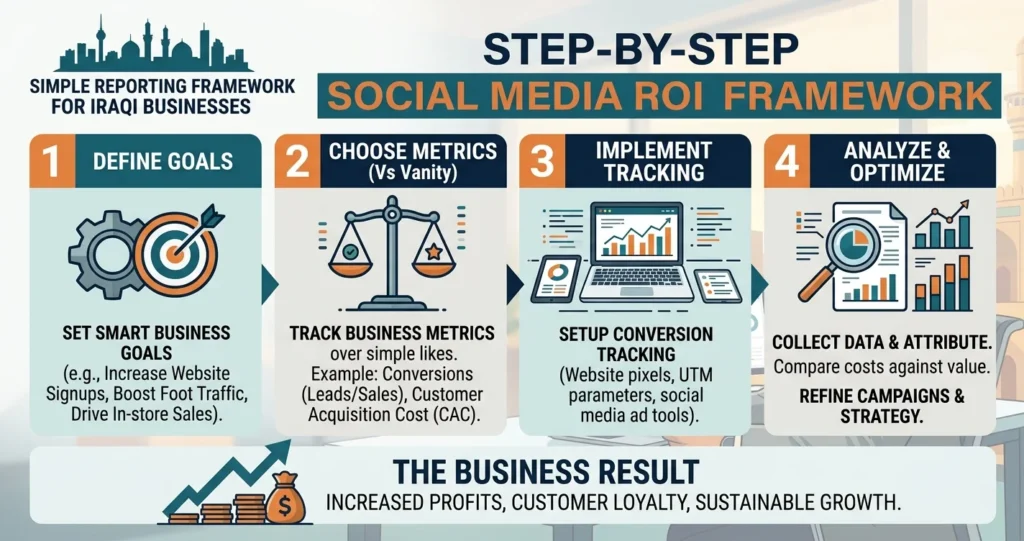
This guide covers the real difference between vanity metrics and metrics that actually reflect business value, how to set up conversion tracking properly, the genuine attribution challenges that make perfect measurement impossible in practice, a simple monthly reporting framework any business can actually use, and how to know when it’s time to adjust strategy rather than just keep doing what you’ve been doing. If you’ve been skeptical of every social media report you’ve received so far, this guide is built to give you tools to genuinely verify whether it’s working.
Vanity Metrics vs Business Metrics
What Vanity Metrics Actually Tell You?
Follower count, likes, and impressions measure reach and surface-level engagement, but they don’t directly tell you whether any of that activity translated into an actual business outcome — a business can have substantial vanity metrics while generating essentially no revenue impact, and the reverse is equally possible.
What Business Metrics Actually Measure?
Website visits originating from social media, inquiries and messages received through social channels, and sales that can be traced back to social media discovery are the metrics that actually connect social media activity to business value, even though they’re generally harder to track precisely than a simple follower count.
Why Both Have a Place, But Aren’t Equivalent?
Vanity metrics aren’t worthless — they can indicate whether content is resonating and whether a following is growing — but they shouldn’t be presented or evaluated as though they were equivalent to business results. Treating engagement growth as success on its own, without connecting it to actual outcomes, is exactly the vague reassurance that fuels justified skepticism about social media KPIs.
Setting Up Conversion Tracking
Website Traffic Attribution Basics
Setting up proper tracking parameters (UTM parameters) on links shared through social media allows website analytics to distinguish traffic that arrived from social platforms specifically, rather than lumping it into generic “direct” or “referral” traffic that obscures where visitors actually came from.
Tracking Inquiries and Messages
For businesses where social media primarily drives WhatsApp messages or direct inquiries rather than website conversions, establishing a simple, consistent process — asking new inquiries where they found you, or using platform-specific contact links — helps quantify this channel even without formal website analytics involved.
What Genuinely Effective Tracking Requires?
Effective tracking isn’t a single tool or setting — it requires a consistent process applied over time, since a single month of data reveals far less than several months of consistent tracking that starts to show genuine patterns in what content and campaigns actually drive results.
Attribution Challenges (Being Honest About Limits)
Why Perfect Attribution Isn’t Realistic?
A customer who discovers a business on Instagram, later searches for it on Google, and eventually completes a purchase through a WhatsApp conversation represents a genuinely multi-touch journey that no single tracking method captures completely — this is a real limitation, not a failure of technique.
A Practical Example of This Challenge
Consider a Baghdad furniture retailer that noticed a spike in WhatsApp inquiries following a particularly popular Instagram Reel, but couldn’t definitively prove the connection since customers rarely mention exactly how they found the business unprompted. Rather than dismissing the apparent correlation as unmeasurable, the retailer began asking a simple question at the start of each new inquiry — “how did you hear about us?” — and after a few months, a clear pattern emerged linking spikes in that specific Reel’s engagement to genuine increases in inquiries. This wasn’t perfect, scientific attribution, but it was honest, actionable evidence built from a simple habit rather than an expensive tracking system.
The Offline Conversion Problem
When purchases happen in person or through a phone call after social media discovery, no automated tracking system captures this connection at all, meaning genuine social media impact can be systematically undercounted for businesses relying heavily on offline completion of the sale.
Working Honestly Within These Limits
Rather than pretending attribution is perfectly solvable, the honest approach combines available tracking data with simple, low-effort methods like asking customers directly how they found you, accepting that the resulting picture will be directionally useful rather than perfectly precise.
A Simple Monthly Reporting Framework
What to Track Each Month?
A practical monthly report should include website traffic from social platforms (via UTM tracking), inquiries or messages attributable to social media, engagement trends on top-performing content, and any sales or leads that can be reasonably connected back to social media activity.
A Quick Reporting Checklist
- Website visits from social media, broken out by platform where possible.
- Inquiries or messages received through social channels or attributable through customer-reported source.
- Engagement trends on your best and worst-performing content, to inform what to make more or less of.
- Any sales or leads reasonably connected to social media discovery, even if attribution is approximate.
Keeping the Framework Sustainable
A reporting framework that’s too complex to maintain consistently is worse than a simpler one actually followed every month — consistency in tracking the same core metrics over time reveals genuine trends that an occasional, more elaborate report would miss entirely.
When to Adjust Strategy?
Signals That Something Needs to Change
Consistently declining engagement despite steady posting effort, business metrics (inquiries, sales) not improving despite growing vanity metrics, or a specific content type consistently underperforming across multiple attempts are all signals worth acting on rather than continuing unchanged.
Distinguishing Normal Fluctuation From a Genuine Problem
Social media performance naturally fluctuates month to month, so a single weaker month doesn’t necessarily signal a problem requiring strategy change — looking at trends across several months, rather than reacting to single-month variance, produces more reliable decisions about when adjustment is actually warranted.
Creative 4 All provides transparent social media reporting services that measure what actually matters for your business, not just vanity metrics that look good but don’t reflect genuine value, as part of comprehensive digital marketing in Iraq strategy.
Request a Free Audit to get an honest assessment of what your current social media presence is actually achieving for your business.
FAQs
It depends entirely on whether it’s producing measurable business results for your specific situation — the honest answer requires tracking actual outcomes, not assuming value based on activity or vanity metrics alone.
Because customer journeys often span multiple touchpoints (discovering on social media, researching elsewhere, completing purchase offline or through messaging), no single tracking method captures the full picture — this is a genuine, universal limitation, not something specific to Iraqi businesses.
Engagement (likes, comments, shares) reflects how content resonates, but it doesn’t automatically translate into business value. Actual results — inquiries, sales, website conversions — are the metrics that connect activity to genuine business impact.
Monthly reviews using a consistent, simple framework reveal genuine trends more reliably than occasional, elaborate reports, and looking at trends across several months rather than single-month variance leads to better strategy decisions.
Use simple, practical methods like asking customers directly how they found you, combined with whatever digital tracking data is available, and accept that the resulting picture will be directionally useful rather than perfectly precise — this is a normal limitation, not a sign your measurement approach has failed.