
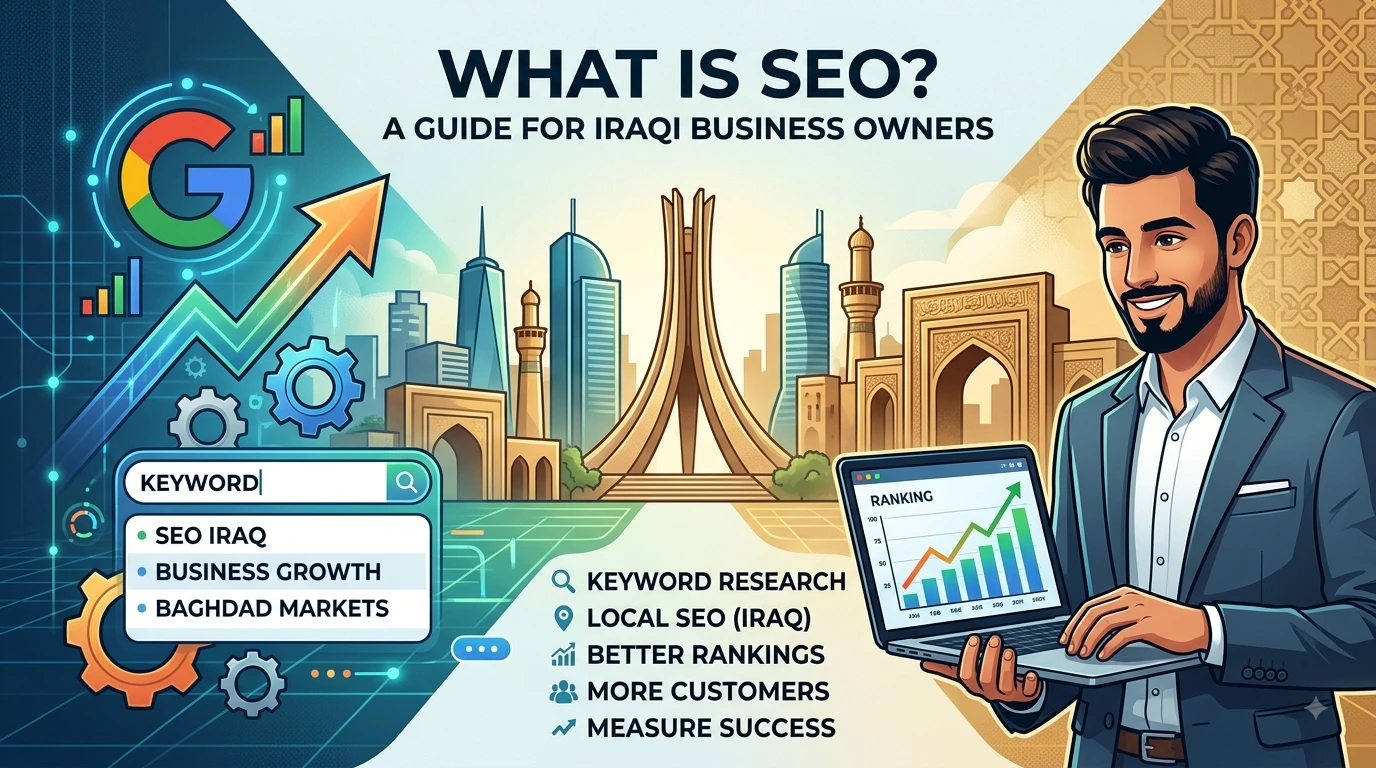
If you’re a business owner in Iraq who just heard the term “SEO” from a competitor, a consultant, or a marketing agency and thought — “okay, but what is SEO, actually?” — you’re not alone. It’s one of the most common questions first-time website owners search for, and most of the answers online are written by people assuming you already understand half the vocabulary.
This guide skips the jargon. By the end, you’ll understand exactly what is SEO in plain terms, how does SEO work on a technical level, and — more importantly — why it matters specifically for a business operating in the Iraqi market, where the rules of online visibility don’t always match what a global guide assumes.
What SEO Means in Plain English?
The Simple Definition
SEO stands for search engine optimization. In the simplest terms, it’s the practice of shaping a website so that Google — and the people searching on it — can find, understand, and trust it more easily. When someone types “web design company Baghdad” or “best restaurants in Erbil” into Google, the results that appear aren’t random. They’re the pages Google’s systems judged most relevant, useful, and trustworthy for that specific search. SEO meaning, at its core, is the work of earning that judgment in your favor.
It’s worth being precise about one thing early: SEO is not a single action you complete once. It’s an ongoing set of practices — covering technical setup, content, and reputation — that collectively influence where a website lands in organic search results, meaning the free, unpaid listings as opposed to ads.
A useful way to picture what is SEO in practice: imagine two furniture retailers in Baghdad with identical product quality and identical prices. One has a fast, well-structured website with clear product pages that answer common customer questions. The other has a slow, outdated site with thin descriptions. All else equal, Google will consistently favor the first retailer for relevant searches — not because the algorithm “likes” one business more, but because the first site does a measurably better job of matching what searchers are actually looking for. That gap, repeated across thousands of searches every month, is the real-world impact of SEO.
What SEO Is Not?
Understanding what is SEO also means understanding what it isn’t. SEO is not buying your way to the top of results — that’s paid advertising. It’s not a trick or a loophole in Google’s system; the algorithm is specifically designed to penalize manipulative shortcuts. And it’s not a marketing department’s side project — the businesses that see the strongest results treat SEO as core infrastructure, reviewed and maintained the same way a business would review its finances or its inventory. Clearing up these misconceptions is as important to answering what is SEO as the positive definition itself.
SEO vs Paid Advertising
A lot of confusion around what is SEO comes from mixing it up with paid search advertising. They’re related but fundamentally different. Paid ads (PPC) put your business at the top of the results page instantly — for as long as you keep paying. SEO earns that same visibility organically, without paying per click, but it takes time to build. Think of PPC as renting visibility and SEO as building an asset you own. Most established businesses eventually use both, but SEO is what keeps generating traffic long after an ad budget runs out. Keeping this distinction in mind is central to answering what is SEO compared with everything else competing for a marketing budget.
How Google Ranks Websites?
Crawling and Indexing
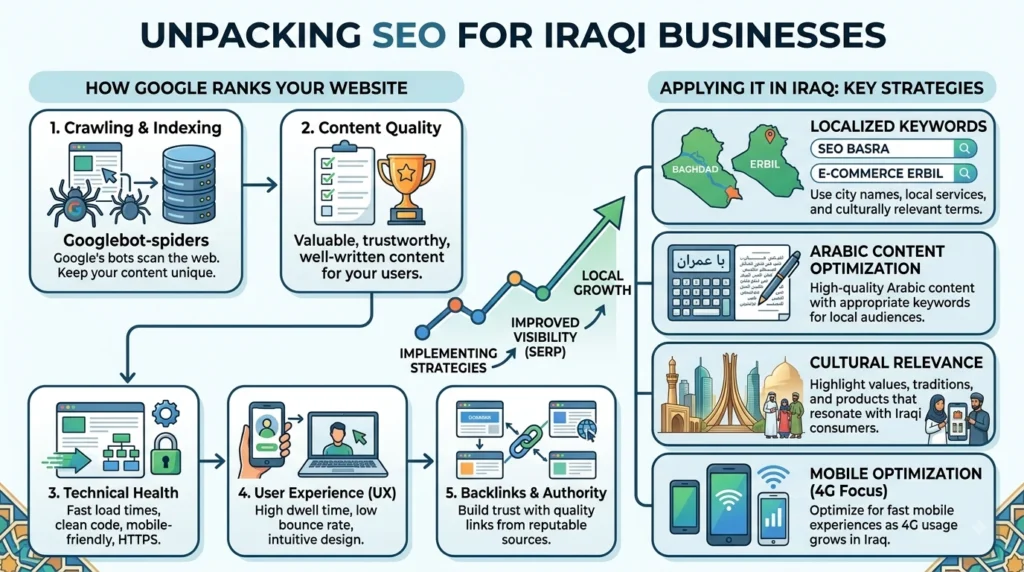
Before Google can rank any page, it has to find it. Google uses automated programs called crawlers that follow links across the web, reading page content along the way. Once a page is discovered, it gets added to Google’s index — essentially a massive library of every page Google knows about. If a page isn’t indexed, it can’t appear in search results at all, no matter how good the content is. This is the very first thing any answer to how does SEO work, or indeed what is SEO doing behind the scenes, has to account for.
Ranking Factors That Matter Most
Once a page is indexed, Google’s ranking systems evaluate it against hundreds of signals to decide where it belongs in the results for a given search. The major categories worth understanding as a business owner are:
- Relevance — how well the page’s content actually matches what the searcher is looking for.
- Authority — signals like quality backlinks from other credible sites, which act as a vote of trust.
- User experience — page speed, mobile usability, and whether visitors stay or immediately leave.
- Technical health — whether the site is secure, properly structured, and free of crawl errors.
Together, these four categories are the practical answer to what is SEO when it’s broken down into its working parts rather than treated as one vague activity.
No single factor guarantees a top ranking. Google’s algorithm weighs all of these together, and it changes constantly — which is why SEO is a practice, not a one-time fix. This is also the part of how does SEO work that trips up business owners who expect a simple checklist: there is no fixed formula, because Google’s systems are continuously being refined to better match real user satisfaction, not just technical signals.
A Simple Real-World Example
Consider a Baghdad-based medical clinic that had an existing website but had never touched SEO. Before any optimization, the site wasn’t ranking for “clinic Baghdad” or any related term — not because the clinic lacked credibility, but because Google’s crawlers had never properly indexed several of its key pages, and the site loaded slowly on mobile. After a technical cleanup, properly structured service pages, and a handful of informational articles answering common patient questions, the site began appearing for a growing set of relevant local searches over the following months. Nothing about the clinic’s actual quality of care changed — what changed was whether Google, and by extension patients searching online, could see it clearly. That’s what is SEO doing in practice: removing the barriers between a genuinely good business and the customers already searching for it. The clinic example illustrates what is SEO capable of when the underlying business is already sound — the work simply makes that quality visible.
Where Iraq Fits Into the Algorithm?
Google’s core ranking systems are global, but the competitive environment they operate within is entirely local. A page competing for “digital marketing company” in a saturated market like the US is up against thousands of established competitors. The same search intent in Iraq — “digital marketing company Baghdad,” for instance — is competing in a much thinner field. That doesn’t mean ranking is automatic; it means the opportunity for a well-optimized Iraqi business to rank well, faster than it could in a saturated market, is real. This is precisely why what is SEO in Iraq deserves its own explanation rather than a copy-pasted global one.
Why It Matters for Iraqi Businesses Specifically?
The Trust Gap Local Businesses Face Online
Many Iraqi businesses that are well-established offline — with strong local reputations built over years — are nearly invisible in Google search results because their websites were never properly optimized, or don’t exist at all. That’s a trust gap: a potential customer researching before making a purchase decision finds a competitor’s optimized page first, even if that competitor is objectively less established. SEO closes that gap by making sure a business’s actual credibility is reflected online. For a business owner still asking what is SEO worth to them personally, this trust gap is often the clearest answer: it’s the difference between being found by ready-to-buy customers and losing them to a less established competitor simply because that competitor’s website was easier to find.
Mobile-First Searching in Iraq
A large share of search activity in Iraq happens on mobile devices, often over inconsistent network conditions. Google factors mobile usability directly into rankings, which means a site that isn’t fast and easy to use on a phone is at a structural disadvantage before a single keyword is even considered. Understanding what is SEO in the Iraqi context means understanding that mobile performance isn’t optional — it’s foundational. Any answer to what is SEO that ignores mobile experience is an incomplete answer for the Iraqi market specifically.
Long-Term Cost Efficiency
For many Iraqi SMEs operating on tight marketing budgets, the ongoing cost of paid advertising can become unsustainable. SEO requires an upfront investment of time and expertise, but once a page earns a strong position for a valuable search term, it continues generating visits without an ongoing per-click cost. Over a two- or three-year horizon, this typically makes SEO one of the most cost-efficient channels available to a growing Iraqi business — a point worth remembering any time the question of what is SEO worth gets reduced to a short-term cost comparison against ads.
The AI Search Layer
There’s a newer dimension to what is SEO that’s becoming increasingly relevant: AI-powered answer engines and chat-based search tools now pull directly from well-structured, clearly written web content when generating answers. A business with clear, well-organized SEO content isn’t just improving its position in traditional Google results — it’s improving its odds of being cited as a source when a potential customer asks an AI assistant a question about services in Iraq. This is still an emerging area, but the underlying requirement is the same one SEO has always had: clear, well-organized, trustworthy content wins. It’s a reminder that what is SEO today is broader than ranking on a results page alone.
Common Myths About SEO
Misunderstanding what is SEO — and what it isn’t — is one of the biggest reasons business owners either avoid it entirely or invest in it poorly. A few persistent myths worth correcting directly:
- “SEO is a one-time setup.” In reality, rankings shift as competitors publish new content and Google updates its algorithm — SEO is ongoing maintenance, not a checkbox.
- “More keywords on a page means better rankings.” Stuffing a page with repeated keywords is an outdated tactic that can actively hurt rankings today; relevance and clarity matter far more than repetition.
- “SEO results are immediate.” Meaningful ranking movement typically takes months, not days, particularly for a newer or previously unoptimized site.
- “Social media likes directly improve SEO rankings.” Social signals can indirectly support visibility, but they are not a direct Google ranking factor.
- “Once you understand what is SEO, you can rank for anything.” Understanding the concept is the starting point, not the finish line — competitive terms still require sustained, expert execution.
Next Steps
How to Start Without Overwhelming Yourself
Now that the question of what is SEO has a clear answer, the natural next question is where to start. If your business doesn’t have any SEO foundation yet, the right starting point isn’t a massive overhaul — it’s a proper audit. Understanding where your current site stands technically, how it compares to competitors already ranking in your city or industry, and which keywords actually reflect what your customers search for gives you a realistic roadmap instead of guesswork.
When to Bring in Professional Help
Basic on-page adjustments are manageable for a business owner willing to learn once they understand what is SEO at a fundamental level. But technical SEO, competitive keyword strategy, and sustainable link building typically require dedicated expertise — especially in a market like Iraq, where generic global SEO advice often doesn’t translate directly. That’s where a properly researched, Iraq-specific strategy makes the difference between slow, guesswork-driven progress and a compounding asset — the same principle behind what is SEO at every stage of this guide.
To go deeper than this introductory guide, explore SEO services in Iraq for a full breakdown of what a professional engagement actually involves, or browse more foundational guides on the SEO blog as you keep learning.
Now that you have a clear answer to what is SEO, the practical next step is applying it to your own site rather than researching the concept further in isolation.
Read More on the SEO Blog — or subscribe to get future guides on ranking your Iraqi business online sent straight to you.
FAQs
In the simplest terms, what is SEO comes down to this: it’s the practice of improving a website so it appears higher in Google’s free, unpaid search results — making it easier for potential customers to find a business without paying for ads.
Google’s crawlers discover and index pages, then rank them based on relevance, authority, user experience, and technical health. SEO is the ongoing work of improving a site across all of these areas — which is really the fullest answer to what is SEO once you move past the one-sentence definition.
Understanding what is SEO worth locally comes down to three things: it closes the trust gap between a business’s real-world reputation and its online visibility, it performs well against a comparatively thin competitive field, and it delivers long-term cost efficiency compared to continuously paying for ads.
Within the broader digital marketing mix, what is SEO comes down to this: it’s one channel sitting alongside paid advertising, social media, and email marketing — but it’s unique in that it builds a compounding, owned asset rather than renting temporary visibility.
Early signals like improved indexing and rising impressions typically appear within the first two to three months; meaningful ranking movement and traffic growth usually build from month four onward. This timeline is a core part of any honest answer to what is SEO realistically capable of delivering, and how quickly.