

Ask ten Iraqi business owners what makes a good website, and most will describe how it looks — clean, modern, professional. Very few will mention how it performs: whether it loads quickly on a mid-range phone over a mobile connection, whether a visitor can actually find the contact information within a few seconds, or whether the structure helps Google understand what the business does. Web design Iraq businesses invest in has to deliver both, and the gap between a site that merely looks professional and one that actually converts visitors into customers is where most of the real value gets won or lost.
This guide covers what a genuinely professional website needs to include — beyond visual polish — the real tradeoffs between design and function, mobile-first considerations specific to how Iraqi users actually browse, the bilingual requirements many Iraqi businesses eventually face, and the exact questions worth asking any web design agency before committing to a project. Whether you’re planning a first website or evaluating whether your current one is actually working, this guide is built to answer the practical questions that matter most.
Elements of a High-Converting Website
Clear Navigation and Information Architecture
A visitor should be able to find what they’re looking for — services, pricing information, contact details — within a few clicks from any page, with a navigation structure that reflects how customers actually think about the business rather than how the business is internally organized. Confusing or overly deep navigation is one of the most common reasons an otherwise attractive site fails to convert visitors into inquiries.
Fast, Reliable Performance
Page speed isn’t a technical afterthought — it directly affects whether a visitor stays long enough to see anything else the site offers. A beautifully designed page that takes eight seconds to load loses a meaningful share of visitors before they ever see the design at all, particularly given how much Iraqi traffic arrives over mobile connections with variable speeds.
A Practical Example of the Cost of Getting This Wrong
Consider two competing clinics in Baghdad, both with attractive, professionally designed websites. One loads in under two seconds and lets a visitor find the appointment booking page within a single click from the homepage. The other, built with heavier animations and unoptimized images, takes six seconds to load and requires three clicks to reach the same booking page. Despite comparable design quality, the first clinic converts a meaningfully higher share of its visitors into actual appointments — not because it looks better, but because it removes friction at every step between arrival and action. This is the practical difference web design Iraq businesses should be optimizing for, beyond visual appeal alone.
Obvious, Low-Friction Contact Paths
Every page that could plausibly lead to a business inquiry needs a clear, immediate way to make contact — a visible phone number, a WhatsApp link given how central it is to how Iraqi customers actually initiate conversations, and a simple contact form that doesn’t demand excessive information before a first conversation happens. A visually stunning site that buries its contact information is optimizing for the wrong priority.
Genuine, Specific Content Over Generic Copy
Service pages that genuinely explain what a business does, who it serves, and what makes it different perform better — for both visitors and search engines — than generic template language that could describe any business in any city. Website design Iraq projects that treat content as an afterthought to visual design consistently underperform ones that plan content and design together from the start.
A Quick Website Elements Checklist
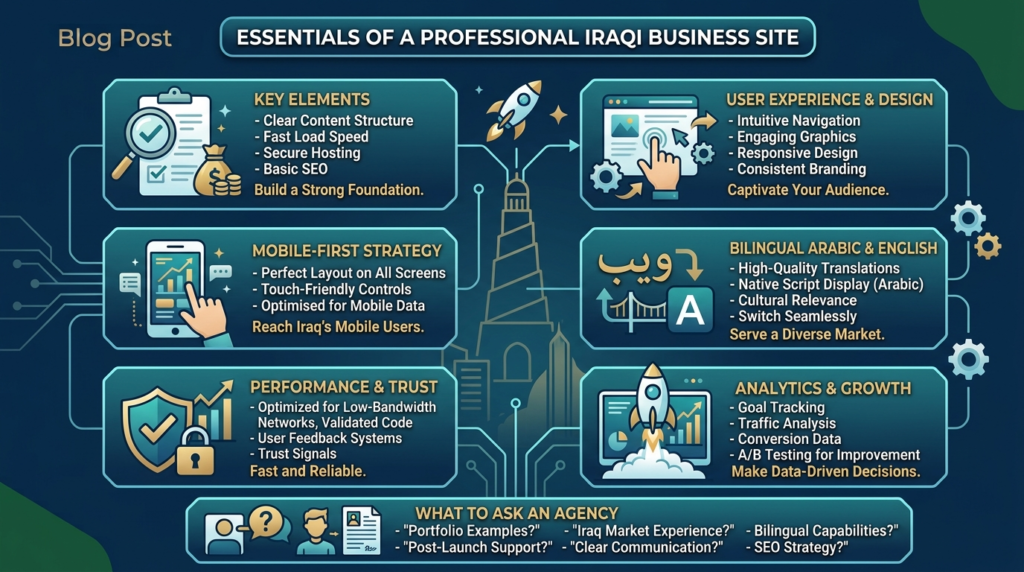
- Navigation structured around how customers think, not internal company structure.
- Fast loading performance tested specifically on mobile connections, not just office Wi-Fi.
- Visible, low-friction contact paths (phone, WhatsApp, simple form) on every key page.
- Genuine, business-specific content rather than generic template language.
Design vs Function
Why This Isn’t Actually a Tradeoff?
Framing design and function as competing priorities is a false choice — the best websites achieve both, because good function is itself a design decision. A site that looks impressive but loads slowly, confuses visitors, or hides its contact information isn’t well-designed; it’s decorated. Genuine web design Iraq work treats usability and conversion performance as core design requirements, not constraints imposed on top of the “real” creative work. This reframing matters because it changes what gets prioritized during the actual design process, not just how the finished site is evaluated afterward.
Where Businesses Commonly Get This Wrong?
The most common mistake is prioritizing visual trends — heavy animations, complex layouts, unconventional navigation patterns — over the more mundane work of ensuring visitors can actually accomplish what they came to do. A striking homepage that makes finding the pricing page unnecessarily difficult has prioritized the wrong thing, regardless of how good it looks in a portfolio.
Evaluating a Design on Function, Not Just Appearance
Before approving any design concept, it’s worth asking directly: can a first-time visitor find our three most important pages within 10 seconds? Is the primary call-to-action visible without scrolling on both desktop and mobile? Does the design work as well on a mid-range Android phone as it does on the designer’s high-end monitor? These questions surface function problems that pure visual review often misses.
Mobile-First Considerations for Iraq
Why Mobile Isn’t Optional in This Market?
A large share of Iraqi internet traffic arrives via mobile devices, often over connections that are less consistent than fixed broadband. A web design company Iraq businesses hire needs to design and test for mobile first, not as an afterthought once the desktop version is finished, since for many visitors the mobile experience is the only experience they’ll ever have with the site.
What Genuine Mobile-First Design Requires?
Beyond simply being “responsive” in the technical sense, genuine mobile-first design means touch-friendly button sizing, text that’s readable without zooming, images optimized for fast loading on mobile networks, and forms that are actually usable on a small screen without excessive typing. A site that technically resizes for mobile but remains difficult to actually use on a phone has fallen short of what mobile-first design requires.
Testing on Real Conditions, Not Just Simulators
The most reliable way to validate mobile performance is testing on an actual phone over an actual mobile connection, not just a browser’s responsive-design simulator on a fast office network. Many usability and speed issues only become apparent under real-world mobile conditions that a desktop-based simulator doesn’t accurately replicate.
Bilingual Design Needs
Why Bilingual Sites Need Structural Planning, Not Just Translation?
A website planning both English and Arabic versions needs genuine right-to-left (RTL) layout support for Arabic, not a simple mirrored template, along with proper hreflang implementation so search engines understand the two versions are language alternatives rather than duplicate content. Retrofitting bilingual support onto a site designed only for English is considerably more expensive and error-prone than planning for it from the outset.
Content Structure Across Two Languages
Navigation, forms, and calls-to-action need to work naturally in both languages, which sometimes means different structural decisions rather than a direct one-to-one translation of English page elements. A business planning eventual Arabic expansion benefits from raising this requirement during initial design, even if the Arabic version launches later, since it shapes decisions about site architecture and CMS structure made early on.
What to Ask Your Web Design Agency?
Questions About Process and Deliverables
Ask directly: will the site be built mobile-first, and how will that be tested before launch? What’s included in terms of ongoing support after launch — is basic content editing something we can do ourselves, or does every change require contacting the agency? How is site speed specifically addressed during development, not just at final review?
Questions About Technical Ownership
Ask who owns the website’s code, hosting, and domain once the project is complete, and confirm this in writing. Some agencies structure engagements in ways that make it difficult or costly to move a site elsewhere later, which is worth understanding clearly before signing rather than discovering after the relationship ends.
Questions About Future Bilingual Plans
Even if Arabic isn’t part of the initial launch, ask whether the proposed technical approach and CMS would support adding a bilingual version later without a costly rebuild. A web design Iraq provider with genuine experience in this area should have a clear, specific answer rather than a vague assurance.
Creative 4 All builds web design and development projects around exactly these priorities — mobile-first performance, genuine bilingual readiness through proper responsive design, and a CMS that gives your team real control after launch rather than permanent dependency on the agency.
Request a Free Audit to see how your current website measures up against these elements, or to get this framework applied to a new website project from the start.
FAQs
Prioritizing visual design trends over usability and conversion performance — a site can look impressive and still fail to help visitors find what they need or make contact easily, which is the actual purpose of a business website.
Even in industries where desktop use is more common, mobile-first design principles — fast loading, clear navigation, accessible contact information — improve the experience for all visitors, not just mobile ones, so there’s little downside to building this way regardless of current traffic patterns.
Planning bilingual structure from the start, even if only English launches initially, avoids the considerably more expensive and error-prone process of retrofitting RTL layout and hreflang implementation onto a site that wasn’t designed to support it.
Ask specifically how they approach mobile-first design given Iraq’s connection conditions, how they handle WhatsApp integration for contact paths, and whether they have direct experience with bilingual Arabic-English projects — vague or generic answers to these specific questions are a warning sign.
You should, and this should be confirmed in writing before the project begins. Structures that make it difficult to move your site to a different host or developer later can create unnecessary long-term dependency on a single agency.